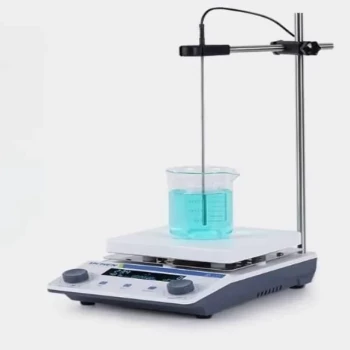
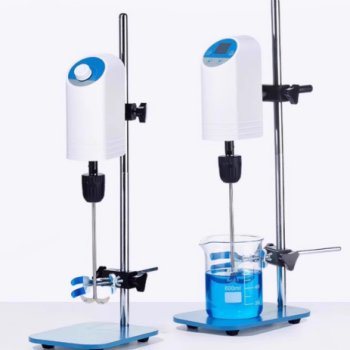
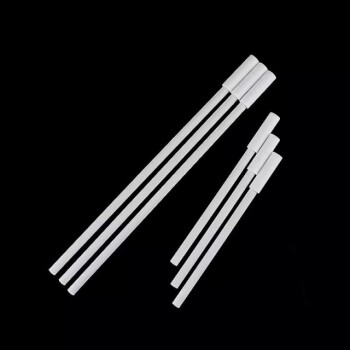
The magnetic stirrer acts as the primary source of mechanical shear force needed to homogenize the Palladium/Graphene (Pd/G) slurry. By maintaining continuous rotation, it ensures that palladium powder, reduced graphene oxide, and the Polyvinylidene Fluoride (PVDF) binder are thoroughly mixed within the N-Methyl-2-pyrrolidone (NMP) solvent. This mechanical action is the defining factor in transforming raw ingredients into a coating-ready precursor.
The stirrer's core function is to facilitate a discrete distribution of Palladium nanoparticles across graphene sheets, preventing particle agglomeration to maximize the resulting electrode's catalytic active sites.
The Mechanics of Slurry Homogenization
Generating Constant Shear Force
The magnetic stirrer provides a continuous input of energy into the mixture through rotation.
This generates a constant mechanical shear force throughout the liquid medium.
This force is necessary to physically integrate the solid components (Pd and graphene) with the binder (PVDF) and the solvent (NMP).
Preventing Particle Agglomeration
In the absence of agitation, nanoparticles tend to cluster due to surface energy.
The stirrer acts as a disruptor, breaking apart potential clumps of Palladium powder and reduced graphene oxide.
This ensures the mixture remains a physical suspension rather than a sedimented liquid.
Maximizing Catalytic Surface Area
The performance of the final electrode depends heavily on the surface area available for reactions.
By ensuring a "discrete distribution" of Palladium nanoparticles, the stirrer exposes the maximum amount of active material.
This distribution directly correlates to an increase in catalytic active sites on the graphene sheets.
Ensuring Process Consistency
Maintaining a Uniform Physical Mixture
Electrode fabrication requires that the slurry be homogeneous at the exact moment of application.
The stirrer creates a uniform distribution of the dispersed phase throughout the solvent volume.
This guarantees that every drop of slurry contains the correct stoichiometric ratio of Pd, graphene, and binder.
Establishing a Consistent Concentration
Just as in other composite synthesis processes, uniformity is key to reproducibility.
The stirring establishes a consistent concentration foundation, ensuring no "hot spots" or "dead zones" exist in the beaker.
This consistency allows for a uniform coating when the slurry is eventually applied to the current collector.
Common Pitfalls to Avoid
Insufficient Shear Duration
If the stirring duration is too short, the binder may not fully disperse the solid particles.
This leads to localized agglomeration, where Palladium particles clump together rather than spreading across the graphene.
Clumped particles reduce the active surface area, significantly degrading electrode performance.
Inconsistent Rotation Speeds
Variable stirring speeds can lead to inconsistent shear forces.
If the force fluctuates, the suspension may become unstable, leading to partial settling of heavier particles.
This results in an electrode with uneven catalytic properties across its surface.
Optimizing Your Electrode Fabrication
To ensure the highest quality Pd/G electrode, align your mixing strategy with your specific fabrication goals:
- If your primary focus is maximizing catalytic activity: Prioritize high-consistency stirring to ensure the Palladium nanoparticles are discretely distributed and fully exposed on the graphene sheets.
- If your primary focus is process reproducibility: Standardize your rotation speed and duration to maintain the exact same mechanical shear force for every batch.
A uniform slurry is the non-negotiable prerequisite for a high-performance electrode.
Summary Table:
| Component/Parameter | Role in Slurry Formulation | Impact on Electrode Performance |
|---|---|---|
| Mechanical Shear | Homogenizes Pd, Graphene, and PVDF binder | Ensures coating-ready precursor consistency |
| Particle Distribution | Prevents Pd nanoparticle agglomeration | Maximizes catalytic active sites |
| Stirring Duration | Facilitates full binder dispersion | Prevents localized clumping and material loss |
| Rotation Speed | Maintains stable physical suspension | Guarantees uniform catalytic properties |
Elevate Your Battery and Catalyst Research with KINTEK
Achieving the perfect slurry homogenization is critical for high-performance electrode fabrication. At KINTEK, we specialize in providing researchers with the high-precision tools needed to ensure process consistency and catalytic efficiency.
Whether you are formulating advanced Pd/G slurries or exploring new material composites, our comprehensive range of laboratory equipment and consumables is designed to meet your strictest requirements. Our portfolio includes:
- High-Performance Magnetic Stirrers & Shakers for precise homogenization.
- Crushing, Milling, and Sieving Systems for optimal particle size control.
- High-Temperature Muffle & Vacuum Furnaces for material calcination.
- High-Pressure Reactors & Autoclaves for advanced chemical synthesis.
- Electrolytic Cells, Electrodes, and Battery Research Tools for comprehensive testing.
Don't let inconsistent mixing compromise your research results. Partner with KINTEK for reliable, high-quality solutions tailored to your laboratory's needs.
Contact KINTEK Today to Optimize Your Lab Workflow!
References
- Wenqing Ma, Shaohui Zhang. Electrochemical reduction of Cr (VI) using a palladium/graphene modified stainless steel electrode. DOI: 10.2166/wst.2022.348
This article is also based on technical information from Kintek Solution Knowledge Base .
Related Products
- Laboratory Small Constant Temperature Heated Magnetic Stirrer Heater and Stirrer
- Custom PTFE Teflon Parts Manufacturer for Magnetic Stirring Bar
- Three-dimensional electromagnetic sieving instrument
- High Performance Laboratory Stirrers for Diverse Applications
- Custom PTFE Teflon Parts Manufacturer for PTFE Stirring Bar Recovery Rod
People Also Ask
- What role does a magnetic stirrer with heating play in ZnO nanoparticle synthesis? Precision Control for Quality Results
- What role does a constant temperature heating magnetic stirrer play in MFC-HAp synthesis? Achieve Material Homogeneity
- What is the function of a laboratory magnetic stirrer in Ni–Cr–P electrodeposition? Optimize Ion Transport & Coating
- Why is a laboratory magnetic stirrer required for benzoic acid esters? Boost Reaction Speed & Yield with High RPM
- What role does a laboratory magnetic stirrer play in TiO2 and TiO2-Ag sol preparation? Master Chemical Kinetics