Knowledge What role does a non-consumable vacuum arc furnace play in the melting of CoCrFeNiZr0.3 high-entropy alloys?
Author avatar

Tech Team · Kintek Solution

Updated 15 hours ago

What role does a non-consumable vacuum arc furnace play in the melting of CoCrFeNiZr0.3 high-entropy alloys?


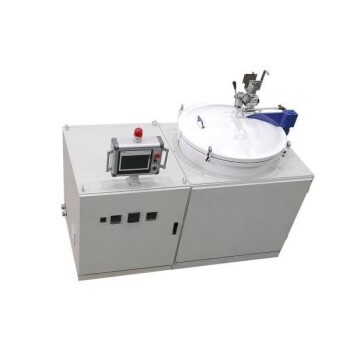
The non-consumable vacuum arc furnace is the critical primary processing tool for creating high-purity CoCrFeNiZr0.3 ingots. It utilizes an electric arc to generate extreme localized temperatures, melting high-purity metal particles while strictly controlling the environment. Its specific design ensures that the electrode itself does not degrade and contaminate the sensitive high-entropy alloy (HEA) mixture.

Core Takeaway By combining a stable, non-consumable electrode with a vacuum or inert gas environment, this furnace solves the two biggest challenges in HEA fabrication: contamination from equipment and oxidation of reactive elements (like Zirconium and Chromium). It is the standard for achieving the compositional uniformity required for high-performance alloys.

Ensuring Compositional Purity

The Non-Consumable Advantage

In standard melting processes, the electrode itself can sometimes erode or melt, introducing foreign materials into the alloy. A non-consumable electrode is designed to remain physically stable even under intense heat.

This prevents the electrode material from entering the melt pool. For an alloy like CoCrFeNiZr0.3, this guarantees that the final chemical composition matches your precise calculations without external impurities.

Preventing Oxidation of Active Elements

Your specific alloy contains elements like Zirconium (Zr) and Chromium (Cr), which are highly "active" and prone to rapid oxidation at high temperatures. If exposed to oxygen, they form brittle oxides that degrade the material's performance.

The furnace operates under a high vacuum or a protective atmosphere of high-purity argon. This creates a shielded environment that effectively blocks oxygen, ensuring the active elements remain metallic and integrated into the alloy matrix rather than turning into slag or inclusions.

Achieving Microstructural Homogeneity

Overcoming Melting Point Discrepancies

High-entropy alloys consist of multiple principal elements, each with a different melting point. The vacuum arc furnace generates extreme local temperatures capable of fully melting even the most refractory (heat-resistant) components in the mix.

This capability ensures that high-melting-point particles do not remain as undissolved solids within the ingot.

The Necessity of Flip-Melting

Achieving a uniform distribution of five distinct elements (Co, Cr, Fe, Ni, Zr) is difficult in a single pass. To solve this, the furnace process involves multiple flip-melting cycles.

After the initial melt, the ingot is solidified, flipped over, and melted again. Repeating this process ensures that heavy and light elements are thoroughly mixed, eliminating segregation and resulting in high compositional uniformity throughout the ingot.

Understanding the Process Constraints

Batch Processing Limitations

Vacuum arc melting is typically a batch process rather than a continuous one. It is excellent for producing high-quality ingots for research or initial feedstock, but it may have throughput limitations compared to industrial induction melting for massive volumes.

The Risk of Incomplete Mixing

While the furnace provides the capability for homogeneity, the machine does not guarantee it automatically. Operator technique is critical.

If the "flip-melting" cycles are insufficient in number or duration, element segregation will persist. The presence of Zirconium (Zr) specifically adds complexity, as its density and melting behavior must be carefully managed to prevent it from settling or floating disproportionately.

Making the Right Choice for Your Goal

To maximize the quality of your CoCrFeNiZr0.3 alloy, focus on these operational parameters:

  • If your primary focus is Purity: Ensure the vacuum system is capable of maintaining low oxygen partial pressure or use high-purity argon to protect the Zirconium content.
  • If your primary focus is Homogeneity: Mandate a minimum number of flip-melting cycles (typically 4-6) to guarantee that the Zirconium is evenly distributed within the CoCrFeNi matrix.

The non-consumable vacuum arc furnace is not just a heat source; it is a contamination control system essential for the integrity of complex, multi-element alloys.

Summary Table:

Feature Role in CoCrFeNiZr0.3 Fabrication Benefit to High-Entropy Alloys
Non-Consumable Electrode Prevents electrode erosion/melting into the pool Maintains 100% compositional purity
Vacuum/Inert Atmosphere Eliminates oxygen exposure during melting Prevents oxidation of active elements like Zr and Cr
Extreme Localized Heat Fully liquifies refractory components Ensures no undissolved solids or particles
Flip-Melting Cycles Repeatedly re-melts and mixes the ingot Eliminates element segregation for homogeneity

Elevate Your Material Research with KINTEK Precision

High-performance alloys like CoCrFeNiZr0.3 demand the highest standards of purity and thermal control. KINTEK specializes in advanced laboratory equipment designed to meet these exact needs. Our state-of-the-art non-consumable vacuum arc furnaces and high-temperature furnaces provide the stable, contamination-free environment essential for fabricating complex high-entropy alloys.

From induction melting systems and crushing and milling for feedstock preparation to high-pressure reactors and battery research tools, KINTEK offers a comprehensive portfolio to support every stage of your material science workflow.

Ready to achieve superior homogeneity in your next batch? Contact our technical experts today to find the perfect solution for your laboratory.

References

  1. Peng Lyu, Xinlin Liu. Hot Deformation Characteristics and Microstructure Evolution of CoCrFeNiZr0.3 Hypoeutectic High-Entropy Alloy. DOI: 10.3390/met14060632

This article is also based on technical information from Kintek Solution Knowledge Base .

Related Products

People Also Ask

Related Products

Vacuum Heat Treat Sintering Brazing Furnace

Vacuum Heat Treat Sintering Brazing Furnace

A vacuum brazing furnace is a type of industrial furnace used for brazing, a metalworking process that joins two pieces of metal using a filler metal that melts at a lower temperature than the base metals. Vacuum brazing furnaces are typically used for high-quality applications where a strong, clean joint is required.

Small Vacuum Heat Treat and Tungsten Wire Sintering Furnace

Small Vacuum Heat Treat and Tungsten Wire Sintering Furnace

The small vacuum tungsten wire sintering furnace is a compact experimental vacuum furnace specially designed for universities and scientific research institutes. The furnace features a CNC welded shell and vacuum piping to ensure leak-free operation. Quick-connect electrical connections facilitate relocation and debugging, and the standard electrical control cabinet is safe and convenient to operate.

Vacuum Heat Treat Furnace with Ceramic Fiber Liner

Vacuum Heat Treat Furnace with Ceramic Fiber Liner

Vacuum furnace with polycrystalline ceramic fiber insulation liner for excellent heat insulation and uniform temperature field. Choose from 1200℃ or 1700℃ max. working temperature with high vacuum performance and precise temperature control.

Laboratory Vacuum Tilt Rotary Tube Furnace Rotating Tube Furnace

Laboratory Vacuum Tilt Rotary Tube Furnace Rotating Tube Furnace

Discover the versatility of Laboratory Rotary Furnace: Ideal for calcination, drying, sintering, and high-temperature reactions. Adjustable rotating and tilting functions for optimal heating. Suitable for vacuum and controlled atmosphere environments. Learn more now!

Vacuum Dental Porcelain Sintering Furnace

Vacuum Dental Porcelain Sintering Furnace

Get precise and reliable results with KinTek's Vacuum Porcelain Furnace. Suitable for all porcelain powders, it features hyperbolic ceramic furnace function, voice prompt, and automatic temperature calibration.

2200 ℃ Tungsten Vacuum Heat Treat and Sintering Furnace

2200 ℃ Tungsten Vacuum Heat Treat and Sintering Furnace

Experience the ultimate refractory metal furnace with our Tungsten vacuum furnace. Capable of reaching 2200℃, perfect for sintering advanced ceramics and refractory metals. Order now for high-quality results.

Molybdenum Vacuum Heat Treat Furnace

Molybdenum Vacuum Heat Treat Furnace

Discover the benefits of a high-configuration molybdenum vacuum furnace with heat shield insulation. Ideal for high-purity, vacuum environments like sapphire crystal growth and heat treatment.

Graphite Vacuum Furnace High Thermal Conductivity Film Graphitization Furnace

Graphite Vacuum Furnace High Thermal Conductivity Film Graphitization Furnace

The high thermal conductivity film graphitization furnace has uniform temperature, low energy consumption and can operate continuously.

Horizontal High Temperature Graphite Vacuum Graphitization Furnace

Horizontal High Temperature Graphite Vacuum Graphitization Furnace

Horizontal Graphitization Furnace: This type of furnace is designed with the heating elements placed horizontally, allowing for uniform heating of the sample. It's well-suited for graphitizing large or bulky samples that require precise temperature control and uniformity.

Graphite Vacuum Furnace Bottom Discharge Graphitization Furnace for Carbon Materials

Graphite Vacuum Furnace Bottom Discharge Graphitization Furnace for Carbon Materials

Bottom-out graphitization furnace for carbon materials, ultra-high temperature furnace up to 3100°C, suitable for graphitization and sintering of carbon rods and carbon blocks. Vertical design, bottom discharging, convenient feeding and discharging, high temperature uniformity, low energy consumption, good stability, hydraulic lifting system, convenient loading and unloading.

Ultra-High Temperature Graphite Vacuum Graphitization Furnace

Ultra-High Temperature Graphite Vacuum Graphitization Furnace

The ultra-high temperature graphitization furnace utilizes medium frequency induction heating in a vacuum or inert gas environment. The induction coil generates an alternating magnetic field, inducing eddy currents in the graphite crucible, which heats up and radiates heat to the workpiece, bringing it to the desired temperature. This furnace is primarily used for graphitization and sintering of carbon materials, carbon fiber materials, and other composite materials.

Vacuum Sealed Continuous Working Rotary Tube Furnace Rotating Tube Furnace

Vacuum Sealed Continuous Working Rotary Tube Furnace Rotating Tube Furnace

Experience efficient material processing with our vacuum-sealed rotary tube furnace. Perfect for experiments or industrial production, equipped with optional features for controlled feeding and optimized results. Order now.

Graphite Vacuum Furnace IGBT Experimental Graphitization Furnace

Graphite Vacuum Furnace IGBT Experimental Graphitization Furnace

IGBT experimental graphitization furnace, a tailored solution for universities and research institutions, with high heating efficiency, user-friendliness, and precise temperature control.

2200 ℃ Graphite Vacuum Heat Treat Furnace

2200 ℃ Graphite Vacuum Heat Treat Furnace

Discover the power of the KT-VG Graphite Vacuum Furnace - with a maximum working temperature of 2200℃, it's perfect for vacuum sintering of various materials. Learn more now.

Graphite Vacuum Furnace Negative Material Graphitization Furnace

Graphite Vacuum Furnace Negative Material Graphitization Furnace

Graphitization furnace for battery production has uniform temperature and low energy consumption. Graphitization furnace for negative electrode materials: an efficient graphitization solution for battery production and advanced functions to enhance battery performance.

1200℃ Controlled Atmosphere Furnace Nitrogen Inert Atmosphere Furnace

1200℃ Controlled Atmosphere Furnace Nitrogen Inert Atmosphere Furnace

Discover our KT-12A Pro Controlled atmosphere furnace - high precision, heavy duty vacuum chamber, versatile smart touch screen controller, and excellent temperature uniformity up to 1200C. Ideal for both laboratory and industrial application.

Dental Porcelain Zirconia Sintering Ceramic Vacuum Press Furnace

Dental Porcelain Zirconia Sintering Ceramic Vacuum Press Furnace

Get precise dental results with Dental Vacuum Press Furnace. Automatic temperature calibration, low noise tray, and touch screen operation. Order now!

1200℃ Split Tube Furnace with Quartz Tube Laboratory Tubular Furnace

1200℃ Split Tube Furnace with Quartz Tube Laboratory Tubular Furnace

KT-TF12 split tube furnace: high-purity insulation, embedded heating wire coils, and max. 1200C. Widely used for new materials and chemical vapour deposition.

Vertical High Temperature Graphite Vacuum Graphitization Furnace

Vertical High Temperature Graphite Vacuum Graphitization Furnace

Vertical high temperature graphitization furnace for carbonization and graphitization of carbon materials up to 3100℃.Suitable for shaped graphitization of carbon fiber filaments and other materials sintered in a carbon environment.Applications in metallurgy, electronics, and aerospace for producing high-quality graphite products like electrodes and crucibles.

Large Vertical Graphite Vacuum Graphitization Furnace

Large Vertical Graphite Vacuum Graphitization Furnace

A large vertical high-temperature graphitization furnace is a type of industrial furnace used for the graphitization of carbon materials, such as carbon fiber and carbon black. It is a high-temperature furnace that can reach temperatures of up to 3100°C.


Leave Your Message