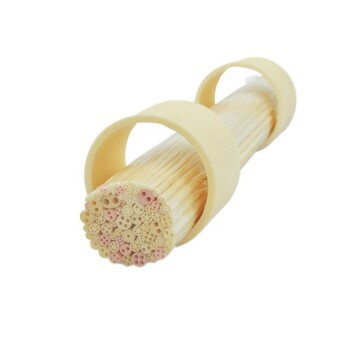
The quartz tube acts as a critical isolation vessel that defines the thermodynamic environment for synthesis. It serves to seal ball-milled precursor powders in an inert, argon-filled atmosphere, protecting them from environmental degradation while withstanding the physical stresses of heating up to 500°C.
Fundamentally, the quartz tube enables the synthesis of pure-phase electrolytes by creating a closed system. It prevents the evaporation of volatile components and maintains the internal pressure required to drive the correct crystalline phase transformation.
The Mechanics of Protection and Synthesis
Creating an Inert Barrier
Sulfide solid electrolytes are highly sensitive to the environment. Exposure to moisture or oxygen leads to immediate chemical degradation.
The quartz tube facilitates a hermetic seal, typically involving an argon fill or vacuum.
This isolation ensures that during the ball-milling and subsequent annealing stages, the precursors remain chemically stable and uncontaminated by ambient air.
Preserving Stoichiometry
Achieving the correct chemical formula (stoichiometry) is the most difficult challenge in high-temperature synthesis.
Key components, specifically Sulfur (S) and Phosphorus (P), are volatile and prone to evaporation when heated.
In an open system, these elements would escape, altering the ratio of the final product. The sealed quartz tube traps these vapors, forcing them to react and ensuring the production of pure-phase electrolytes like Na3PS4.
Facilitating Phase Transformation
Annealing is not just about heating; it is about restructuring the material at the atomic level.
The heating process generates significant internal pressure within the sealed tube.
The quartz material provides the structural integrity necessary to contain this pressure. This containment helps drive the specific crystalline phase transformations required for high ionic conductivity.
Understanding the Operational Trade-offs
The Risk of Over-Pressurization
While quartz is thermally stable, it is brittle.
If the internal pressure rises too rapidly or exceeds the tube's tensile strength, the vessel will fail catastrophically.
This is often caused by excessive heating rates or overfilling the tube with precursor material.
Sealing Integrity Dependencies
The entire process relies on the quality of the seal.
Whether using a flame seal or a vacuum valve, even a microscopic leak will introduce oxygen.
This compromises the inert environment, leading to the formation of unwanted oxides rather than the target sulfide electrolyte.
Ensuring Success in Electrolyte Synthesis
To achieve high-conductivity sulfide electrolytes, you must balance containment with safety.
- If your primary focus is Phase Purity: Prioritize a high-quality vacuum or argon seal to strictly prevent the loss of volatile sulfur and phosphorus, ensuring the reaction stoichiometry remains exact.
- If your primary focus is Process Safety: Calculate the theoretical pressure generation of your reactants at 500°C to ensure the quartz wall thickness is sufficient to prevent explosion.
The quartz tube is the defining boundary that forces the thermodynamics of the reaction to favor the desired solid electrolyte phase.
Summary Table:
| Feature | Role in Annealing Treatment |
|---|---|
| Atmosphere Control | Provides a hermetic seal for argon or vacuum to prevent moisture/oxygen degradation. |
| Stoichiometry Preservation | Contains volatile elements like Sulfur and Phosphorus to ensure pure-phase electrolytes. |
| Pressure Management | Withstands internal pressure to drive necessary crystalline phase transformations. |
| Thermal Stability | Maintains structural integrity at high temperatures (up to 500°C) during the reaction. |
Elevate Your Battery Research with Precision Equipment
Success in synthesizing high-conductivity sulfide electrolytes depends on the quality of your containment and thermal processing. KINTEK specializes in advanced laboratory solutions designed for the most demanding material science applications.
Whether you require high-purity quartz tubes and crucibles, precision high-temperature furnaces (muffle, tube, or vacuum), or robust ball milling systems for precursor preparation, KINTEK provides the reliability your research demands. Our portfolio also includes high-pressure reactors, PTFE consumables, and battery research tools tailored for next-generation energy storage development.
Ready to optimize your synthesis process? Contact our technical experts today to find the perfect equipment and consumables for your lab's specific needs!
Related Products
- Laboratory Rapid Thermal Processing (RTP) Quartz Tube Furnace
- 1200℃ Split Tube Furnace with Quartz Tube Laboratory Tubular Furnace
- Optical Window Glass Substrate Wafer Quartz Plate JGS1 JGS2 JGS3
- High Temperature Resistant Optical Quartz Glass Sheet
- Rotary Tube Furnace Split Multi Heating Zone Rotating Tube Furnace
People Also Ask
- What technical advantages does an RTP tube furnace offer for photoelectrodes? Achieve Precision & High Phase Purity
- How does a quartz tube furnace facilitate the synthesis of rGO? Optimize Your Cathode Matrix with Precise Pyrolysis
- What is the temperature of a quartz tube furnace? Master the Limits for Safe, High-Temp Operation
- What are the advantages of using an electric heating furnace with a quartz tube for liquid bismuth corrosion control?
- What is the maximum temperature for a quartz tube furnace? Key Limits for Safe & Efficient Operation