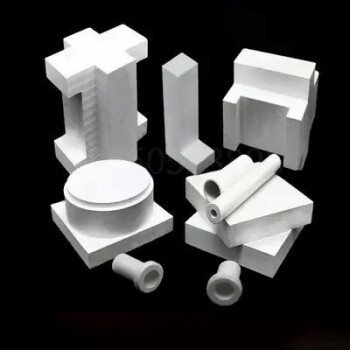
Reaction Bonded Silicon Nitride (RBSN) crucibles function as the critical containment vessel for the direct nitridation growth of Aluminum Nitride crystals. They provide the necessary thermal stability and corrosion resistance to hold Aluminum-Silicon melts at extreme reaction temperatures reaching up to 1700°C. Beyond simple containment, the crucible's surface characteristics play a vital role in stabilizing the environment for crystal nucleation.
While acting as a robust container, the RBSN crucible also interacts physically with the melt through its surface structure. It facilitates the successful growth of needle-like crystals on both the melt surface and the crucible walls, provided the alloy ratios are managed correctly.
Ensuring Process Stability at Extreme Temperatures
High-Temperature Resilience
The primary function of the RBSN crucible is to withstand the intense thermal environment required for nitridation. It maintains structural integrity at temperatures up to 1700°C.
Chemical Resistance
At these elevated temperatures, the crucible must resist corrosion from the reactive components inside. It effectively holds Aluminum-Silicon (Al-Si) melts without degrading, ensuring the purity of the growth environment.
The Influence of Surface Structure
Controlling Wettability
The crucible is not an inert passive observer; its physical properties actively influence the process. The surface characteristics of the RBSN material directly impact the wettability of the melt.
The Role of Porosity
RBSN possesses a distinct porous structure. This structural feature is a key factor in how the crucible interacts with the liquid metal alloy during the heating phase.
Facilitating Crystal Formation
Supporting Nucleation Sites
The crucible creates a stable environment that fosters nucleation. The reference indicates that crystal growth occurs not just on the melt surface, but also along the crucible walls.
Encouraging Needle-like Growth
The stability provided by the RBSN crucible allows for specific crystal morphologies to develop. Specifically, it facilitates the growth of needle-like Aluminum Nitride crystals.
Understanding the Trade-offs
Vulnerability to Pore Penetration
While the porous structure aids certain interactions, it presents a limitation regarding melt composition. High-aluminum melts have a tendency to penetrate the pores of the crucible.
Sensitivity to Alloy Ratios
The RBSN crucible is most effective when used with specific alloy ratios. If the aluminum concentration is too high, the stability of the containment may be compromised by the infiltration described above.
Making the Right Choice for Your Goal
To maximize the effectiveness of an RBSN crucible in your crystal growth project, consider your specific operational parameters:
- If your primary focus is thermal capacity: Rely on the RBSN crucible for operations requiring stability up to 1700°C.
- If your primary focus is melt composition: Exercise caution with high-aluminum concentrations to prevent pore penetration and ensure container longevity.
By balancing the thermal benefits against the porosity constraints, you can optimize the nucleation and growth of high-quality Aluminum Nitride crystals.
Summary Table:
| Feature | Function in AlN Crystal Growth |
|---|---|
| Thermal Stability | Maintains structural integrity up to 1700°C |
| Chemical Resistance | Resists corrosion from Al-Si melts during nitridation |
| Porous Structure | Influences melt wettability and provides nucleation sites |
| Crystal Support | Enables needle-like growth on melt surfaces and walls |
| Process Compatibility | Optimized for specific alloy ratios to prevent pore penetration |
Precision Lab Solutions for High-Temperature Success
Elevate your crystal growth research with high-performance laboratory equipment from KINTEK. Whether you are working on direct nitridation with RBSN crucibles or scaling your production with our advanced high-temperature furnaces (vacuum, tube, and atmosphere), we provide the precision tools necessary for superior results.
Our extensive portfolio for material science includes:
- High-Temperature High-Pressure Reactors & Autoclaves
- Crushing, Milling, and Sieving Systems for precursor preparation
- Ceramics and Crucibles tailored for extreme chemical environments
- Hydraulic Presses for pelletizing and advanced material processing
Don't let equipment limitations compromise your research purity or structural outcomes. Contact KINTEK today to discuss how our specialized high-temperature solutions and laboratory consumables can optimize your AlN crystal growth and material synthesis workflows.
References
- Ryota Kobayashi, Takayuki TAKAGI. Synthesis of AlN needles by nitridation of Al–Si melt. DOI: 10.2109/jcersj2.16137
This article is also based on technical information from Kintek Solution Knowledge Base .
Related Products
- Boron Nitride (BN) Crucible for Phosphorous Powder Sintered
- Electron Beam Evaporation Coating Conductive Boron Nitride Crucible BN Crucible
- High Purity Pure Graphite Crucible for Electron Beam Evaporation
- Engineering Advanced Fine Ceramics Alumina Al2O3 Crucible With Lid Cylindrical Laboratory Crucible
- High Purity Pure Graphite Crucible for Evaporation
People Also Ask
- Why use Boron Nitride (BN) crucibles in metal infiltration? Ensure sample purity and non-wetting performance.
- Why are Boron Nitride (BN) or Alumina crucibles preferred for Na-flux GaN growth? Optimize Your Crystal Yield
- What is the necessity of using a ceramic crucible as a carrier during BN synthesis? Ensure High-Purity Results
- How much heat can a ceramic crucible take? Find the Right Crucible for Your High-Temp Process
- What is the necessity of using ceramic crucibles in TGA for TClPhMA? Ensure Accurate Thermal Data Integrity