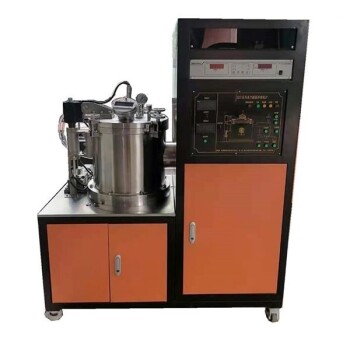
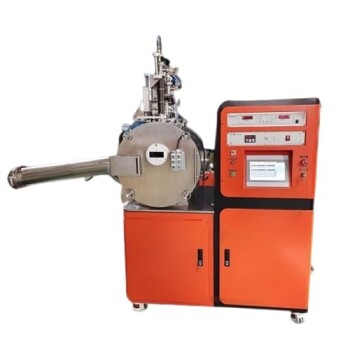
The primary role of a vacuum induction furnace is to provide a strictly controlled, oxygen-free environment for melting 27% Cr super duplex stainless steel. This equipment is critical for preventing the oxidation of chemically active elements and significantly reducing impurity levels, specifically oxygen and sulfur.
By isolating the molten metal from the atmosphere, vacuum induction melting enables the precise addition of reactive elements like Rare Earth Metals (REM) without burn-off. This ensures the alloy achieves the exact chemical composition and high purity necessary for the superior performance of super duplex steel.
Preserving Alloy Composition
Preventing Element Loss
27% Cr super duplex stainless steel contains high levels of chromium and other active alloying elements. In an open atmosphere, these elements react rapidly with oxygen.
A vacuum induction furnace creates an environment that prevents this oxidation. This ensures that the expensive alloying elements remain in the steel rather than being lost as slag or oxide inclusions.
Enabling Rare Earth Metal (REM) Additions
To enhance the properties of super duplex steel, manufacturers often add precise amounts of Rare Earth Metals (REM).
These metals are extremely reactive and would instantly oxidize in air. The vacuum environment allows you to add REMs safely, ensuring they are retained in the final solution to perform their intended metallurgical function.
Enhancing Material Purity
Removal of Harmful Impurities
High-performance steels require exceptional cleanliness to avoid cracking or corrosion failure.
The vacuum melting process actively reduces the levels of oxygen and sulfur in the molten bath. By lowering these impurities, the furnace produces a cleaner final microstructure with fewer non-metallic inclusions.
Isolation from Atmospheric Gases
Beyond oxygen, the vacuum environment isolates the melt from nitrogen (where not intended) and other atmospheric contaminants.
This isolation is a prerequisite for producing ultra-pure steel grades. It eliminates the risk of unintended reactions that could embrittle the material or alter its mechanical properties.
Thermal Homogeneity and Efficiency
Uniform Thermal Field
The induction mechanism generates heat directly within the raw materials—such as scrap duplex steel and ferroalloys (FeCr, FeNb, FeMo)—using electromagnetic fields.
This creates a uniform thermal field throughout the crucible. Unlike arc furnaces that have hot spots, induction heating ensures the entire batch reaches the liquid state evenly.
Electromagnetic Stirring
A key advantage of induction melting is the natural stirring action caused by the electromagnetic field.
This stirring effect ensures that all alloying components are thoroughly mixed in the liquid state. It guarantees that the chemical composition is consistent from the top to the bottom of the ingot, which is vital for subsequent casting or forming.
Operational Considerations and Trade-offs
Equipment Complexity
A vacuum induction melting (VIM) furnace is a complete set of complex equipment, including vacuum pumps, chambers, and flow controllers.
This complexity requires higher maintenance and technical expertise compared to standard open-air induction furnaces. The system must maintain precise pressure levels (e.g., extremely low background pressure) to be effective.
Batch Processing Limitations
Because the process requires sealing a chamber and pumping it down to a vacuum, it is inherently a batch process.
This can limit throughput speed compared to continuous casting methods used for lower-grade steels. However, for high-value alloys like super duplex, the trade-off in speed is accepted to achieve the required quality.
Making the Right Choice for Your Project
To maximize the quality of your 27% Cr super duplex stainless steel, align your melting strategy with your specific quality targets:
- If your primary focus is mechanical reliability and corrosion resistance: Prioritize vacuum induction melting to enable REM addition and minimize oxide inclusions that act as failure points.
- If your primary focus is chemical precision: Rely on the vacuum environment to prevent element burn-off, ensuring your final cast matches your calculated theoretical composition exactly.
- If your primary focus is environmental impact: Note that vacuum induction melting is fundamentally flameless and produces significantly less smoke and dust than conventional combustion methods.
Ultimately, for 27% Cr super duplex steel, the vacuum induction furnace is not just a melting tool; it is the primary safeguard for alloy integrity.
Summary Table:
| Feature | Benefit for 27% Cr Super Duplex Steel |
|---|---|
| Vacuum Environment | Prevents oxidation of Cr and loss of reactive Rare Earth Metals (REM). |
| Impurity Removal | Significantly reduces oxygen and sulfur levels for a cleaner microstructure. |
| Induction Stirring | Ensures uniform thermal field and consistent chemical distribution. |
| Atmospheric Isolation | Eliminates risk of embrittlement from unintended nitrogen or gas absorption. |
| Precise Alloying | Allows for exact chemical matching by eliminating element burn-off. |
Elevate Your Alloy Production with KINTEK
Precision matters when melting high-performance 27% Cr super duplex stainless steel. KINTEK specializes in advanced laboratory and industrial solutions, providing high-tier vacuum induction melting systems, high-temperature furnaces, and specialized consumables like ceramics and crucibles designed for the most demanding metallurgical processes.
Whether you are refining superalloys or conducting critical battery research, our comprehensive portfolio—including high-temperature high-pressure reactors, crushing and milling systems, and cooling solutions—is engineered to ensure material integrity and operational efficiency.
Ready to optimize your lab's performance? Contact KINTEK today to discuss your custom equipment needs!
References
- Hang Wang, Chenlu Liu. Effects of rare earth metals on microstructure, mechanical properties, and pitting corrosion of 27% Cr hyper duplex stainless steel. DOI: 10.1515/rams-2022-0284
This article is also based on technical information from Kintek Solution Knowledge Base .
Related Products
- 600T Vacuum Induction Hot Press Furnace for Heat Treat and Sintering
- Lab-Scale Vacuum Induction Melting Furnace
- Non Consumable Vacuum Arc Induction Melting Furnace
- Vacuum Heat Treat Furnace and Levitation Induction Melting Furnace
- Vacuum Arc Induction Melting Furnace
People Also Ask
- What role does an induction vacuum hot pressing furnace play in sintering? Achieve 98% Density in Carbide Blocks
- What advantages does a vacuum hot press furnace provide for LSLBO ceramic electrolytes? Achieve 94% Relative Density
- What role does a Vacuum Hot Press (VHP) furnace play in the densification of austenitic stainless steel 316 composites?
- What role does mechanical pressure play during the vacuum diffusion bonding of tungsten and copper? Keys to Solid Bonding
- What are the advantages of a vacuum hot press furnace for W-50%Cu? Achieve 99.6% Density at Lower Temperatures