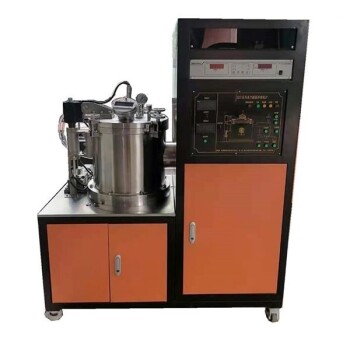
The vacuum tube furnace is the essential environment for the thermal consolidation of magnesium-based composites. It provides the precise high-temperature conditions required for atomic diffusion while maintaining a strictly controlled atmosphere to prevent the magnesium matrix from oxidizing or combusting. By balancing heat delivery with atmospheric exclusion, the furnace transforms powder "green compacts" into high-strength, densified metallurgical bodies.
The vacuum tube furnace acts as both a thermal catalyst and a protective shield, enabling metal particles to bond at the atomic level without reacting with ambient oxygen. This dual role is critical for maintaining the chemical integrity and mechanical performance of highly reactive magnesium alloys.
Facilitating Metallurgical Bonding through Thermal Diffusion
Driving Atomic Migration
The primary role of the furnace is to provide the thermal energy necessary to initiate solid-phase sintering. By holding the material at temperatures near the melting point (typically between 500°C and 590°C), the furnace promotes atomic diffusion across the boundaries of the compressed magnesium particles.
Achieving Material Densification
As atoms migrate, the gaps between individual powder particles—known as pores—begin to close. This process, known as densification, transforms a brittle "green compact" into a solid, high-performance bulk material with enhanced structural integrity.
Controlling Grain Growth
A high-quality tube furnace uses sophisticated control systems to maintain a constant temperature for extended periods. This precision is vital to prevent excessive grain coarsening, a phenomenon where metal crystals grow too large, which can significantly weaken the final mechanical properties of the composite.
Maintaining Atmospheric Purity for Reactive Metals
Preventing Rapid Oxidation
Magnesium is an extremely active metal that reacts violently with oxygen and water vapor at high temperatures. The furnace’s vacuum or inert gas environment (such as high-purity argon) excludes these reactive gases, ensuring the magnesium does not turn into oxide during the heating process.
Protecting Composite Reinforcements
Magnesium-based composites often incorporate sensitive reinforcements like MXenes, graphene nanoplatelets, or titanium dioxide. The protective atmosphere within the tube furnace prevents these additives from degrading or undergoing unintended chemical reactions, preserving their functional benefits.
Ensuring Interfacial Bonding
By removing surface contaminants and preventing new oxide layers from forming, the vacuum environment facilitates high-quality interfacial bonding. This strong connection between the magnesium matrix and the reinforcement particles is what gives the composite its superior hardness and wear resistance.
Understanding the Trade-offs and Pitfalls
Vacuum vs. Inert Gas Protection
While a vacuum is effective, some magnesium sintering processes require a positive pressure of high-purity argon gas. This is because magnesium has a high vapor pressure; in a deep vacuum at high temperatures, the metal can actually sublimate (turn to gas), leading to material loss and furnace contamination.
Pressureless Sintering Limitations
Standard tube furnaces perform pressureless sintering, which relies entirely on temperature to drive bonding. Without the addition of mechanical pressure (as found in vacuum hot-pressing furnaces), it can be difficult to break through the stubborn native oxide films on magnesium particles, sometimes resulting in lower final density.
The Overheating Risk
There is a narrow window between effective sintering and material failure. If the furnace temperature exceeds the magnesium alloy's solidus line, localized melting can occur, leading to a total loss of the component’s geometric shape and a dramatic reduction in strength.
Making the Right Choice for Your Goal
How to Apply This to Your Project
To achieve the best results when sintering magnesium-based composites, you must align your furnace parameters with your specific material objectives.
- If your primary focus is maximum chemical purity: Utilize a high-vacuum cycle followed by a constant flow of high-purity argon to ensure all traces of oxygen and moisture are eliminated.
- If your primary focus is high mechanical strength: Prioritize precise temperature "soaking" times to maximize diffusion bonding while using rapid cooling to prevent grain growth.
- If your primary focus is achieving near-theoretical density: Consider a vacuum hot-pressing furnace that applies axial mechanical pressure to assist the thermal sintering process.
The success of a magnesium-based composite depends entirely on the furnace’s ability to provide a clean, stable, and precisely controlled thermal environment.
Summary Table:
| Key Role | Primary Benefit | Technical Mechanism |
|---|---|---|
| Thermal Diffusion | Material Densification | Promotes atomic migration near melting points (500°C-590°C). |
| Atmospheric Control | Oxidation Prevention | Uses vacuum or high-purity Argon to exclude reactive oxygen. |
| Precision Heating | Grain Growth Control | Sophisticated PID control prevents crystal coarsening. |
| Environment Purity | Strong Interfacial Bonding | Protects reinforcements (graphene, MXenes) from degradation. |
Precision Sintering Starts with KINTEK
Achieving the perfect balance of densification and purity in magnesium-based composites requires uncompromising thermal control. KINTEK specializes in providing the high-precision laboratory equipment necessary for advanced material science.
From our state-of-the-art vacuum tube furnaces, CVD, and PECVD systems to specialized vacuum hot-pressing furnaces, we provide the exact environment your reactive alloys need. Our comprehensive portfolio also includes:
- High-Temperature Furnaces: Muffle, rotary, and induction melting systems.
- Sample Preparation: Crushing, milling, and hydraulic presses (pellet, isostatic).
- Advanced Research Tools: High-pressure reactors, electrolytic cells, and battery research consumables.
Ready to elevate your metallurgical results? Contact our technical experts today to discuss your specific sintering parameters and discover how KINTEK can enhance your lab's efficiency and material performance.
References
- Ogunlakin Nasirudeen Olalekan, Nouari Saheb. Nb2CTx MXene reinforcement stimulated microstructure and mechanical properties of magnesium. DOI: 10.1038/s41598-023-41067-8
This article is also based on technical information from Kintek Solution Knowledge Base .
Related Products
- Vacuum Sealed Continuous Working Rotary Tube Furnace Rotating Tube Furnace
- Laboratory High Pressure Vacuum Tube Furnace
- Laboratory Vacuum Tilt Rotary Tube Furnace Rotating Tube Furnace
- Split Chamber CVD Tube Furnace with Vacuum Station Chemical Vapor Deposition System Equipment Machine
- 1200℃ Controlled Atmosphere Furnace Nitrogen Inert Atmosphere Furnace
People Also Ask
- What are the advantages of using a rotary tube furnace for MoVOx catalysts? Elevate Uniformity and Crystallinity
- What are the process advantages of using a rotary tube furnace for WS2 powder? Achieve Superior Material Crystallinity
- Why is a vacuum tube furnace with argon protection required for RGO/Cu? Ensure Conductivity and Material Purity
- Why is a rotary tube furnace preferred over a fixed tube furnace for the carbonization of asphaltenes? Superior Quality
- Why is a rotary tube furnace recommended for the calcination stage of potassium vanadium oxide catalysts? Optimize Purity