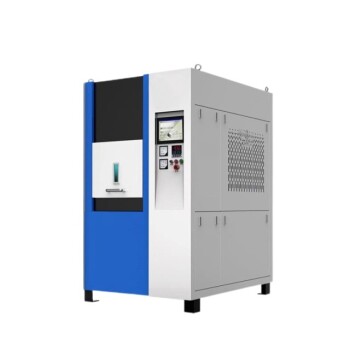
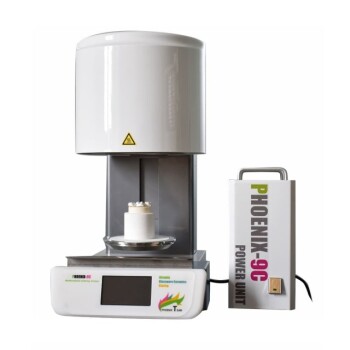
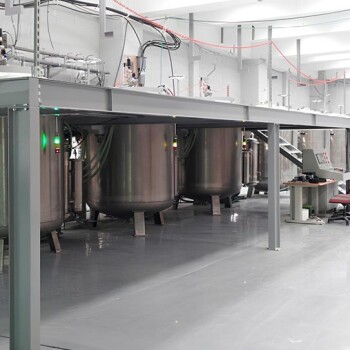
The atmosphere sintering furnace serves as the critical reaction vessel where raw battery components are transformed into a unified, functional device. Specifically, for NMC622 and LLZ all-solid-state batteries, this equipment provides a precisely controlled high-temperature environment—typically between 750°C and 800°C—combined with a specific atmosphere, such as dry air, to facilitate co-sintering.
By strictly controlling temperature and gas composition, the furnace drives the densification of the battery green body. This process forces the cathode and electrolyte particles to fuse, creating a tight solid-solid interface that minimizes impedance and enables high electrochemical performance.
Creating the Critical Interface
The primary function of the furnace is not merely to heat the materials, but to engineer the physical boundary between them.
Overcoming Physical Barriers
In solid-state batteries, the cathode (NMC622) and the electrolyte (LLZ) are solids. Unlike liquid electrolytes, they do not naturally "wet" or cover each other.
Without intervention, gaps exist between particles. The furnace provides the energy required to overcome this lack of physical contact.
The Densification Mechanism
Under high heat (750-800°C), the powder particles within the battery "green body" (the un-fired compressed powder) undergo material migration.
As grain boundaries move, pores between the particles are gradually eliminated. The material shrinks and densifies, transforming from a loose aggregate into a cohesive solid structure.
Reducing Interface Impedance
This densification creates a tight solid-solid contact interface. This is the single most important outcome of the process.
A tight interface ensures low impedance (resistance). This allows lithium ions to move freely between the cathode and electrolyte, which is essential for the battery to achieve its desired electrochemical performance.
Precise Environmental Control
The furnace distinguishes itself from a standard oven through its ability to strictly regulate the reaction environment.
Thermal Precision
The furnace utilizes resistance or induction heating elements to reach and maintain the target temperature range of 750-800°C.
Sensors and thermal controllers ensure the temperature remains stable, preventing fluctuations that could lead to uneven sintering or material degradation.
Atmospheric Regulation
For NMC622 and LLZ, the presence of specific gases is vital. The primary requirement is often dry air.
The furnace's gas system strictly controls this atmosphere. This prevents the introduction of moisture or other contaminants that could react negatively with the sensitive ceramic materials.
Structural Transformation
Beyond electrochemical properties, the furnace imparts mechanical strength.
The sintering process converts the fragile green body into a "porcelain body." This hardened state provides the mechanical integrity necessary for the battery to withstand handling and operation.
Understanding the Trade-offs
While the atmosphere sintering furnace is essential, the process involves critical sensitivities that must be managed.
Atmospheric Sensitivity
Ceramic materials like LLZ are highly sensitive to their environment. Even slight deviations in the furnace atmosphere can alter the composition or structure of the material.
If the gas control system fails to maintain the specific "dry air" environment, the quality of the product will degrade, potentially rendering the battery non-functional.
The Balance of Densification
The goal is maximum density, but the process is time-dependent.
The material must remain at the preset temperature for a specific duration to achieve full densification. Cutting this time short results in a porous, weak interface; extending it too long could waste energy or cause excessive grain growth.
How to Apply This to Your Project
To maximize the effectiveness of your co-sintering process, align your furnace parameters with your specific performance targets.
- If your primary focus is lowering resistance: Prioritize the precision of the 750-800°C temperature hold to ensure maximum pore elimination and tight interface formation.
- If your primary focus is material stability: Focus on the strict maintenance of the dry air atmosphere to prevent composition changes in the sensitive ceramic powders.
- If your primary focus is mechanical strength: Ensure the sintering duration is sufficient to transform the green body into a fully hardened porcelain structure.
Success in co-sintering lies in the precise synchronization of thermal energy and atmospheric chemistry to eliminate physical voids between particles.
Summary Table:
| Feature | Function in NMC622/LLZ Co-sintering | Impact on Battery Performance |
|---|---|---|
| Temperature (750-800°C) | Facilitates material migration and pore elimination. | High densification and mechanical strength. |
| Atmosphere Control | Maintains dry air environment to prevent contamination. | Ensures chemical stability of ceramic LLZ. |
| Interface Engineering | Creates tight solid-solid contact between particles. | Minimizes impedance for lithium-ion mobility. |
| Structural Change | Transforms 'green body' into 'porcelain body'. | Enhances durability and operational integrity. |
Elevate Your Solid-State Battery Research with KINTEK
Precise atmospheric control and thermal stability are the foundation of high-performance battery interfaces. KINTEK specializes in advanced laboratory equipment, providing the cutting-edge atmosphere furnaces (CVD, PECVD, vacuum, and dental), high-temperature high-pressure reactors, and hydraulic presses (pellet, isostatic) required for NMC622 and LLZ research.
From battery research tools and electrolytic cells to essential ceramic crucibles, our comprehensive portfolio empowers scientists to achieve perfect densification and low impedance. Contact us today to discover how our tailored solutions can optimize your co-sintering process and accelerate your innovation.
Related Products
- Mesh belt controlled atmosphere furnace
- Vacuum Heat Treat and Sintering Furnace with 9MPa Air Pressure
- Controlled Nitrogen Inert Hydrogen Atmosphere Furnace
- 1200℃ Controlled Atmosphere Furnace Nitrogen Inert Atmosphere Furnace
- 1700℃ Controlled Atmosphere Furnace Nitrogen Inert Atmosphere Furnace
People Also Ask
- What role does a controlled atmosphere furnace with argon gas flow play in the production of reduced graphene oxide (rGO)?
- What are some of the reasons why a controlled atmosphere furnace is desirable in sintering? Achieve Superior Sintering Results
- Why is a furnace equipped with a controlled atmosphere necessary for the preparation of active metal catalysts?
- How does a mesh belt furnace work? Achieve High-Volume, Repeatable Heat Treatment
- What is the process of a mesh belt furnace? Achieve Consistent, High-Volume Heat Treatment