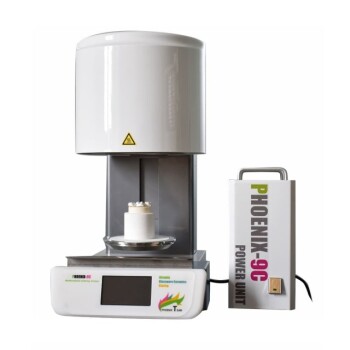
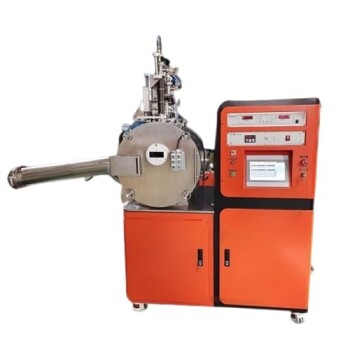
A vacuum sintering furnace provides a controlled, dual-factor environment characterized by temperatures up to 1700°C and a high vacuum level exceeding 1 mPa. These specific conditions are not merely for heating; they are the critical drivers required to manipulate the microstructure of Yttrium Oxide, turning it from a packed powder into a transparent solid.
The core function of this environment is to facilitate grain boundary migration and the total elimination of internal micropores. By removing these physical defects, the furnace prevents light scattering, allowing the ceramic to achieve near-theoretical density and excellent linear light transmittance.
The Critical Environmental Factors
Extreme Thermal Capabilities
To process Yttrium Oxide effectively, the furnace must generate intense heat.
The system is designed to provide a high-temperature environment reaching up to 1700°C. This thermal energy is the primary catalyst that activates the sintering mechanism within the ceramic material.
High-Vacuum Atmosphere
Temperature alone is insufficient for high-grade transparency; the atmospheric pressure is equally critical.
The furnace creates a high vacuum environment, specifically exceeding 1 mPa. This vacuum is essential for removing trapped gases and preventing oxidation or contamination that would occur at normal atmospheric pressures.
How These Conditions Create Transparency
Eliminating Light Scattering Sources
The primary enemy of transparency in ceramics is the presence of micropores.
These microscopic voids within the material act as light scattering sources, causing opacity. The furnace's combined heat and vacuum environment is engineered specifically to target and remove these pores.
Facilitating Grain Boundary Migration
The high temperature promotes mobility within the material's atomic structure.
This energy facilitates grain boundary migration, a process where the crystals within the ceramic grow and merge. As these boundaries move, they sweep away and eliminate the voids between particles.
Achieving Theoretical Density
The ultimate goal of these environmental conditions is densification.
By closing internal gaps, the Yttrium Oxide ceramic reaches a densification level close to its theoretical density. This solid, pore-free structure allows light to pass through linearly without scattering.
Operational Constraints and Installation
While the internal environment is key, the external environment affects the furnace's performance.
Ambient Humidity Control
The furnace cannot operate at peak efficiency in uncontrolled humidity.
To maintain the integrity of the process, the sintering furnace must be installed in a dry room. This prevents ambient moisture from affecting the sensitive vacuum components or the ceramic material itself.
Thermal Dissipation Requirements
The high internal temperatures require adequate external spacing for safety and heat management.
The unit must be positioned at least 25cm away from any wall. This clearance ensures proper airflow and prevents heat buildup in the surrounding facility structure.
Making the Right Choice for Your Goal
To ensure the production of high-quality transparent ceramics, consider these priorities:
- If your primary focus is optical clarity: Ensure your vacuum system can reliably sustain pressures exceeding 1 mPa throughout the peak heating cycle to guarantee pore elimination.
- If your primary focus is material density: Verify that the heating elements can achieve and hold 1700°C to drive the necessary grain boundary migration.
- If your primary focus is facility planning: Prepare a dedicated dry room layout that accommodates the required 25cm safety clearance around the unit.
Success in producing transparent Yttrium Oxide lies in the precise balance of extreme heat and deep vacuum to remove every microscopic imperfection.
Summary Table:
| Environmental Factor | Specification | Role in Production |
|---|---|---|
| Sintering Temperature | Up to 1700°C | Activates grain boundary migration and atomic mobility |
| Vacuum Level | Exceeding 1 mPa | Eliminates trapped gases and prevents oxidation/contamination |
| Ambient Humidity | Dry Room Environment | Protects vacuum components and material integrity |
| Clearance Space | 25cm from walls | Ensures proper thermal dissipation and operational safety |
Elevate Your Material Research with KINTEK's Advanced Thermal Solutions
Precision is the difference between an opaque sample and a transparent masterpiece. KINTEK specializes in high-performance laboratory equipment designed to meet the rigorous demands of advanced ceramic production. Our range of high-temperature vacuum and atmosphere furnaces provides the stable, high-vacuum environments and uniform heating required to achieve near-theoretical density in Yttrium Oxide and other technical ceramics.
Whether you are scaling up production or refining grain boundary migration in the lab, our expert team is ready to support your goals with:
- High-Temperature Furnaces: Muffle, tube, and vacuum systems capable of reaching 1700°C and beyond.
- Integrated Systems: From crushing and milling to high-pressure pellet presses for superior pre-sintering preparation.
- Specialized Consumables: High-purity ceramics, crucibles, and PTFE products to maintain sample purity.
Ready to achieve optical-grade clarity in your materials? Contact our technical specialists today to find the perfect sintering solution for your laboratory.
Related Products
- Vacuum Dental Porcelain Sintering Furnace
- Dental Porcelain Zirconia Sintering Ceramic Vacuum Press Furnace
- 600T Vacuum Induction Hot Press Furnace for Heat Treat and Sintering
- Vacuum Heat Treat Furnace with Ceramic Fiber Liner
- Vacuum Heat Treat and Sintering Furnace with 9MPa Air Pressure
People Also Ask
- What is the primary function of a dental sintering furnace? Transform Zirconia into Durable Crowns & Bridges
- What is sintering dentistry? The Key to Strong, Aesthetic Dental Restorations
- What is sintering process in dentistry? Transform Milled 'Chalk' into Durable Dental Restorations
- What factors are important to consider when choosing a dental sintering furnace? Match Your Workflow for Optimal Results
- What does sintering mean in dentistry? The Essential Process for Strong, Durable Restorations