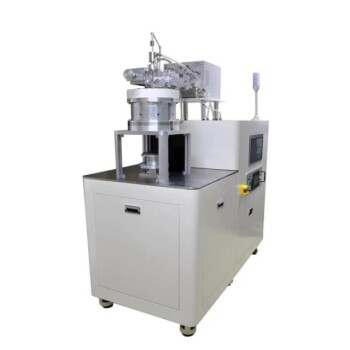
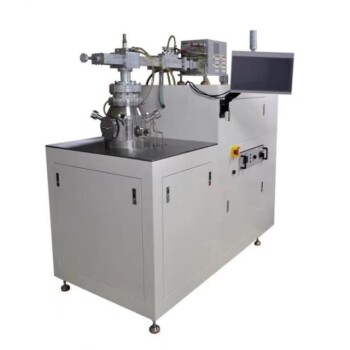
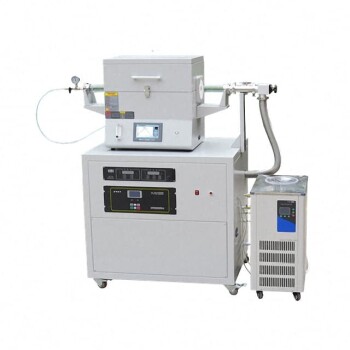
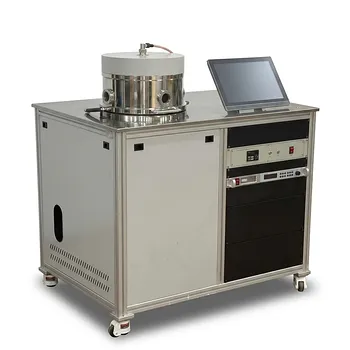
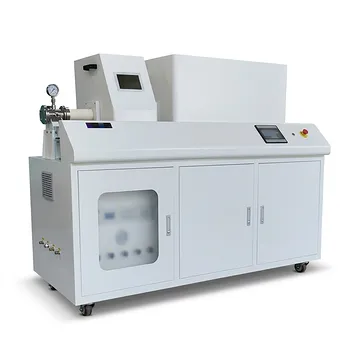
The decisive technical advantage of a Chemical Vapor Deposition (CVD) reactor lies in its non-line-of-sight deposition capability, which fundamentally distinguishes it from Physical Vapor Deposition (PVD). While PVD relies on a directional spray that creates "shadows" on irregular surfaces, CVD utilizes gaseous precursors that flow freely around the heated implant. This ensures that even the most intricate features—such as deep threads, undercuts, and osseointegrative micropores—receive a coating of highly uniform thickness and continuous composition.
Core Takeaway The complex geometry of a dental implant requires a coating process that is not limited by directional constraints. CVD reactors excel here by offering superior "step coverage" and "throwing power," ensuring that every micron of the implant's surface—regardless of depth or orientation—is coated with the same functional density and quality.
Overcoming Geometric Complexity
The primary challenge in coating dental implants is ensuring the bioactive or protective layer reaches every part of the screw thread and surface texture.
The "Non-Line-of-Sight" Mechanism
PVD processes are generally directional; if the source cannot "see" the surface, it cannot coat it effectively.
CVD operates on a different principle. It creates a chemical reaction within a gaseous environment surrounding the implant.
Because the gas fills the entire reactor chamber, it coats any exposed surface it touches, eliminating the shadowing effects common in PVD.
Superior Step Coverage
The primary reference highlights step coverage as the critical metric for implant modification.
This refers to the ratio of coating thickness on the walls of a step (or thread) to the thickness on the flat surface.
CVD achieves near-perfect step coverage, maintaining uniform thickness even on vertical walls and sharp corners of the implant threads.
High Throwing Power for Micropores
Dental implants often feature microporous surfaces to encourage bone growth.
CVD possesses high throwing power, allowing the gas to penetrate deep recesses, holes, and internal cavities.
This ensures that the internal surfaces of pores are coated just as effectively as the outer geometry, preventing weak points in the bioactive interface.
Consistency and Film Quality
Beyond geometry, the reactor environment ensures the coating performs consistently once implanted.
Molecular-Level Nucleation
CVD film growth occurs via nucleation at the molecular level on the heated surface.
This results in a dense, non-porous film structure that adheres strongly to the substrate.
Compositional Homogeneity
The chemical reaction ensures a continuous composition across the entire implant.
There are no gradients or weak spots caused by the angle of deposition, ensuring consistent biological response across the full surface area of the device.
Batch Processing Efficiency
Unlike evaporation methods which may be limited by source geometry, CVD reactors can process substrates in larger batches.
This allows for the mass production of implants with stable quality, as the gas flow can be managed to ensure uniformity across all parts in the chamber.
Understanding the Trade-offs
While CVD offers superior coverage for complex shapes, there are specific constraints you must consider.
Thermal Constraints
CVD requires the implant surface to be heated to initiate the chemical reaction.
You must ensure the substrate material (typically titanium for implants) can withstand the required process temperatures without degrading its mechanical properties.
Contact Points
The gas coats every exposed surface, but the implant must be held in place within the reactor.
The specific "support points" where the implant touches the fixture will remain uncoated.
Fixture design is critical to ensure these contact points are located on non-functional areas of the implant.
Making the Right Choice for Your Goal
To determine if a CVD reactor is the correct tool for your specific manufacturing requirement, consider the following:
- If your primary focus is deep-thread or porous coverage: CVD is the mandatory choice due to its high throwing power and ability to coat non-line-of-sight features uniformly.
- If your primary focus is avoiding high thermal loads: You must verify that the specific CVD precursor temperature requirements stay within the safe thermal budget of your implant alloy, or consider PVD if the geometry allows.
- If your primary focus is mass production consistency: CVD offers a scalable advantage for batch processing large numbers of small, complex parts with high repeatability.
Ultimately, CVD is the superior technical choice when the implant's geometry is too complex for directional line-of-sight methods to coat reliably.
Summary Table:
| Feature | Chemical Vapor Deposition (CVD) | Physical Vapor Deposition (PVD) |
|---|---|---|
| Deposition Mechanism | Non-line-of-sight (Gaseous) | Directional (Line-of-sight) |
| Step Coverage | Superior (Uniform on walls/threads) | Poor (Shadowing effects) |
| Throwing Power | High (Penetrates micropores) | Low (Surface level only) |
| Surface Adhesion | High (Molecular-level nucleation) | Variable |
| Batch Efficiency | High (Uniformity across large batches) | Limited by source geometry |
Precision engineering for dental implants requires the highest standards in surface modification. KINTEK specializes in advanced laboratory equipment, providing state-of-the-art CVD and PECVD reactors, high-temperature furnaces, and specialized ceramics designed to handle the most demanding coating processes. Whether you are optimizing osseointegration or scaling up mass production, our team delivers the technical expertise and high-performance tools your lab needs. Contact KINTEK today to discover how our comprehensive range of reactors and thermal solutions can elevate your research and manufacturing quality.
References
- Pietro Mandracci, Stefano Carossa. Surface Treatments and Functional Coatings for Biocompatibility Improvement and Bacterial Adhesion Reduction in Dental Implantology. DOI: 10.3390/coatings6010007
This article is also based on technical information from Kintek Solution Knowledge Base .
Related Products
- Microwave Plasma Chemical Vapor Deposition MPCVD Machine System Reactor for Lab and Diamond Growth
- 915MHz MPCVD Diamond Machine Microwave Plasma Chemical Vapor Deposition System Reactor
- Cylindrical Resonator MPCVD Machine System Reactor for Microwave Plasma Chemical Vapor Deposition and Lab Diamond Growth
- Customer Made Versatile CVD Tube Furnace Chemical Vapor Deposition Chamber System Equipment
- Split Chamber CVD Tube Furnace with Vacuum Station Chemical Vapor Deposition System Equipment Machine
People Also Ask
- How does a microwave plasma reactor facilitate the synthesis of diamond? Master MPCVD with Precision Technology
- What are the advantages of a Microwave Plasma CVD reactor for MCD/NCD coatings? Precision Multilayer Diamond Engineering
- How do vacuum pumps and valves collaborate in MPCVD? Achieve Precise Pressure Control for Superior CNT Synthesis
- How does MPCVD work? A Guide to Low-Temperature, High-Quality Film Deposition
- What is microwave plasma chemical vapor deposition? A Guide to High-Purity Diamond Film Growth