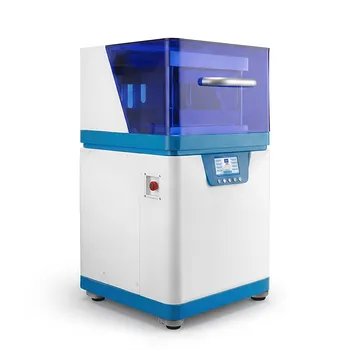
Vacuum hot-press sintering furnaces provide a "heat-force-vacuum" coupling field that fundamentally overcomes the sintering resistance of Silicon Carbide (SiC) composites.
By applying simultaneous axial pressure (typically 20 to 100 MPa) and high temperatures in a vacuum, these furnaces accelerate the flow of the liquid or glass phase to fill pores between SiC particles. This synergy enables the material to reach near-theoretical density (often exceeding 98%) at significantly lower temperatures than conventional methods, while the vacuum environment strictly prevents oxidation and contamination of the non-oxide components.
The vacuum hot-press furnace is a definitive solution for SiC ceramics because it replaces pure thermal diffusion with mechanical driving forces, ensuring high densification and a refined microstructure that is otherwise impossible to achieve in pressureless environments.
Accelerated Densification Mechanisms
The Role of Axial Mechanical Pressure
The application of external pressure acts as a powerful driving force that supplements thermal energy. This force facilitates particle rearrangement and plastic flow, effectively forcing the matrix material into the interstitial spaces between rigid SiC particles.
Enhanced Mass Transfer and Liquid Phase Flow
In many SiC composites, high temperatures create a liquid or glass phase that acts as a lubricant. The axial pressure in a hot-press furnace utilizes this phase to accelerate mass transfer, allowing for full densification at temperatures as low as 700-1000°C for certain glass-bonded composites, or higher for ceramic matrices.
Eliminating Internal Porosity
Unlike pressureless sintering, which relies on slow capillary forces, hot-pressing actively collapses internal voids. This results in ceramic blocks with extremely low porosity and relative densities reaching as high as 98.6%.
Atmospheric and Microstructural Control
Prevention of Oxidation and Decomposition
Silicon Carbide and associated metallic matrices (like Aluminum) are highly sensitive to oxygen at elevated temperatures. The high-vacuum environment prevents the formation of unwanted oxides and the chemical decomposition of non-oxide phases, ensuring high-purity final parts.
Inhibition of Excessive Grain Growth
Because the mechanical pressure allows for lower sintering temperatures and shorter dwell times, there is less opportunity for grain coarsening. This results in a fine-grained, uniform microstructure that significantly improves the mechanical toughness and reliability of the SiC composite.
Precise Process Stability
Vacuum hot-press furnaces allow for the simultaneous control of temperature, pressure, and atmosphere. This precision ensures that in-situ reactions—where new phases form during the sintering process—occur predictably, leading to stable and repeatable material properties.
Understanding the Trade-offs
Geometric Limitations
The primary limitation of vacuum hot-pressing is the requirement for uniaxial pressure. This restricts the production to relatively simple shapes, such as plates, disks, or cylinders, as the force cannot be applied evenly to complex, three-dimensional geometries.
Equipment and Operational Costs
The integration of high-vacuum systems, hydraulic press components, and high-temperature heating elements makes these furnaces a significant capital investment. Furthermore, the batch-processing nature and the need for precision-machined graphite dies increase the cost per part compared to continuous sintering methods.
Thermal Stress and Die Wear
The use of SiC heating elements provides excellent thermal radiation, but the mechanical stress on the dies at temperatures reaching 1850°C can lead to wear and potential contamination from the carbon in the dies. Maintaining the balance between high pressure and die longevity requires careful technical management.
How to Apply This to Your Project
Making the Right Choice for Your Goal
- If your primary focus is maximum mechanical strength: Utilize high axial pressure (above 30 MPa) to ensure near-zero porosity and a refined, fine-grained microstructure.
- If your primary focus is preventing material degradation: Prioritize the vacuum system's integrity to eliminate oxygen traces that could react with SiC or metallic matrix components.
- If your primary focus is cost-effective production: Evaluate if the composite's density requirements can be met at lower temperatures (700-1000°C) to reduce energy consumption and extend the life of the furnace dies.
By mastering the coupling of mechanical force and vacuum atmosphere, manufacturers can produce SiC composites with superior density and structural integrity that meet the most demanding industrial standards.
Summary Table:
| Feature | Technical Mechanism | Impact on SiC Composites |
|---|---|---|
| Axial Pressure | 20 to 100 MPa mechanical force | Eliminates internal porosity; >98% relative density |
| Vacuum Environment | High-vacuum atmosphere control | Prevents oxidation & decomposition of non-oxides |
| Thermal Synergy | Heat-force-vacuum coupling | Lowers sintering temp; inhibits grain coarsening |
| Process Control | Precise in-situ reaction monitoring | Stable microstructure and repeatable mechanical properties |
Elevate Your Material Performance with KINTEK Precision
Achieving the perfect microstructure in Silicon Carbide (SiC) composites requires equipment that masters the synergy of heat, pressure, and vacuum. KINTEK specializes in advanced laboratory solutions, offering high-performance vacuum hot-press furnaces, isostatic presses, and high-temperature furnaces (CVD, PECVD, vacuum, and atmosphere) designed to overcome sintering resistance and prevent material degradation.
Whether you are refining ceramic toughness or scaling battery research, KINTEK provides the reliability and technical support you need. Maximize your lab’s efficiency and material integrity—contact our experts today to find the ideal sintering solution.
References
- Lan Zhang, Xingyou Tian. Effect of Bi-B-Si-Zn-Al glass additive on the properties of low-temperature sintered silicon carbide ceramics. DOI: 10.3389/fphy.2022.1090437
This article is also based on technical information from Kintek Solution Knowledge Base .
Related Products
- Dental Porcelain Zirconia Sintering Ceramic Vacuum Press Furnace
- 600T Vacuum Induction Hot Press Furnace for Heat Treat and Sintering
- Vacuum Heat Treat and Sintering Furnace with 9MPa Air Pressure
- Vacuum Heat Treat and Pressure Sintering Furnace for High Temperature Applications
- Vacuum Heat Treat Furnace with Ceramic Fiber Liner
People Also Ask
- What does sintering do to zirconia? Unlock Its Full Strength and Aesthetic Potential
- What is the shrinkage of zirconia during sintering? Mastering the 20-25% Dimensional Change
- What is the sintering temperature of zirconia ceramic? Mastering the 1400°C-1600°C Thermal Profile
- What is the price of zirconia sintering furnace? Invest in Precision, Not Just a Price Tag
- What factors are important to consider when choosing a dental sintering furnace? Match Your Workflow for Optimal Results