Knowledge What temperature does titanium vaporize at? Unlocking Its Extreme Heat Resistance for Aerospace
Author avatar

Tech Team · Kintek Solution

Updated 6 days ago

What temperature does titanium vaporize at? Unlocking Its Extreme Heat Resistance for Aerospace


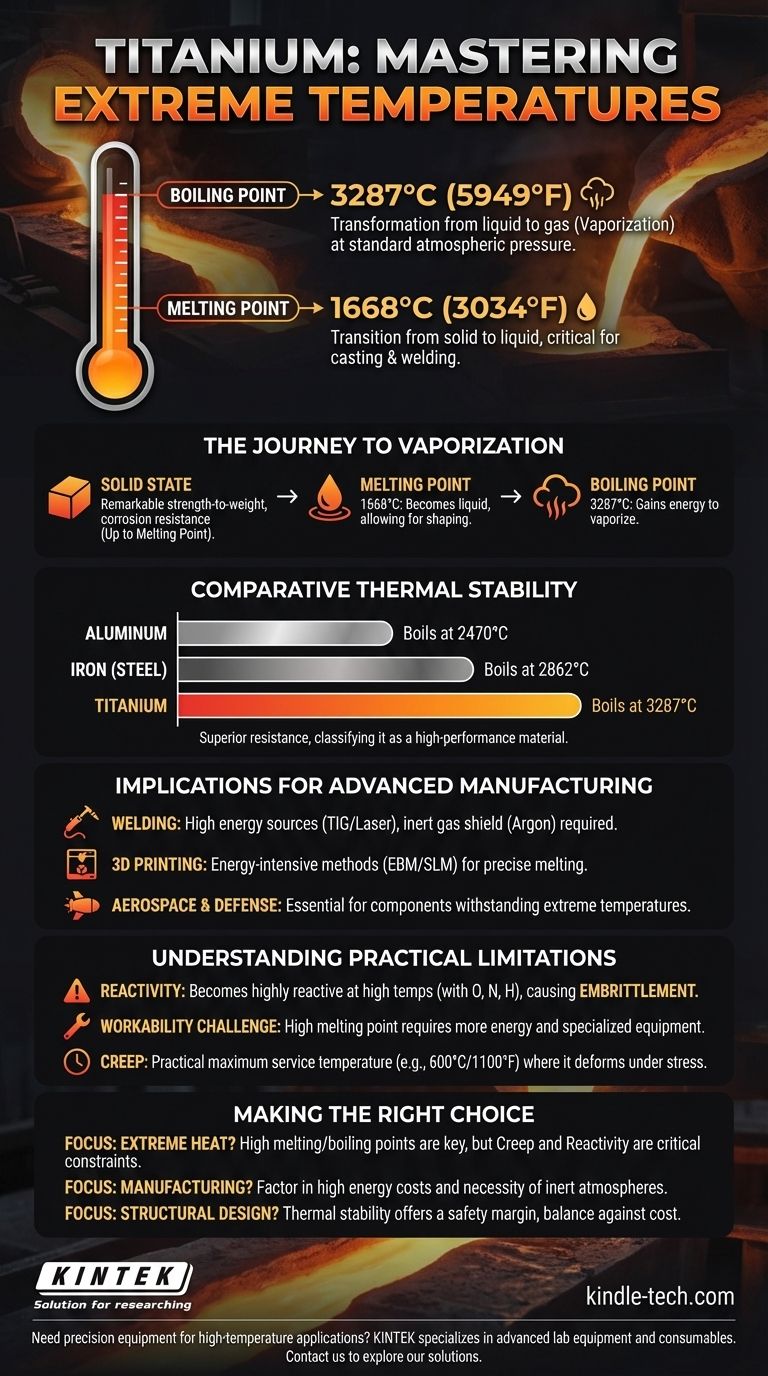
Titanium vaporizes at a temperature of approximately 3287°C (5949°F). This transformation from liquid to gas, known as the boiling point, occurs under standard atmospheric pressure. It represents an incredibly high thermal threshold, a key characteristic that defines both the material's greatest strengths and its most significant manufacturing challenges.

Understanding titanium's boiling point is less about a single number and more about appreciating its entire thermal profile. This extreme temperature resistance is the very reason it is chosen for critical applications, but it also dictates the complex and energy-intensive methods required to work with it.
What temperature does titanium vaporize at? Unlocking Its Extreme Heat Resistance for Aerospace

The Journey to Vaporization

A material's transition from solid to gas is a process with distinct stages. For titanium, each stage occurs at temperatures that far exceed those of common structural metals, highlighting its exceptional thermal stability.

The Solid State

At room temperature and up to its melting point, titanium is known for its remarkable strength-to-weight ratio and corrosion resistance. This is the state in which it is used for most structural applications.

The Melting Point: Transition to Liquid

Before titanium can boil, it must first melt. The melting point of titanium is 1668°C (3034°F). At this temperature, it transitions from a solid to a liquid state, a critical parameter for processes like casting and welding.

The Boiling Point: From Liquid to Gas

Once in a liquid state, the temperature must continue to rise significantly to reach the boiling point. At 3287°C (5949°F), the liquid titanium gains enough energy to transform into a gaseous vapor.

Why This Extreme Temperature Matters

The exceptionally high melting and boiling points of titanium are not just academic data points; they are fundamental to its most critical real-world uses.

A Benchmark for Thermal Stability

To put titanium's properties in perspective, consider how it compares to other common metals:

  • Aluminum boils at 2470°C.
  • Iron (the primary component of steel) boils at 2862°C.
  • Titanium boils at 3287°C.

This superior resistance to heat is a primary reason it's classified as a high-performance material.

Implications for Advanced Manufacturing

This thermal resilience makes titanium difficult to process.

  • Welding requires very high energy sources (like TIG or laser) and must be done in an inert gas shield (like argon) to prevent contamination.
  • 3D Printing with titanium often involves energy-intensive methods like electron-beam melting (EBM) or selective laser melting (SLM) to precisely melt and fuse the metal powder.

Dominance in Aerospace and Defense

Applications like jet engine components, turbine blades, and spacecraft airframes rely on materials that can withstand extreme temperatures without failing. Titanium's ability to maintain its structural integrity well past the limits of aluminum alloys makes it indispensable in these fields.

Understanding the Practical Limitations

While its thermal resistance is a major advantage, it also introduces significant trade-offs that must be managed in engineering and manufacturing.

Reactivity at High Temperatures

Despite being highly corrosion-resistant at room temperature, titanium becomes very reactive with oxygen, nitrogen, and hydrogen at elevated temperatures. This can cause embrittlement, severely compromising the material's integrity. This is why controlled atmospheres are non-negotiable for high-temperature processing.

The Challenge of Workability

The same properties that make titanium strong and heat-resistant also make it difficult and expensive to machine, form, and join. Its high melting point demands more energy and specialized equipment than conventional metals like steel or aluminum.

Creep: The True Service Temperature Limit

In practice, the maximum temperature a material can be used at is often determined by its creep resistance. Creep is the tendency of a material to slowly deform over time under stress at high temperatures. For most titanium alloys, the practical maximum service temperature is well below the melting point, typically in the range of 600°C (1100°F), beyond which it begins to lose its useful strength.

Making the Right Choice for Your Goal

Understanding the full thermal profile of titanium allows you to select and process it effectively for your specific application.

  • If your primary focus is extreme heat resistance: Titanium's high melting and boiling points are a clear advantage, but the practical service limit defined by creep and high-temperature reactivity is the more critical design constraint.
  • If your primary focus is manufacturing: You must factor in the high energy costs and the absolute necessity of inert atmospheres to prevent contamination and material failure during welding or printing.
  • If your primary focus is structural design: Titanium's thermal stability provides a significant safety margin, but it must be balanced against its higher cost and processing complexity compared to steel for applications not requiring its extreme performance.

Ultimately, leveraging titanium successfully comes from respecting its properties and acknowledging that its greatest strengths are intrinsically linked to its greatest challenges.

Summary Table:

Thermal Property Temperature (°C) Temperature (°F)
Melting Point 1668°C 3034°F
Boiling Point 3287°C 5949°F

Need precision equipment for high-temperature applications like titanium processing? KINTEK specializes in advanced lab equipment and consumables designed to meet the demanding needs of aerospace, defense, and materials science laboratories. Our high-temperature furnaces, controlled atmosphere systems, and durable consumables ensure reliable performance under extreme conditions. Contact us today to explore how our solutions can enhance your research and manufacturing processes!

Visual Guide
What temperature does titanium vaporize at? Unlocking Its Extreme Heat Resistance for Aerospace Visual Guide

Related Products

People Also Ask

Related Products

Vacuum Heat Treat Furnace with Ceramic Fiber Liner

Vacuum Heat Treat Furnace with Ceramic Fiber Liner

Vacuum furnace with polycrystalline ceramic fiber insulation liner for excellent heat insulation and uniform temperature field. Choose from 1200℃ or 1700℃ max. working temperature with high vacuum performance and precise temperature control.

Vacuum Heat Treat and Pressure Sintering Furnace for High Temperature Applications

Vacuum Heat Treat and Pressure Sintering Furnace for High Temperature Applications

Vacuum pressure sintering furnaces are designed for high temperature hot pressing applications in metal and ceramic sintering. Its advanced features ensure precise temperature control, reliable pressure maintenance, and a robust design for seamless operation.

1700℃ Laboratory Quartz Tube Furnace with Alumina Tube Tubular Furnace

1700℃ Laboratory Quartz Tube Furnace with Alumina Tube Tubular Furnace

Looking for a high-temperature tube furnace? Check out our 1700℃ Tube Furnace with Alumina Tube. Perfect for research and industrial applications up to 1700C.

Vacuum Heat Treat and Molybdenum Wire Sintering Furnace for Vacuum Sintering

Vacuum Heat Treat and Molybdenum Wire Sintering Furnace for Vacuum Sintering

A vacuum molybdenum wire sintering furnace is a vertical or bedroom structure, which is suitable for withdrawal, brazing, sintering and degassing of metal materials under high vacuum and high temperature conditions. It is also suitable for dehydroxylation treatment of quartz materials.

1200℃ Muffle Furnace Oven for Laboratory

1200℃ Muffle Furnace Oven for Laboratory

Upgrade your lab with our 1200℃ Muffle Furnace. Achieve fast, precise heating with Japan alumina fibers and Molybdenum coils. Features TFT touch screen controller for easy programming and data analysis. Order now!

Graphite Vacuum Furnace Bottom Discharge Graphitization Furnace for Carbon Materials

Graphite Vacuum Furnace Bottom Discharge Graphitization Furnace for Carbon Materials

Bottom-out graphitization furnace for carbon materials, ultra-high temperature furnace up to 3100°C, suitable for graphitization and sintering of carbon rods and carbon blocks. Vertical design, bottom discharging, convenient feeding and discharging, high temperature uniformity, low energy consumption, good stability, hydraulic lifting system, convenient loading and unloading.

Ultra-High Temperature Graphite Vacuum Graphitization Furnace

Ultra-High Temperature Graphite Vacuum Graphitization Furnace

The ultra-high temperature graphitization furnace utilizes medium frequency induction heating in a vacuum or inert gas environment. The induction coil generates an alternating magnetic field, inducing eddy currents in the graphite crucible, which heats up and radiates heat to the workpiece, bringing it to the desired temperature. This furnace is primarily used for graphitization and sintering of carbon materials, carbon fiber materials, and other composite materials.

600T Vacuum Induction Hot Press Furnace for Heat Treat and Sintering

600T Vacuum Induction Hot Press Furnace for Heat Treat and Sintering

Discover the 600T Vacuum Induction Hot Press Furnace, designed for high-temperature sintering experiments in vacuum or protected atmospheres. Its precise temperature and pressure control, adjustable working pressure, and advanced safety features make it ideal for nonmetal materials, carbon composites, ceramics, and metal powders.

1200℃ Split Tube Furnace with Quartz Tube Laboratory Tubular Furnace

1200℃ Split Tube Furnace with Quartz Tube Laboratory Tubular Furnace

KT-TF12 split tube furnace: high-purity insulation, embedded heating wire coils, and max. 1200C. Widely used for new materials and chemical vapour deposition.

Large Vertical Graphite Vacuum Graphitization Furnace

Large Vertical Graphite Vacuum Graphitization Furnace

A large vertical high-temperature graphitization furnace is a type of industrial furnace used for the graphitization of carbon materials, such as carbon fiber and carbon black. It is a high-temperature furnace that can reach temperatures of up to 3100°C.

Horizontal High Temperature Graphite Vacuum Graphitization Furnace

Horizontal High Temperature Graphite Vacuum Graphitization Furnace

Horizontal Graphitization Furnace: This type of furnace is designed with the heating elements placed horizontally, allowing for uniform heating of the sample. It's well-suited for graphitizing large or bulky samples that require precise temperature control and uniformity.

Vertical High Temperature Graphite Vacuum Graphitization Furnace

Vertical High Temperature Graphite Vacuum Graphitization Furnace

Vertical high temperature graphitization furnace for carbonization and graphitization of carbon materials up to 3100℃.Suitable for shaped graphitization of carbon fiber filaments and other materials sintered in a carbon environment.Applications in metallurgy, electronics, and aerospace for producing high-quality graphite products like electrodes and crucibles.

Graphite Vacuum Furnace Negative Material Graphitization Furnace

Graphite Vacuum Furnace Negative Material Graphitization Furnace

Graphitization furnace for battery production has uniform temperature and low energy consumption. Graphitization furnace for negative electrode materials: an efficient graphitization solution for battery production and advanced functions to enhance battery performance.

Vacuum Sealed Continuous Working Rotary Tube Furnace Rotating Tube Furnace

Vacuum Sealed Continuous Working Rotary Tube Furnace Rotating Tube Furnace

Experience efficient material processing with our vacuum-sealed rotary tube furnace. Perfect for experiments or industrial production, equipped with optional features for controlled feeding and optimized results. Order now.

Vacuum Hot Press Furnace Machine for Lamination and Heating

Vacuum Hot Press Furnace Machine for Lamination and Heating

Experience clean and precise lamination with Vacuum Lamination Press. Perfect for wafer bonding, thin-film transformations, and LCP lamination. Order now!

Small Vacuum Heat Treat and Tungsten Wire Sintering Furnace

Small Vacuum Heat Treat and Tungsten Wire Sintering Furnace

The small vacuum tungsten wire sintering furnace is a compact experimental vacuum furnace specially designed for universities and scientific research institutes. The furnace features a CNC welded shell and vacuum piping to ensure leak-free operation. Quick-connect electrical connections facilitate relocation and debugging, and the standard electrical control cabinet is safe and convenient to operate.

Ultra-Vacuum Electrode Feedthrough Connector Flange Power Electrode Lead for High-Precision Applications

Ultra-Vacuum Electrode Feedthrough Connector Flange Power Electrode Lead for High-Precision Applications

Discover the Ultra-Vacuum Electrode Feedthrough Connector Flange, perfect for high-precision applications. Ensure reliable connections in ultra-vacuum environments with advanced sealing and conductive technology.

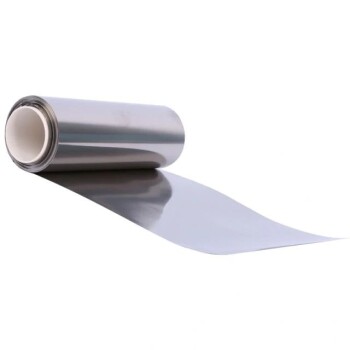
High-Purity Titanium Foil and Sheet for Industrial Applications

High-Purity Titanium Foil and Sheet for Industrial Applications

Titanium is chemically stable, with a density of 4.51g/cm3, which is higher than aluminum and lower than steel, copper, and nickel, but its specific strength ranks first among metals.

High Purity Pure Graphite Crucible for Evaporation

High Purity Pure Graphite Crucible for Evaporation

Vessels for high temperature applications, where materials are kept at extremely high temperatures to evaporate, allowing thin films to be deposited on substrates.

Custom PTFE Teflon Parts Manufacturer for Culture Dish and Evaporation Dish

Custom PTFE Teflon Parts Manufacturer for Culture Dish and Evaporation Dish

The PTFE culture dish evaporating dish is a versatile laboratory tool known for its chemical resistance and high-temperature stability. PTFE, a fluoropolymer, offers exceptional non-stick properties and durability, making it ideal for various applications in research and industry, including filtration, pyrolysis, and membrane technology.


Leave Your Message