Knowledge cvd machine What temperature is chemical vapor deposition? Unlock the Right Process for Your Application
Author avatar

Tech Team · Kintek Solution

Updated 3 months ago

What temperature is chemical vapor deposition? Unlock the Right Process for Your Application


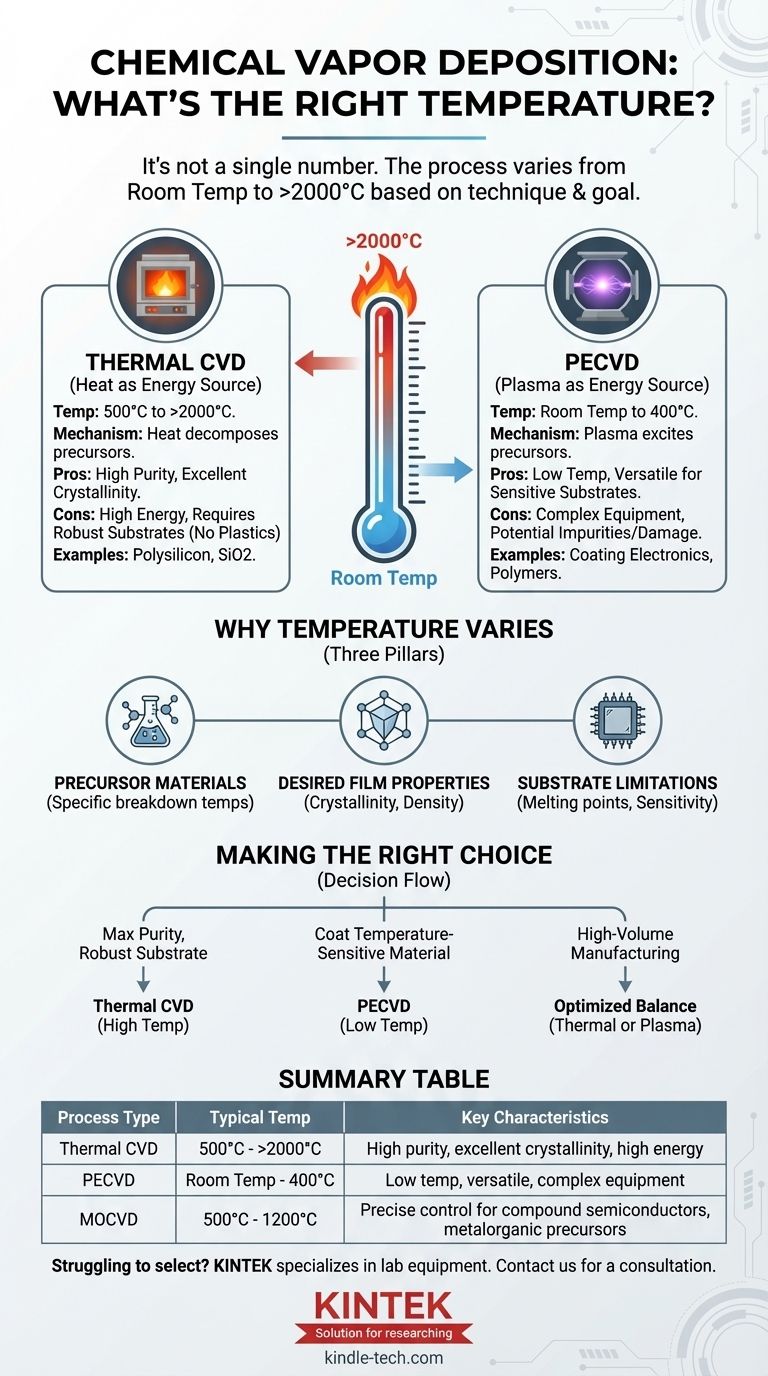
There is no single temperature for chemical vapor deposition (CVD). The process temperature varies dramatically based on the specific technique, the precursor materials used, and the desired properties of the final film. This range can span from near room temperature for plasma-assisted methods to well over 2000°C for high-purity thermal processes.

The core principle of CVD is providing enough energy to initiate a chemical reaction on a substrate's surface. While high temperature is a common way to supply this energy, it is not the only way. Understanding the trade-offs between different energy sources is key to selecting the right process.
What temperature is chemical vapor deposition? Unlock the Right Process for Your Application

The Role of Energy in CVD

Chemical vapor deposition is not a single process but a family of techniques. They all share one goal: to use precursor gases to deposit a solid thin film onto a surface. The "best" temperature is simply the one that provides the right amount of energy for the specific chemical reaction required.

Heat as the Primary Energy Source (Thermal CVD)

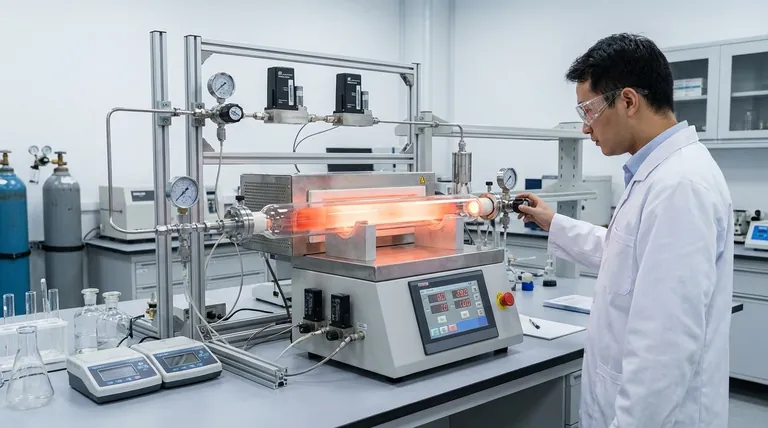
Traditional CVD relies on heat to drive the reaction. The substrate is placed in a chamber and heated to a temperature high enough to cause the precursor gases to decompose and react, forming a solid layer on the surface.

This is the principle behind Thermal CVD, Hot-Filament CVD, and Metalorganic CVD (MOCVD). These methods are often used to create highly pure, crystalline films like the polysilicon used in solar cells or silicon dioxide in microelectronics.

Plasma as an Alternative Energy Source (PECVD)

Plasma-Enhanced Chemical Vapor Deposition (PECVD) is a major advancement that allows for deposition at much lower temperatures. Instead of relying solely on heat, an electric field is used to excite the precursor gases into a plasma state.

This highly energetic plasma provides the energy needed for the chemical reaction to occur. Because the energy comes from the plasma rather than thermal heating of the substrate, the process can run at significantly lower temperatures, often from room temperature to a few hundred degrees Celsius.

Why Temperature Varies So Widely

The required temperature for a CVD process is not an arbitrary number; it's determined by a precise set of physical and chemical constraints.

The Precursor Materials

Every chemical compound has a specific temperature at which it begins to break down or react. The choice of precursor gas is the first factor that dictates the necessary temperature window.

The Desired Film Properties

Temperature directly influences the final properties of the deposited film. Higher temperatures often lead to denser, more crystalline films with higher purity. Lower temperatures might result in an amorphous (non-crystalline) structure, which can be desirable for certain applications.

The Substrate's Limitations

Perhaps the most important practical constraint is the substrate material. You cannot deposit a film at 900°C onto a plastic substrate that melts at 150°C. The need to coat temperature-sensitive materials, like completed electronic circuits or polymers, is a primary driver for using low-temperature PECVD methods.

Understanding the Trade-offs

The choice between a high-temperature and low-temperature process is a critical engineering decision based on a clear set of trade-offs.

High-Temperature CVD (e.g., Thermal CVD)

  • Pros: Typically produces films with very high purity and excellent crystalline quality. The process is often simpler and more controlled for fundamental materials research.
  • Cons: Extremely high energy consumption and requires substrates that can withstand intense heat. This process is unsuitable for coating finished electronics or plastics.

Low-Temperature CVD (e.g., PECVD)

  • Pros: Highly versatile, enabling the coating of temperature-sensitive materials. It can also achieve higher deposition rates for certain materials, increasing manufacturing throughput.
  • Cons: The equipment is more complex. The plasma environment can sometimes introduce impurities or cause damage to the film, and the resulting film quality may be different (e.g., less crystalline) than its high-temperature equivalent.

Making the Right Choice for Your Goal

To determine the appropriate temperature, you must first define your objective. The "right" CVD process is the one that achieves your desired film properties without damaging the substrate.

  • If your primary focus is maximum purity and crystallinity on a robust substrate: A high-temperature thermal CVD process is the conventional and often superior choice.
  • If your primary focus is coating a temperature-sensitive material: A low-temperature PECVD process is not just an option, it is a necessity.
  • If your primary focus is high-volume manufacturing (e.g., solar cells or protective coatings): The decision involves a complex balance of deposition rate, energy cost, and final film performance, leading to highly optimized thermal or plasma systems.

Ultimately, your goal dictates the process, and the process dictates the temperature.

Summary Table:

CVD Process Type Typical Temperature Range Key Characteristics
Thermal CVD 500°C to >2000°C High purity, excellent crystallinity, high energy use
PECVD Room Temp to 400°C Low temp, versatile for sensitive substrates, more complex equipment
MOCVD 500°C to 1200°C Precise control for compound semiconductors, uses metalorganic precursors

Struggling to select the right CVD process for your specific substrate and film requirements? KINTEK specializes in lab equipment and consumables, serving laboratory needs. Our experts can help you navigate the trade-offs between high-temperature and low-temperature techniques to achieve your desired film properties—whether it's maximum purity on a robust substrate or coating a temperature-sensitive material. Contact our team today for a personalized consultation and discover the ideal CVD solution for your research or production goals.

Visual Guide
What temperature is chemical vapor deposition? Unlock the Right Process for Your Application Visual Guide

Related Products

People Also Ask

Related Products

Chemical Vapor Deposition CVD Equipment System Chamber Slide PECVD Tube Furnace with Liquid Gasifier PECVD Machine

Chemical Vapor Deposition CVD Equipment System Chamber Slide PECVD Tube Furnace with Liquid Gasifier PECVD Machine

KT-PE12 Slide PECVD System: Wide power range, programmable temp control, fast heating/cooling with sliding system, MFC mass flow control & vacuum pump.

RF PECVD System Radio Frequency Plasma-Enhanced Chemical Vapor Deposition RF PECVD

RF PECVD System Radio Frequency Plasma-Enhanced Chemical Vapor Deposition RF PECVD

RF-PECVD is an acronym for "Radio Frequency Plasma-Enhanced Chemical Vapor Deposition." It deposits DLC (Diamond-like carbon film) on germanium and silicon substrates. It is utilized in the 3-12um infrared wavelength range.

915MHz MPCVD Diamond Machine Microwave Plasma Chemical Vapor Deposition System Reactor

915MHz MPCVD Diamond Machine Microwave Plasma Chemical Vapor Deposition System Reactor

915MHz MPCVD Diamond Machine and its multi-crystal effective growth, the maximum area can reach 8 inches, the maximum effective growth area of single crystal can reach 5 inches. This equipment is mainly used for the production of large-size polycrystalline diamond films, the growth of long single crystal diamonds, the low-temperature growth of high-quality graphene, and other materials that require energy provided by microwave plasma for growth.

Customer Made Versatile CVD Tube Furnace Chemical Vapor Deposition Chamber System Equipment

Customer Made Versatile CVD Tube Furnace Chemical Vapor Deposition Chamber System Equipment

Get your exclusive CVD furnace with KT-CTF16 Customer Made Versatile Furnace. Customizable sliding, rotating, and tilting functions for precise reactions. Order now!

Microwave Plasma Chemical Vapor Deposition MPCVD Machine System Reactor for Lab and Diamond Growth

Microwave Plasma Chemical Vapor Deposition MPCVD Machine System Reactor for Lab and Diamond Growth

Get high-quality diamond films with our Bell-jar Resonator MPCVD machine designed for lab and diamond growth. Discover how Microwave Plasma Chemical Vapor Deposition works for growing diamonds using carbon gas and plasma.

HFCVD Machine System Equipment for Drawing Die Nano-Diamond Coating

HFCVD Machine System Equipment for Drawing Die Nano-Diamond Coating

The nano-diamond composite coating drawing die uses cemented carbide (WC-Co) as the substrate, and uses the chemical vapor phase method ( CVD method for short ) to coat the conventional diamond and nano-diamond composite coating on the surface of the inner hole of the mold.

Split Chamber CVD Tube Furnace with Vacuum Station Chemical Vapor Deposition System Equipment Machine

Split Chamber CVD Tube Furnace with Vacuum Station Chemical Vapor Deposition System Equipment Machine

Efficient split chamber CVD furnace with vacuum station for intuitive sample checking and quick cooling. Up to 1200℃ max temperature with accurate MFC mass flowmeter control.

Inclined Rotary Plasma Enhanced Chemical Vapor Deposition PECVD Equipment Tube Furnace Machine

Inclined Rotary Plasma Enhanced Chemical Vapor Deposition PECVD Equipment Tube Furnace Machine

Introducing our inclined rotary PECVD furnace for precise thin film deposition. Enjoy automatic matching source, PID programmable temperature control, and high accuracy MFC mass flowmeter control. Built-in safety features for peace of mind.

Multi Heating Zones CVD Tube Furnace Machine Chemical Vapor Deposition Chamber System Equipment

Multi Heating Zones CVD Tube Furnace Machine Chemical Vapor Deposition Chamber System Equipment

KT-CTF14 Multi Heating Zones CVD Furnace - Precise Temperature Control and Gas Flow for Advanced Applications. Max temp up to 1200℃, 4 channels MFC mass flow meter, and 7" TFT touch screen controller.

Cylindrical Resonator MPCVD Machine System Reactor for Microwave Plasma Chemical Vapor Deposition and Lab Diamond Growth

Cylindrical Resonator MPCVD Machine System Reactor for Microwave Plasma Chemical Vapor Deposition and Lab Diamond Growth

Learn about Cylindrical Resonator MPCVD Machine, the microwave plasma chemical vapor deposition method used for growing diamond gemstones and films in the jewelry and semi-conductor industries. Discover its cost-effective advantages over traditional HPHT methods.

Inclined Rotary Plasma Enhanced Chemical Vapor Deposition PECVD Equipment Tube Furnace Machine

Inclined Rotary Plasma Enhanced Chemical Vapor Deposition PECVD Equipment Tube Furnace Machine

Upgrade your coating process with PECVD coating equipment. Ideal for LED, power semiconductors, MEMS and more. Deposits high-quality solid films at low temps.

CVD Diamond for Thermal Management Applications

CVD Diamond for Thermal Management Applications

CVD diamond for thermal management: High-quality diamond with thermal conductivity up to 2000 W/mK, ideal for heat spreaders, laser diodes, and GaN on Diamond (GOD) applications.

Custom CVD Diamond Coating for Lab Applications

Custom CVD Diamond Coating for Lab Applications

CVD Diamond Coating: Superior Thermal Conductivity, Crystal Quality, and Adhesion for Cutting Tools, Friction, and Acoustic Applications

CVD Diamond Dressing Tools for Precision Applications

CVD Diamond Dressing Tools for Precision Applications

Experience the Unbeatable Performance of CVD Diamond Dresser Blanks: High Thermal Conductivity, Exceptional Wear Resistance, and Orientation Independence.

Molybdenum Tungsten Tantalum Evaporation Boat for High Temperature Applications

Molybdenum Tungsten Tantalum Evaporation Boat for High Temperature Applications

Evaporation boat sources are used in thermal evaporation systems and are suitable for depositing various metals, alloys and materials. Evaporation boat sources are available in different thicknesses of tungsten, tantalum and molybdenum to ensure compatibility with a variety of power sources. As a container, it is used for vacuum evaporation of materials. They can be used for thin film deposition of various materials, or designed to be compatible with techniques such as electron beam fabrication.

Hemispherical Bottom Tungsten Molybdenum Evaporation Boat

Hemispherical Bottom Tungsten Molybdenum Evaporation Boat

Used for gold plating, silver plating, platinum, palladium, suitable for a small amount of thin film materials. Reduce the waste of film materials and reduce heat dissipation.

Electron Beam Evaporation Coating Oxygen-Free Copper Crucible and Evaporation Boat

Electron Beam Evaporation Coating Oxygen-Free Copper Crucible and Evaporation Boat

Electron Beam Evaporation Coating Oxygen-Free Copper Crucible enables precise co-deposition of various materials. Its controlled temperature and water-cooled design ensure pure and efficient thin film deposition.

Aluminized Ceramic Evaporation Boat for Thin Film Deposition

Aluminized Ceramic Evaporation Boat for Thin Film Deposition

Vessel for depositing thin films; has an aluminum-coated ceramic body for improved thermal efficiency and chemical resistance. making it suitable for various applications.

Evaporation Boat for Organic Matter

Evaporation Boat for Organic Matter

The evaporation boat for organic matter is an important tool for precise and uniform heating during the deposition of organic materials.

Vacuum Cold Mounting Machine for Sample Preparation

Vacuum Cold Mounting Machine for Sample Preparation

Vacuum Cold Mounting Machine for precise sample prep. Handles porous, fragile materials with -0.08MPa vacuum. Ideal for electronics, metallurgy, and failure analysis.


Leave Your Message