To synthesize graphene via Chemical Vapor Deposition (CVD), you can utilize carbon precursors in any of the three states of matter: solid, liquid, or gaseous compounds. While gaseous sources like methane are the most prevalent in standard applications, the fundamental requirement is simply a material that can decompose to release carbon atoms for deposition.
Core Takeaway: The versatility of the CVD process allows for the use of solid, liquid, or gaseous carbon sources. However, the specific precursor chosen will dictate the processing conditions—such as temperature and delivery method—and heavily influence the final quality and grain structure of the graphene film.
The Mechanism of Carbon Deposition
To understand why different sources can be used, it is essential to understand how the CVD process converts a raw material into a graphene sheet.
Adsorption and Decomposition
Regardless of the source material's initial state, the chemical principle remains consistent. Carbon precursor molecules adsorb (adhere) onto the surface of a catalyst substrate.
Once on the surface, these precursors decompose. This breakdown releases specific carbon species that act as the fundamental building blocks, rearranging themselves into the hexagonal lattice structure of graphene.
The Role of the Catalyst
The substrate, typically a metal foil like copper (Cu), plays a dual role.
First, it acts as a catalyst, lowering the energy barrier required for the chemical reaction to occur. Second, the specific nature of the metal dictates the deposition mechanism, which is a critical factor in determining the quality of the final graphene product.
Categorizing the Carbon Sources
Gaseous Precursors
Gaseous compounds are the most commonly cited sources for producing large-area, monolayer graphene sheets.
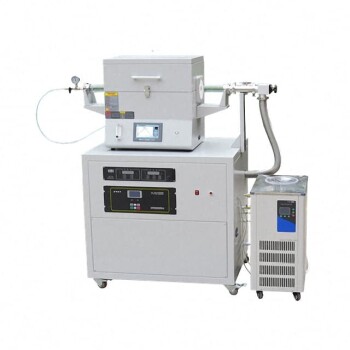
Methane is the standard precursor for this method. It is typically introduced into a tubular furnace alongside hydrogen and argon gases.
In a thermal CVD setup, the furnace is heated to between 900 and 1000°C, causing the methane gas to decompose and deposit carbon onto the metal film.
Solid and Liquid Precursors
While gases are popular for their ease of flow control, they are not the only option. Materials containing carbon in solid or liquid forms are also employed as precursors.
The use of these alternative states requires different methods of introduction into the chamber, but they function on the same principle: providing a carbon-rich feedstock that can be broken down to facilitate growth on the catalyst surface.
Understanding the Trade-offs
Selecting a carbon source and a CVD method involves balancing temperature constraints against material quality.
Thermal CVD vs. PECVD
The state of the precursor and the desired processing temperature often determine the type of CVD employed.
Thermal CVD relies on high temperatures (thermal decomposition) to break down the precursor. This method generally yields relatively high-quality graphene but requires substrates that can withstand extreme heat.
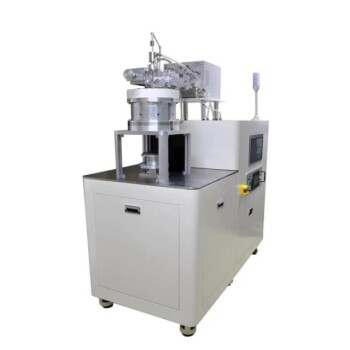
Plasma-Enhanced CVD (PECVD) creates a plasma (ionic) state within a vacuum chamber to drive the chemical reactions. This allows for graphene deposition at significantly lower temperatures, expanding the range of usable substrates.
Controlling Layer Formation
The process does not end with the choice of carbon source; thermal management is equally critical.
After the carbon is deposited, the chamber typically undergoes a fast cooling rate.
This rapid drop in temperature is necessary to suppress the formation of multiple graphene layers, ensuring the isolation of the desired single-layer graphene sheet.
Making the Right Choice for Your Goal
The "best" carbon source depends entirely on your specific synthesis requirements and constraints.
- If your primary focus is producing high-quality, large-area monolayers: Utilize gaseous precursors like methane in a Thermal CVD setup, as this is the standard for isolating uniform graphene sheets.
- If your primary focus is processing at lower temperatures: Investigate Plasma-Enhanced CVD (PECVD), which uses plasma to drive the reaction rather than relying solely on the high heat required to decompose standard precursors.
Successful graphene synthesis relies on matching the state of your carbon source with the appropriate thermal or plasma-based activation method.
Summary Table:
| Precursor State | Common Examples | CVD Method | Typical Temperature | Key Advantages |
|---|---|---|---|---|
| Gaseous | Methane (CH4) | Thermal CVD / PECVD | 900°C - 1000°C | Standard for high-quality, large-area monolayers |
| Solid | PMMA, Polymers | Thermal CVD | Variable | Ease of handling; alternative feedstock options |
| Liquid | Benzene, Ethanol | Thermal CVD | Variable | High carbon density; diverse chemical precursors |
| Any | All states | PECVD | Lower Temperatures | Enables use of heat-sensitive substrates |
Elevate Your Graphene Research with KINTEK Precision
Choosing the right carbon source is only half the battle—high-performance synthesis requires reliable equipment. KINTEK specializes in advanced laboratory solutions designed for the most demanding material science applications. Whether you are scaling up production with our CVD and PECVD systems, or need precise material processing with our high-temperature furnaces, crushing and milling systems, and hydraulic presses, we provide the tools to ensure uniform, high-quality graphene growth.
From high-pressure reactors to essential PTFE and ceramic consumables, KINTEK is your partner in laboratory excellence. Let our experts help you select the ideal configuration for your research goals.
➡️ Contact KINTEK today to optimize your lab's performance!
Related Products
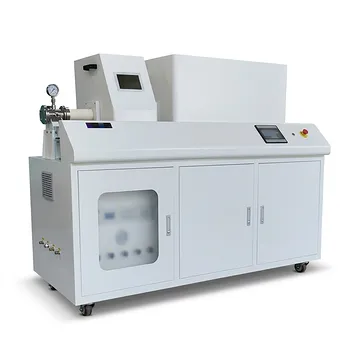
- Chemical Vapor Deposition CVD Equipment System Chamber Slide PECVD Tube Furnace with Liquid Gasifier PECVD Machine
- Customer Made Versatile CVD Tube Furnace Chemical Vapor Deposition Chamber System Equipment
- HFCVD Machine System Equipment for Drawing Die Nano-Diamond Coating
- Split Chamber CVD Tube Furnace with Vacuum Station Chemical Vapor Deposition System Equipment Machine
- Multi Heating Zones CVD Tube Furnace Machine Chemical Vapor Deposition Chamber System Equipment
People Also Ask
- What are the advantages of chemical vapor deposition? Achieve Superior Thin Films for Your Lab
- What types of substrates are used in CVD to facilitate graphene films? Optimize Graphene Growth with the Right Catalyst
- What is the chemical vapor deposition growth process? Build Superior Thin Films from the Atom Up
- How expensive is chemical vapor deposition? Understanding the True Cost of High-Performance Coating
- Why is Chemical Vapor Deposition (CVD) equipment uniquely suited for constructing hierarchical superhydrophobic structures?