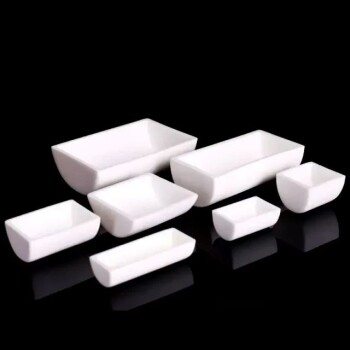
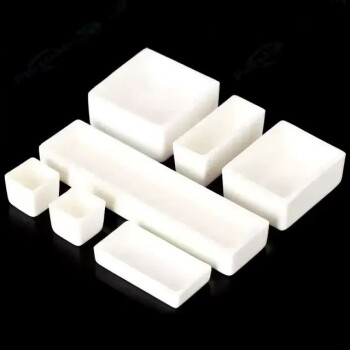
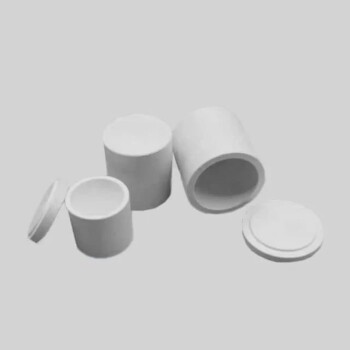
Alumina crucibles perform a critical dual function in the high-temperature synthesis of Al-LLZ lithium garnet. While they serve as a standard heat-resistant vessel, their unique value lies in acting as a passive doping source that introduces aluminum ions ($Al^{3+}$) directly into the material during sintering.
Core Takeaway The interaction between the crucible and the reactants is not a contamination defect, but a beneficial feature for this specific material. The diffusion of aluminum from the crucible stabilizes the cubic phase of the lithium garnet, which is the essential requirement for achieving high lithium-ion conductivity in solid-state electrolytes.
The Role of Passive Aluminum Doping
Stabilizing the Cubic Phase
The primary chemical reason for using alumina crucibles with Al-LLZ is to influence the crystal structure.
During high-temperature processing, aluminum ions diffuse from the crucible walls into the lithium garnet material.
This introduction of $Al^{3+}$ acts as a stabilizer for the cubic phase structure of the garnet.
Enhancing Ionic Conductivity
The phase of the material dictates its performance.
By ensuring the material forms (and maintains) a cubic phase rather than a tetragonal one, the aluminum doping significantly enhances lithium-ion conductivity.
Without this stabilization, the material would likely exhibit lower conductivity, rendering it less effective as a solid electrolyte.
Essential Containment Properties
Thermal and Chemical Stability
Beyond doping, the crucible must withstand the rigors of synthesis.
Alumina offers excellent resistance to thermal shock and remains stable at the high temperatures required for sintering (often exceeding 900°C to 1150°C).
Preventing Furnace Contamination
The crucible acts as a barrier between the reactants and the furnace environment.
It prevents the corrosive molten materials from reacting with the furnace lining or leaking into the heating elements.
This isolation is critical for maintaining the overall purity of the synthesis environment, even while the crucible itself participates in doping.
Understanding the Trade-offs
The Risk of Over-Reaction
While aluminum diffusion is desired for Al-LLZ, it is a "passive" process that can be difficult to control precisely.
In scenarios where pure LLZ (without aluminum) is required, alumina crucibles can actually be detrimental.
Supplementary data suggests that for non-doped electrolytes, reaction with alumina can create impurity phases (such as $La_2Zr_2O_7$) that impair conductivity.
Managing Lithium Volatilization
High-temperature sintering brings the risk of lithium loss through volatilization.
While the alumina crucible helps by containing the sample, it does not stop evaporation on its own.
To counter this, the setup often requires covering the sample with "mother powder" (sacrificial powder of the same composition) inside the crucible to create a lithium-rich atmosphere and maintain stoichiometric balance.
Making the Right Choice for Your Goal
- If your primary focus is synthesizing Al-LLZ: Use an alumina crucible to leverage the passive aluminum doping that stabilizes the high-conductivity cubic phase.
- If your primary focus is synthesizing pure, undoped LLZ: Avoid direct contact with alumina crucibles or use a specialized isolation substrate to prevent unwanted aluminum diffusion and impurity phases.
- If your primary focus is stoichiometry control: Regardless of the crucible material, ensure you use a mother powder cover to suppress lithium volatilization at high temperatures.
The alumina crucible in this context is not merely a container; it is an active participant in the chemical engineering of the final solid electrolyte.
Summary Table:
| Feature | Impact on Al-LLZ Synthesis |
|---|---|
| Passive Al Doping | Diffuses Al³⁺ ions to stabilize the high-conductivity cubic phase |
| Phase Control | Prevents the formation of the less conductive tetragonal phase |
| Thermal Stability | Withstands sintering temperatures between 900°C and 1150°C |
| Chemical Barrier | Protects furnace elements from corrosive lithium-based reactants |
| Contamination Control | High-purity alumina prevents unintended impurity introduction |
Elevate Your Battery Research with KINTEK Precision Ceramics
Achieving the perfect cubic phase in Al-LLZ electrolytes requires superior thermal stability and chemical purity. KINTEK specializes in high-performance alumina crucibles, ceramics, and high-temperature furnaces designed to meet the rigorous demands of solid-state battery synthesis.
From advanced battery research tools to muffle and tube furnaces for precise sintering, we provide the essential equipment and consumables to optimize your material performance.
Ready to enhance your lab's efficiency and results? Contact KINTEK today to discuss our range of laboratory solutions and high-purity consumables tailored for your specific research goals.
Related Products
- Arc-Shaped Alumina Ceramic Crucible High Temperature Resistant for Engineering Advanced Fine Ceramics
- Alumina Al2O3 Ceramic Crucible Semicircle Boat with Lid for Engineering Advanced Fine Ceramics
- Engineering Advanced Fine Ceramics Alumina Al2O3 Crucible With Lid Cylindrical Laboratory Crucible
- Engineering Advanced Fine Ceramics Alumina Crucibles (Al2O3) for Thermal Analysis TGA DTA
- Engineering Advanced Fine Alumina Al2O3 Ceramic Crucible for Laboratory Muffle Furnace
People Also Ask
- Why Use Alumina Crucibles & Powder Burial for NaSICON? Ensure Phase Purity and Prevent Elemental Volatilization
- What is the primary purpose of using alumina crucibles for LLTO ceramics? Optimize Your High-Temperature Sintering
- Why are alumina crucibles and mother powder essential for LATP sintering? Optimize Your Solid Electrolyte Performance
- Why are high-purity alumina crucibles used for liquid lead corrosion experiments? Ensure Data Accuracy at 550°C
- Primary considerations for choosing alumina crucibles and quartz tubes in indium intercalation: Ensure Material Purity