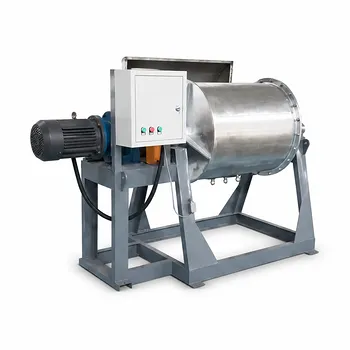
High-energy ball milling and extrusion molding are the critical manufacturing steps required to engineer the internal microstructure of Oxide Dispersion Strengthened (ODS) alloys. Ball milling is the only method capable of forcing a uniform distribution of nanometer-sized oxide particles into a metal matrix, while extrusion molding is necessary to compress this powder into a solid, void-free form capable of surviving extreme nuclear environments.
The core purpose of these combined processes is to overcome the natural limitations of metals. Ball milling establishes high-temperature strength through nanoscopic dispersion, and extrusion molding guarantees structural integrity by eliminating microscopic voids.
The Role of High-Energy Ball Milling
Forcing Nanoscopic Dispersion
Standard mixing methods cannot adequately disperse oxide particles at the scale required for Generation IV reactors. High-energy ball milling is used to mechanically force nanometer-sized oxide particles (such as yttrium oxide) to distribute evenly throughout the metal matrix.
The Mechanism of Fracture and Cold Welding
This process works through a violent cycle of repeated fracturing and cold welding of powder particles. This high-intensity mechanical energy ensures that the oxide nanoparticles are not just mixed, but embedded within the ferritic matrix at an atomic level.
Increasing Reactivity for Sintering
Beyond simple mixing, ball milling introduces significant microscopic defects into the powder. These defects increase the reactivity of the material, establishing a necessary chemical foundation for the subsequent densification and sintering stages.
Achieving High-Temperature Strength
The ultimate goal of this dispersion is to improve the alloy's performance under stress. The uniform presence of these oxide particles is the primary mechanism that grants ODS alloys their exceptional high-temperature strength and resistance to radiation creep.
The Necessity of Extrusion Molding
Eliminating Internal Micropores
Once the powder is milled, it remains a loose collection of particles containing internal voids. High-temperature extrusion molding is required to subject the mixed powders to extreme pressure, effectively squeezing out and eliminating internal micropores.
Solidification and Shaping
This process transforms the loose powder into a solid, cohesive mass. It allows for the production of dense ODS alloy tubes and rods with the specific geometries needed for reactor components.
Withstanding Harsh Thermal Environments
The density achieved through extrusion is non-negotiable for safety. Only a fully solidified, pore-free material can withstand the harsh thermal and radiation environments found inside the cores of fast reactors.
Understanding the Trade-offs
Energy Intensity and Cost
These processes transform the material significantly, but they are energy-intensive and complex compared to standard casting. The requirement for high-intensity mechanical energy during milling and high pressure during extrusion increases the production cost and technical difficulty.
Managing Microstructural Defects
While defects introduced during milling increase reactivity for sintering, they must be carefully managed. The process relies on a delicate balance: inducing enough defects to facilitate bonding and dispersion without compromising the final material's stability.
Making the Right Choice for Your Goal
While both processes are standard for ODS production, understanding their specific contributions helps in optimizing parameters for specific reactor needs.
- If your primary focus is Radiation Creep Resistance: Prioritize the ball milling parameters, as the uniformity of the nanometer-sized oxide dispersion is the direct driver of high-temperature strength.
- If your primary focus is Structural Integrity and Safety: Ensure rigorous control over extrusion molding pressure and temperature, as this step is responsible for eliminating the micropores that lead to component failure.
By strictly adhering to these two processes, you ensure the production of an alloy that is not merely mixed, but atomically engineered to endure the extreme conditions of the next generation of nuclear power.
Summary Table:
| Process | Key Function | Benefit for ODS Alloys |
|---|---|---|
| High-Energy Ball Milling | Uniformly disperses nanometer-sized oxide particles | Enhances high-temperature strength and radiation creep resistance |
| Extrusion Molding | Compresses powders under extreme pressure | Eliminates internal micropores to ensure dense, void-free structural integrity |
Elevate Your Material Research with KINTEK
Producing high-performance ODS alloys for Generation IV reactors requires precision and reliability. KINTEK specializes in advanced laboratory equipment designed for extreme material engineering. Our high-energy crushing and milling systems ensure atomic-level dispersion, while our robust hydraulic presses (including hot and isostatic models) and high-temperature furnaces provide the critical densification your research demands.
From high-temperature high-pressure reactors to specialized ceramics and crucibles, we provide the end-to-end solutions needed to withstand the harshest thermal environments. Contact KINTEK today to discover how our comprehensive range of equipment and consumables can optimize your production of next-generation alloys.
References
- L. Malerba, Pierre-François Giroux. Advances on GenIV structural and fuel materials and cross-cutting activities between fission and fusion. DOI: 10.1051/epjn/2019021
This article is also based on technical information from Kintek Solution Knowledge Base .
Related Products
- High Energy Planetary Ball Mill Milling Machine for Laboratory
- High-Energy Omnidirectional Planetary Ball Mill Milling Machine for Laboratory
- High Energy Planetary Ball Mill Machine for Laboratory Horizontal Tank Type
- High Energy Planetary Ball Mill for Laboratory Horizontal Tank Type Milling Machine
- High Energy Planetary Ball Mill Milling Machine for Laboratory
People Also Ask
- What role do planetary ball mills and zirconia media play in LLZT preparation? Optimize Your Solid Electrolyte Research
- What is the primary function of a planetary ball mill? Mastering SiC/Al Composite Mixing for Homogeneity
- What is the primary purpose of using a planetary ball mill for LAGP? Achieve High-Purity Solid-State Electrolytes
- What role does a planetary ball mill play in the preparation of LGVO powders? Precision Refinement for Aerosol Deposition
- What is the function of a planetary ball mill in the preparation of high-entropy rare earth silicate multi-phase ceramics?