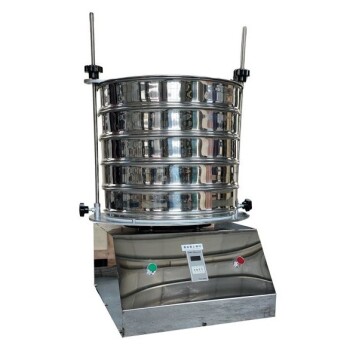
High-precision crushing and sieving systems are the defining factor in the performance of aluminosilicate additives. They are required to strictly control particle size distribution, ensuring the additives possess the massive specific surface area needed to chemically react with and capture gas-phase alkali metals like potassium and sodium in the brief residence time of a pulverized coal boiler.
The core function of these systems is to maximize reaction kinetics. By reducing additives to extremely fine, uniform particles, you exponentially increase the contact frequency between the solid additive and volatile alkali vapors, ensuring efficient pollutant capture.
The Critical Role of Particle Size
Maximizing Specific Surface Area
The primary objective of crushing and sieving is to dramatically increase the specific surface area of the aluminosilicate material.
Chemical reactions occur on the surface of the particle. The finer the particle, the more surface area is available per unit of mass, creating more "active sites" for chemical interaction.
Enhancing Reaction Kinetics
In a pulverized coal boiler, gas streams move at high speeds, leaving little time for chemical reactions.
High-precision processing ensures particles are fine enough to achieve rapid reaction kinetics. This speed is essential for the additive to effectively bond with gas-phase alkali metals (potassium and sodium vapors) before they exit the reaction zone.
Ensuring Uniform Distribution
Sieving systems prevent oversized particles from entering the furnace.
A controlled, narrow particle size distribution ensures that the additive disperses uniformly within the pulverized coal flow. This maximizes the probability that an additive particle will come into contact with the target alkali vapors.
Material Characteristics and Efficiency
Leveraging Low Hardness
The requirement for high precision is made economically feasible by the physical properties of aluminosilicates.
These materials typically have a low Mohs hardness of 1-2, rendering them soft and easy to process. Because the material is naturally brittle, the grinding process is highly efficient, allowing operators to achieve extreme fineness without incurring prohibitive energy costs or equipment wear.
Cost-Effective Optimization
Because the material is easy to grind, the focus shifts from "can we grind it?" to "how precisely can we size it?"
High-precision systems capitalize on this softness to produce a consistent product that guarantees uniform distribution and rapid reaction rates in high-velocity gas streams.
Understanding the Trade-offs
The Risk of Inadequate Processing
Without high-precision sieving, particle sizes vary wildly.
Large particles suffer from low specific surface area and "internal diffusion limitations," meaning the inner volume of the particle never reacts with the gas. This leads to wasted material and inefficient alkali capture.
Balancing Fineness and Handling
While finer particles react faster, they must be consistent.
In experimental and industrial settings, maintaining a specific range (e.g., similar to the 90-300 μm range used in analogous coal additive studies) is vital for obtaining stable combustion data. Inconsistent sizing leads to unpredictable boiler performance and unreliable capture rates.
Making the Right Choice for Your Goal
- If your primary focus is Pollution Control: Prioritize systems that produce the finest possible mesh size to maximize surface area for trapping sodium and potassium vapors.
- If your primary focus is Process Efficiency: Leverage the low Mohs hardness of the material to run high-throughput grinding cycles without overloading equipment.
- If your primary focus is Data Accuracy: Ensure your sieving system enforces a strict upper and lower size limit to eliminate diffusion limitations and ensure consistent reaction kinetics.
High-precision processing transforms raw aluminosilicate from a passive mineral into a highly active chemical agent capable of cleaning boiler emissions.
Summary Table:
| Factor | Requirement | Impact on Performance |
|---|---|---|
| Particle Size | Extremely fine & uniform | Maximizes specific surface area for faster chemical reactions. |
| Distribution | Narrow size range | Ensures uniform dispersion in high-velocity gas streams. |
| Reaction Kinetics | High precision | Enables rapid capture of potassium and sodium vapors within brief residence times. |
| Material Hardness | Mohs 1-2 (Low) | Allows for cost-effective, high-precision grinding with minimal wear. |
| Sieving Accuracy | Strict upper/lower limits | Prevents internal diffusion limitations and ensures predictable boiler data. |
Transform Your Material Preparation with KINTEK Precision Solutions
Achieving the perfect particle size distribution is critical for the performance of aluminosilicate additives and advanced material research. KINTEK specializes in high-performance laboratory equipment designed for accuracy and durability. Our comprehensive range of crushing and milling systems, sieving equipment, and pellet presses ensures your samples meet the most rigorous standards for specific surface area and reaction kinetics.
Beyond sample preparation, KINTEK offers a full suite of laboratory solutions, including:
- High-temperature furnaces (muffle, tube, vacuum, and CVD) for thermal processing.
- High-pressure reactors and autoclaves for complex chemical synthesis.
- Battery research tools and cooling solutions like ULT freezers and freeze dryers.
Ready to elevate your research and process efficiency? Contact our experts today to find the ideal equipment for your laboratory needs and experience the KINTEK advantage in precision engineering.
References
- Izabella Maj, Krzysztof Matus. Aluminosilicate Clay Minerals: Kaolin, Bentonite, and Halloysite as Fuel Additives for Thermal Conversion of Biomass and Waste. DOI: 10.3390/en16114359
This article is also based on technical information from Kintek Solution Knowledge Base .
Related Products
- Engineering Advanced Fine Ceramics Alumina Al2O3 Crucible With Lid Cylindrical Laboratory Crucible
- Advanced Engineering Fine Ceramics Alumina Ceramic Saggar for Fine Corundum
- Laboratory Test Sieves and Sieving Machines
- Engineering Advanced Fine Ceramics Alumina Crucibles (Al2O3) for Thermal Analysis TGA DTA
People Also Ask
- Why are high-purity alumina crucibles used for liquid lead corrosion experiments? Ensure Data Accuracy at 550°C
- Why are alumina crucibles and mother powder essential for LATP sintering? Optimize Your Solid Electrolyte Performance
- What is the primary purpose of using alumina crucibles for LLTO ceramics? Optimize Your High-Temperature Sintering
- Why Use Alumina Crucibles & Powder Burial for NaSICON? Ensure Phase Purity and Prevent Elemental Volatilization
- Why are alumina crucibles used as containers during the tungsten diffusion coating process on diamond surfaces?