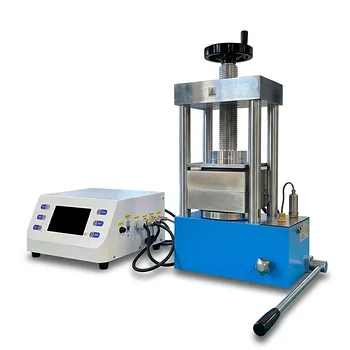
High-precision laboratory hydraulic presses are essential for converting PHBV polymer powder into uniform, defect-free test specimens. By applying constant and controllable pressure, these machines ensure the material achieves uniform internal density and completely eliminates micro-bubbles, which is a prerequisite for obtaining accurate mechanical and thermal data.
Core Takeaway
The validity of material testing data is entirely dependent on the quality of the sample preparation. A high-precision hydraulic press removes variables—specifically density fluctuations and air voids—to ensure that measured properties like tensile strength reflect the actual material, not flaws in the manufacturing of the test bar.
The Critical Role of Sample Preparation
Transforming Powder to Solid
To test PHBV (polyhydroxybutyrate-co-valerate), the raw material typically starts as an extracted polymer powder.
This powder must be consolidated into a solid form, such as a thin sheet or a standard test bar.
A hydraulic press provides the necessary force to compress these loose particles into a cohesive, solid mass.
Achieving Uniform Internal Density
The primary challenge in creating these samples is ensuring consistency throughout the material.
High-precision presses apply uniform axial pressure, ensuring that the density of the sample is identical at every point.
Without this uniformity, the material would exhibit weak spots, leading to skewed test results.
Eliminating Micro-Defects
Air pockets and micro-bubbles are disastrous for mechanical testing.
They act as stress concentrators, causing the sample to fail prematurely during tensile or impact testing.
The controllable pressure of a high-precision press forces air out and compacts the material, eliminating these structural voids.
Ensuring Data Integrity
Standardizing Mechanical Metrics
Once the sample is pressed, it undergoes testing for properties such as tensile strength and elongation at break.
Accurate calculations for these metrics assume a solid, continuous cross-section of material.
The press ensures the physical reality of the sample matches the theoretical assumptions used in the calculations.
Enhancing Reproducibility
Scientific research demands that results can be repeated.
Laboratory presses are preferred because they meet rigorous demands for precision, allowing researchers to apply the exact same pressure profile to every sample.
This consistency creates a baseline that allows researchers to compare different batches of PHBV with confidence.
Understanding the Trade-offs
Equipment Cost vs. Data Quality
High-precision hydraulic presses are significant investments compared to manual or lower-grade alternatives.
However, using lower-precision equipment introduces interfacial contact resistance or density gradients that compromise data.
While the initial cost is higher, the durability and "long life in the lab" often offset the expense by ensuring long-term consistency.
Complexity of Operation
Achieving the perfect sample often requires precise control over pressure ramp rates and dwell times.
Operators must be trained to manage these variables; incorrect pressure settings can lead to under-consolidation or excessive material deformation.
Making the Right Choice for Your Goal
- If your primary focus is mechanical accuracy: Prioritize a press with programmable pressure cycles to ensure the total elimination of micro-bubbles and maximum density.
- If your primary focus is comparing material formulations: Ensure your press offers high reproducibility to rule out sample preparation as a variable between different PHBV batches.
Ultimately, the hydraulic press is not just a molding tool; it is the gatekeeper of your data's reliability.
Summary Table:
| Key Feature | Benefit for PHBV Testing | Impact on Data |
|---|---|---|
| Uniform Axial Pressure | Achieves consistent internal density | Eliminates weak spots and skewed results |
| High-Precision Control | Removes air pockets and micro-bubbles | Prevents premature failure during stress tests |
| Programmable Cycles | Ensures high reproducibility between batches | Standardizes metrics for tensile and impact testing |
| Structural Consolidation | Converts raw powder into cohesive solid forms | Matches physical samples to theoretical models |
Elevate Your Research with Precision Sample Preparation
Don't let sample preparation flaws compromise your data integrity. KINTEK specializes in high-performance laboratory equipment designed for the most demanding material science applications. Our comprehensive range of laboratory hydraulic presses (pellet, hot, and isostatic) ensures your PHBV samples achieve the uniform density and structural perfection required for accurate mechanical and thermal analysis.
Beyond sample preparation, KINTEK offers a full suite of research tools, including:
- High-Temperature Furnaces (Muffle, Vacuum, and Tube) for thermal processing.
- Crushing, Milling, and Sieving Systems for precise powder preparation.
- Advanced Reactors and Autoclaves for chemical synthesis.
- Battery Research Tools and Consumables for cutting-edge energy studies.
Maximize your lab's efficiency and ensure reproducible results with KINTEK's durable, high-precision solutions. Contact our technical experts today to find the perfect press for your application!
References
- Angela Longo, Carlo Giuseppe Rizzello. Bioplastic Production from Agri-Food Waste through the Use of Haloferax mediterranei: A Comprehensive Initial Overview. DOI: 10.3390/microorganisms12061038
This article is also based on technical information from Kintek Solution Knowledge Base .
Related Products
- Automatic High Temperature Heated Hydraulic Press Machine with Heated Plates for Lab
- Manual High Temperature Heated Hydraulic Press Machine with Heated Plates for Lab
- Automatic Laboratory Hydraulic Press for XRF & KBR Pellet Press
- Laboratory Hydraulic Press Lab Pellet Press Machine for Glove Box
- Heated Hydraulic Press Machine with Heated Plates for Vacuum Box Laboratory Hot Press
People Also Ask
- Why is a heated hydraulic press used for warm pressing NASICON green tapes? Optimize Your Solid Electrolyte Density
- What is a heated hydraulic press used for? Essential Tool for Curing, Molding, and Laminating
- Why is a heated laboratory hydraulic press necessary for composite laminates? Achieve Void-Free Structural Integrity
- What is a hot hydraulic press? Harness Heat and Pressure for Advanced Manufacturing
- What role does a heated hydraulic press play in Cold Sintering (CSP)? Enhancing LATP-Halide Densification