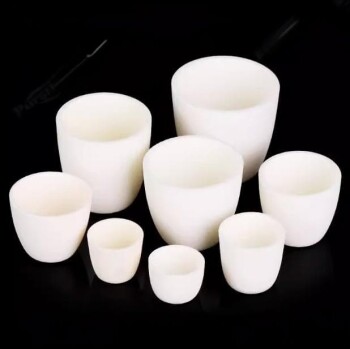
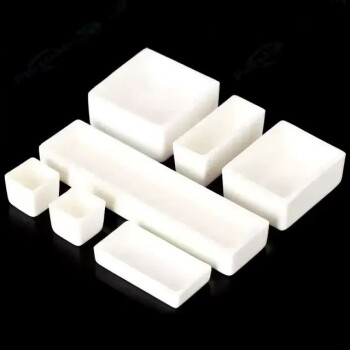
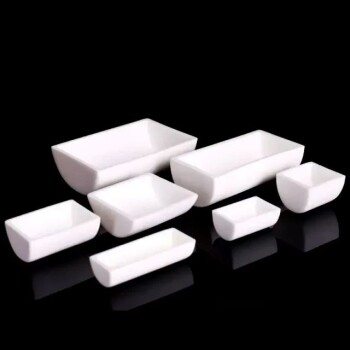
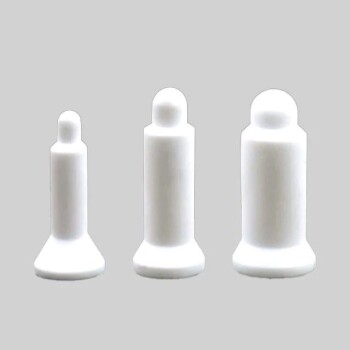
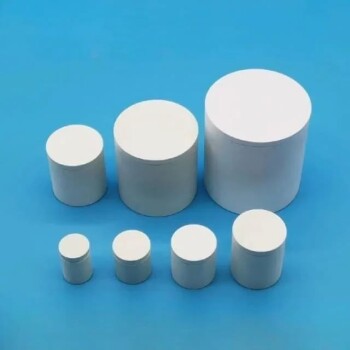
High-purity alumina crucibles are the definitive choice for testing Liquid Antimony Anode Solid Oxide Fuel Cells (LAA-SOFC) because they provide an inert containment vessel that withstands the aggressive nature of molten antimony.
They are explicitly designed to hold metal antimony powder as it transitions into a molten liquid anode bath, preventing the liquid metal from corroding the container or leaking during high-temperature operations.
The Bottom Line: Success in LAA-SOFC testing relies on isolating the anode reaction; high-purity alumina ensures the liquid antimony interacts only with the fuel and electrolyte, not the container, safeguarding both data integrity and laboratory safety.
The Critical Role of Chemical Inertness
Preventing Molten Metal Reactions
The primary challenge in LAA-SOFC testing is managing the liquid antimony anode.
Antimony is heated until it melts (approximately 630°C) and is often maintained at operating temperatures around 750°C.
High-purity alumina possesses excellent high-temperature chemical stability, ensuring it does not react with this molten bath.
Ensuring Experimental Purity
If a crucible reacts with the liquid anode, it introduces impurities into the system.
By using high-purity alumina, you ensure a pure anode environment.
This guarantees that the chemical behavior observed—specifically the contact and reaction between fuels (like coal powder) and the liquid anode—is authentic and not skewed by container contamination.
Thermal Durability and Safety
Withstanding Thermal Shock
The testing environment involves significant temperature shifts, moving from room temperature to an operational range of 750°C.
High-purity alumina offers exceptional thermal shock resistance.
This property is vital for preventing the crucible from cracking or shattering during the rapid heating required to melt the antimony powder.
Eliminating Leakage Risks
A compromised vessel in a vertical tube furnace presents a severe safety hazard.
Because alumina maintains its structural integrity at these elevated temperatures, it effectively prevents molten antimony from leaking.
This containment is critical for protecting the heating elements of the furnace and ensuring the safety of the operator.
Common Pitfalls and Considerations
The Necessity of "High Purity"
It is critical to distinguish between standard technical ceramics and high-purity alumina.
Lower-grade ceramics may contain binders or impurities that can leach out at 750°C or react with the aggressive molten antimony.
Using a vessel with insufficient purity compromises the chemical inertness required for accurate electrochemical testing.
Thermal limits
While alumina has excellent thermal stability, it functions within a specific thermal window optimized for these cells.
The material is selected specifically to remain stable at the 750°C operating temperature; pushing significantly beyond the rated temperatures of specific crucible grades can still risk structural failure.
Making the Right Choice for Your Goal
When setting up your LAA-SOFC experiment, your material selection defines the reliability of your results.
- If your primary focus is Experimental Accuracy: Prioritize high-purity alumina to ensure that no foreign metallic impurities or container reactants alter the electrochemical performance of the liquid anode.
- If your primary focus is Laboratory Safety: Rely on high-purity alumina to prevent containment failure and the hazardous leakage of molten antimony into the furnace heating chamber.
High-purity alumina is not just a container; it is a critical control variable that stabilizes the entire LAA-SOFC testing environment.
Summary Table:
| Feature | High-Purity Alumina Benefit | Impact on LAA-SOFC Testing |
|---|---|---|
| Chemical Stability | Resistant to molten antimony at 750°C | Prevents anode contamination and container corrosion |
| Thermal Resistance | High thermal shock resistance | Prevents cracking during rapid heating of antimony powder |
| Material Purity | Zero binders or reactive impurities | Guarantees authentic electrochemical data integrity |
| Structural Integrity | Excellent high-temperature strength | Eliminates leakage risks into furnace heating elements |
Elevate Your Fuel Cell Research with KINTEK Precision
Don't let container contamination compromise your LAA-SOFC data or laboratory safety. KINTEK specializes in high-performance laboratory equipment and consumables, providing the high-purity alumina crucibles and ceramic components essential for aggressive molten metal environments.
Beyond specialized ceramics, we offer a comprehensive range of thermal and processing solutions, including:
- High-Temperature Furnaces: Muffle, tube, vacuum, and atmosphere-controlled systems.
- Advanced Reactors: High-temperature high-pressure reactors and autoclaves.
- Electrochemical Tools: Electrolytic cells, electrodes, and battery research consumables.
- Sample Preparation: Crushing, milling, and hydraulic pellet presses.
Ready to optimize your high-temperature experiments? Contact our technical experts today to find the perfect materials and equipment for your specific research goals.
References
- Yidong Jiang, Ningsheng Cai. Fabrication and performance of atmospheric plasma sprayed solid oxide fuel cells with liquid antimony anodes. DOI: 10.1007/s40789-021-00430-8
This article is also based on technical information from Kintek Solution Knowledge Base .
Related Products
- Arc-Shaped Alumina Ceramic Crucible High Temperature Resistant for Engineering Advanced Fine Ceramics
- Engineering Advanced Fine Alumina Al2O3 Ceramic Crucible for Laboratory Muffle Furnace
- Engineering Advanced Fine Ceramics Alumina Al2O3 Crucible With Lid Cylindrical Laboratory Crucible
- Engineering Advanced Fine Ceramics Alumina Crucibles (Al2O3) for Thermal Analysis TGA DTA
- Alumina Al2O3 Ceramic Crucible Semicircle Boat with Lid for Engineering Advanced Fine Ceramics
People Also Ask
- Why Use Alumina Crucibles & Powder Burial for NaSICON? Ensure Phase Purity and Prevent Elemental Volatilization
- What is the primary purpose of using alumina crucibles for LLTO ceramics? Optimize Your High-Temperature Sintering
- Why are alumina crucibles and mother powder essential for LATP sintering? Optimize Your Solid Electrolyte Performance
- Why are high-purity alumina crucibles used for liquid lead corrosion experiments? Ensure Data Accuracy at 550°C
- Primary considerations for choosing alumina crucibles and quartz tubes in indium intercalation: Ensure Material Purity