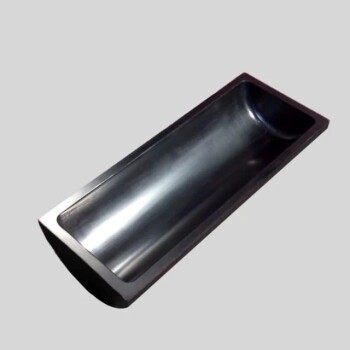
Knowledge Why are magnesia crucibles selected for FeCrAl smelting? Ensure Purity & Stability in High-Temp Metal Casting
Author avatar

Tech Team · Kintek Solution

Updated 17 hours ago

Why are magnesia crucibles selected for FeCrAl smelting? Ensure Purity & Stability in High-Temp Metal Casting


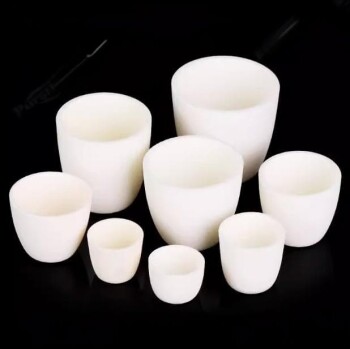
Magnesia crucibles are the definitive choice for smelting FeCrAl alloys because they offer a critical combination of extreme heat resistance and chemical inertness. When melting Iron-Chromium-Aluminum (FeCrAl) alloys, the containment vessel must resist the corrosive nature of the molten metal to ensure the crucible itself does not degrade and contaminate the sensitive alloy composition.

Core Takeaway The selection of magnesia is driven by the requirement for superior thermochemical stability. By resisting corrosion at high temperatures, magnesia crucibles prevent the introduction of harmful impurities, thereby preserving the precise chemical composition and quality of the iron-based alloy.

The Critical Role of Refractoriness

Withstanding Extreme Heat

The smelting of FeCrAl alloys requires exceptionally high temperatures. Magnesia crucibles are selected primarily for their high refractoriness.

This property allows the crucible to maintain its structural integrity without softening or failing during the melting process. It ensures the vessel acts as a secure physical barrier throughout the thermal cycle.

Thermochemical Stability

Beyond simple heat resistance, the crucible must possess superior thermochemical stability.

At melting temperatures, many materials become reactive. Magnesia remains stable, ensuring that the crucible does not chemically interact with the high-energy molten environment inside it.

Preserving Metallurgical Integrity

Resisting Corrosion

Molten metals can be highly aggressive solvents. A key reason for choosing magnesia is its ability to effectively resist corrosion from the liquid metal.

If a crucible lacks this resistance, the molten alloy will attack the vessel walls. This not only damages the crucible but also compromises the containment of the melt.

Preventing Contamination

The most critical aspect of smelting FeCrAl is purity. Magnesia crucibles prevent the introduction of harmful impurities into the alloy liquid.

This chemical inertness is essential. Even trace amounts of dissolved crucible material can alter the alloy's properties, rendering the final product out of specification.

Maintaining Compositional Balance

FeCrAl alloys rely on a specific ratio of iron, chromium, and aluminum to function correctly.

Magnesia ensures the stability of this iron-based alloy composition while it is in the liquid phase. By acting as a neutral container, it ensures that the chemistry you put into the furnace is the chemistry you get out.

Understanding the Trade-offs: The Cost of Contamination

While the primary reference highlights the benefits of magnesia, it is important to understand the risks of using alternative, less stable materials.

The Risk of Impurity Leaching

If a crucible with lower thermochemical stability is used, the "trade-off" is often a corrupted alloy.

Just as low-porosity graphite is required to prevent penetration in other corrosive experiments (such as Bismuth-Lithium), magnesia is required here to prevent chemical leaching.

The failure to use a material as inert as magnesia results in "compositional drift," where the alloy absorbs elements from the crucible, leading to material failure in the final application.

Making the Right Choice for Your Goal

When selecting a crucible for high-performance alloys, your choice dictates the quality of the output.

  • If your primary focus is Alloy Purity: Prioritize magnesia for its chemical inertness to ensure no harmful impurities migrate from the vessel wall into the melt.
  • If your primary focus is Process Stability: Rely on magnesia’s high refractoriness to withstand the thermal load without physical degradation or corrosion.

Magnesia provides the essential inert environment required to transition FeCrAl from a raw melt to a precision alloy without compromise.

Summary Table:

Feature Benefit for FeCrAl Smelting Impact on Final Alloy
High Refractoriness Withstands extreme smelting temperatures without softening. Maintains structural integrity and process safety.
Thermochemical Stability Resists chemical reactions with molten iron, chromium, and aluminum. Prevents alloy contamination and chemical drift.
Corrosion Resistance Prevents the liquid metal from attacking the crucible walls. Extends crucible life and ensures melt containment.
Chemical Inertness Neutral interaction with the liquid phase environment. Preserves the precise chemical composition and purity.

Elevate Your Metallurgical Precision with KINTEK

Don't compromise the integrity of your high-performance alloys. KINTEK provides industry-leading magnesia and ceramic crucibles designed to withstand the most aggressive smelting environments. Our extensive portfolio supports every stage of your research and production—from high-temperature furnaces (muffle, vacuum, and induction melting) to specialized crushing, milling, and hydraulic press systems.

Whether you are refining FeCrAl alloys or developing next-generation battery materials, our high-purity consumables and precision cooling solutions ensure your results are consistent and contamination-free. Contact KINTEK today to discuss your specific laboratory requirements and discover how our expert-grade equipment can optimize your thermal processing workflows.

References

  1. Jian Sun, Xuelin Wang. The Effect of Black-Dot Defects on FeCrAl Radiation Hardening. DOI: 10.3390/met13030458

This article is also based on technical information from Kintek Solution Knowledge Base .

Related Products

People Also Ask

Related Products

Electron Beam Evaporation Coating Tungsten Crucible and Molybdenum Crucible for High Temperature Applications

Electron Beam Evaporation Coating Tungsten Crucible and Molybdenum Crucible for High Temperature Applications

Tungsten and molybdenum crucibles are commonly used in electron beam evaporation processes due to their excellent thermal and mechanical properties.

Alumina Al2O3 Ceramic Crucible Semicircle Boat with Lid for Engineering Advanced Fine Ceramics

Alumina Al2O3 Ceramic Crucible Semicircle Boat with Lid for Engineering Advanced Fine Ceramics

Crucibles are containers widely used for melting and processing various materials, and semicircular boat-shaped crucibles are suitable for special smelting and processing requirements. Their types and uses vary by material and shape.

Arc-Shaped Alumina Ceramic Crucible High Temperature Resistant for Engineering Advanced Fine Ceramics

Arc-Shaped Alumina Ceramic Crucible High Temperature Resistant for Engineering Advanced Fine Ceramics

In the journey of scientific exploration and industrial production, every detail is crucial. Our arc-shaped alumina ceramic crucibles, with their excellent high temperature resistance and stable chemical properties, have become a powerful assistant in laboratories and industrial fields. They are made of high-purity alumina materials and manufactured through precision processes to ensure excellent performance in extreme environments.

Engineering Advanced Fine Ceramics Alumina Crucibles (Al2O3) for Thermal Analysis TGA DTA

Engineering Advanced Fine Ceramics Alumina Crucibles (Al2O3) for Thermal Analysis TGA DTA

TGA/DTA thermal analysis vessels are made of aluminum oxide (corundum or aluminum oxide). It can withstand high temperature and is suitable for analyzing materials that require high temperature testing.

Engineering Advanced Fine Alumina Al2O3 Ceramic Crucible for Laboratory Muffle Furnace

Engineering Advanced Fine Alumina Al2O3 Ceramic Crucible for Laboratory Muffle Furnace

Alumina ceramic crucibles are used in some materials and metal melting tools, and flat-bottomed crucibles are suitable for melting and processing larger batches of materials with better stability and uniformity.

Electron Beam Evaporation Coating Gold Plating Tungsten Molybdenum Crucible for Evaporation

Electron Beam Evaporation Coating Gold Plating Tungsten Molybdenum Crucible for Evaporation

These crucibles act as containers for the gold material evaporated by the electron evaporation beam while precisely directing the electron beam for precise deposition.

Custom Machined and Molded PTFE Teflon Parts Manufacturer with PTFE Crucible and Lid

Custom Machined and Molded PTFE Teflon Parts Manufacturer with PTFE Crucible and Lid

PTFE crucibles, made from pure Teflon, offer chemical inertness and resistance from -196°C to 280°C, ensuring compatibility with a wide range of temperatures and chemicals. These crucibles feature machine-finished surfaces for easy cleaning and prevention of contamination, making them ideal for precise laboratory applications.

Evaporation Crucible for Organic Matter

Evaporation Crucible for Organic Matter

An evaporation crucible for organic matter, referred to as an evaporation crucible, is a container for evaporating organic solvents in a laboratory environment.

Electron Beam Evaporation Coating Oxygen-Free Copper Crucible and Evaporation Boat

Electron Beam Evaporation Coating Oxygen-Free Copper Crucible and Evaporation Boat

Electron Beam Evaporation Coating Oxygen-Free Copper Crucible enables precise co-deposition of various materials. Its controlled temperature and water-cooled design ensure pure and efficient thin film deposition.

Electron Beam Evaporation Coating Conductive Boron Nitride Crucible BN Crucible

Electron Beam Evaporation Coating Conductive Boron Nitride Crucible BN Crucible

High-purity and smooth conductive boron nitride crucible for electron beam evaporation coating, with high temperature and thermal cycling performance.

Boron Nitride (BN) Crucible for Phosphorous Powder Sintered

Boron Nitride (BN) Crucible for Phosphorous Powder Sintered

Phosphorus powder sintered boron nitride (BN) crucible has a smooth surface, dense, pollution-free and long service life.

Molybdenum Disilicide (MoSi2) Thermal Elements Electric Furnace Heating Element

Molybdenum Disilicide (MoSi2) Thermal Elements Electric Furnace Heating Element

Discover the power of Molybdenum Disilicide (MoSi2) Heating Element for high-temperature resistance. Unique oxidation resistance with stable resistance value. Learn more about its benefits now!

Electric Rotary Kiln Continuous Working Small Rotary Furnace Heating Pyrolysis Plant

Electric Rotary Kiln Continuous Working Small Rotary Furnace Heating Pyrolysis Plant

Efficiently calcine and dry bulk powder and lump fluid materials with an electric heating rotary furnace. Ideal for processing lithium ion battery materials and more.

5L Heating Chilling Circulator Cooling Water Bath Circulator for High and Low Temperature Constant Temperature Reaction

5L Heating Chilling Circulator Cooling Water Bath Circulator for High and Low Temperature Constant Temperature Reaction

KinTek KCBH 5L Heating Chilling Circulator - Ideal for labs and industrial conditions with multi-functional design and reliable performance.

Vacuum Heat Treat and Pressure Sintering Furnace for High Temperature Applications

Vacuum Heat Treat and Pressure Sintering Furnace for High Temperature Applications

Vacuum pressure sintering furnaces are designed for high temperature hot pressing applications in metal and ceramic sintering. Its advanced features ensure precise temperature control, reliable pressure maintenance, and a robust design for seamless operation.

Vacuum Sealed Continuous Working Rotary Tube Furnace Rotating Tube Furnace

Vacuum Sealed Continuous Working Rotary Tube Furnace Rotating Tube Furnace

Experience efficient material processing with our vacuum-sealed rotary tube furnace. Perfect for experiments or industrial production, equipped with optional features for controlled feeding and optimized results. Order now.

Laboratory Oscillating Orbital Shaker

Laboratory Oscillating Orbital Shaker

Mixer-OT orbital shaker uses brushless motor, which can run for a long time. It is suitable for vibration tasks of culture dishes, flasks and beakers.

Custom PTFE Teflon Parts Manufacturer for PTFE Mesh F4 Sieve

Custom PTFE Teflon Parts Manufacturer for PTFE Mesh F4 Sieve

PTFE mesh sieve is a specialized test sieve designed for particle analysis in various industries, featuring a non-metallic mesh woven from PTFE filament. This synthetic mesh is ideal for applications where metal contamination is a concern . PTFE sieves are crucial for maintaining the integrity of samples in sensitive environments, ensuring accurate and reliable results in particle size distribution analysis.

Glassy Carbon Sheet RVC for Electrochemical Experiments

Glassy Carbon Sheet RVC for Electrochemical Experiments

Discover our Glassy Carbon Sheet - RVC. Perfect for your experiments, this high-quality material will elevate your research to the next level.

Desktop Fast Laboratory Autoclave Sterilizer 35L 50L 90L for Lab Use

Desktop Fast Laboratory Autoclave Sterilizer 35L 50L 90L for Lab Use

The desktop fast steam sterilizer is a compact and reliable device used for rapid sterilization of medical, pharmaceutical, and research items. It efficiently sterilizes surgical instruments, glassware, medicines, and resistant materials, making it suitable for various applications.


Leave Your Message