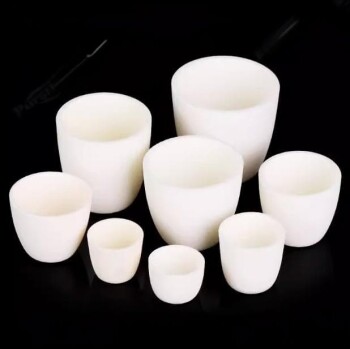
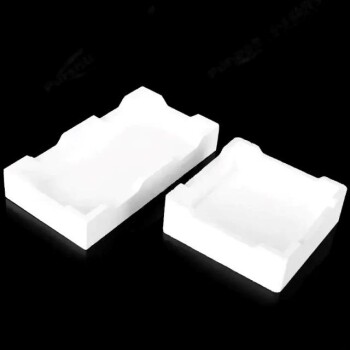
Magnesium oxide (MgO) crucibles are the industry standard for high-purity synthesis at 800°C primarily due to their chemical inertness. Unlike standard metal crucibles, MgO does not degrade in strongly reductive environments or react with molten alkali metal compounds. This prevents the leaching of metallic contaminants, ensuring the integrity of the final product.
The core advantage of MgO is its resistance to chemical attack under extreme heat. While metal crucibles release iron and nickel into molten salts, Magnesium Oxide remains stable, making it the only viable choice for applications requiring high purity.
The Challenge of High-Temperature Environments
The Corrosive Nature of Molten Salts
Synthesis at 800°C creates an aggressive chemical environment. This is particularly true when working with molten alkali metal compounds, which are notorious for attacking containment vessels.
In these conditions, the synthesis environment becomes strongly reductive. Most standard materials cannot withstand this combination of high heat and chemical aggression without degrading.
The Failure of Standard Metal Crucibles
Standard metal crucibles are generally unsuitable for this specific application. The extreme conditions cause the crucible material to break down at a microscopic level.
As the metal degrades, it releases elements such as iron and nickel into the mix. This leaching process contaminates the batch, rendering high-purity synthesis impossible.
Why Magnesium Oxide is the Solution
Superior Chemical Stability
MgO is selected specifically for its superior high-temperature chemical stability. It provides a robust barrier that resists the corrosive effects of molten salts.
By maintaining its structural and chemical integrity, MgO prevents the interaction between the crucible wall and the synthesis material.
Ensuring Product Purity
The primary goal of using MgO is to safeguard the purity of the end product, such as lithium oxide. Because MgO does not react with the molten salt additive, it eliminates the introduction of foreign metallic elements.
This makes MgO crucibles indispensable for experiments or production lines where even trace amounts of iron or nickel would constitute a failure.
The Hidden Risks of Standard Metals
Understanding Contamination Vectors
It is critical to understand that contamination is not always visible to the naked eye. The leaching of iron and nickel from metal crucibles occurs at the elemental level.
The Cost of Impurity
Using a standard metal crucible in a reductive, 800°C environment guarantees product contamination. If your application relies on the precise electrical or chemical properties of the synthesized compound, the presence of these leached metals will likely compromise the results.
Making the Right Choice for Your Goal
Selecting the correct crucible is a decision dictated by your tolerance for impurities and the specific chemistry of your melt.
- If your primary focus is high purity: You must use Magnesium Oxide to prevent iron and nickel contamination from ruining the product.
- If your primary focus is handling molten alkali metals: You require MgO to withstand the corrosive, reductive environment that destroys standard metals.
Ultimately, for rigorous synthesis at 800°C, MgO is not just an option; it is a prerequisite for chemical integrity.
Summary Table:
| Feature | Magnesium Oxide (MgO) Crucible | Standard Metal Crucible |
|---|---|---|
| Chemical Stability | High; resistant to reductive environments | Low; susceptible to chemical attack |
| Contamination Risk | Negligible; maintains high purity | High; leaches iron and nickel |
| Alkali Resistance | Excellent; ideal for molten alkali salts | Poor; prone to corrosion and breakdown |
| Primary Application | High-purity synthesis (e.g., Lithium Oxide) | Low-purity or non-reactive applications |
| Integrity at 800°C | Remains structurally & chemically stable | Degrades and releases metallic impurities |
Elevate Your Material Purity with KINTEK Precision Solutions
Don't let metallic contamination compromise your high-temperature research. KINTEK specializes in high-performance laboratory equipment, providing premium MgO crucibles and ceramics specifically engineered to withstand aggressive molten salts and reductive environments.
Whether you are performing complex synthesis in our high-temperature furnaces or requiring specialized high-pressure reactors, our expert team ensures your lab is equipped with the most durable and inert tools available.
Ready to secure the integrity of your results? Contact KINTEK today to discuss our full range of crucibles, furnaces, and laboratory consumables tailored for your specific application.
References
- Э. А. Карфидов, Alexey V. Dub. High-Temperature Passivation of the Surface of Candidate Materials for MSR by Adding Oxygen Ions to FLiNaK Salt. DOI: 10.3390/ma15155174
This article is also based on technical information from Kintek Solution Knowledge Base .
Related Products
- High Purity Pure Graphite Crucible for Evaporation
- High Purity Pure Graphite Crucible for Electron Beam Evaporation
- Electron Beam Evaporation Coating Gold Plating Tungsten Molybdenum Crucible for Evaporation
- Electron Beam Evaporation Coating Tungsten Crucible and Molybdenum Crucible for High Temperature Applications
- Engineering Advanced Fine Ceramics Alumina Al2O3 Crucible With Lid Cylindrical Laboratory Crucible
People Also Ask
- Why are high-purity graphite crucibles preferred for sulfide solid electrolytes? Achieve Superior Material Purity
- Why is a high-purity graphite crucible required for Chromel-TaC composites? Ensure Peak Purity at 1400°C
- What role do high-purity graphite crucibles play in molten salt corrosion research? Ensure Reactor-Grade Precision
- Why are high-purity graphite crucibles used for magnesium distillation? Ensure 3N8 Purity & Thermal Stability
- Why is a high-purity graphite crucible ideal for nitrogen-doped graphene at 1500 °C? Maximize Purity and Stability