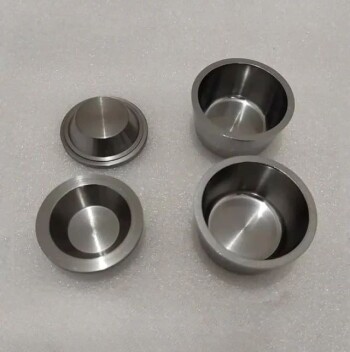
Platinum/Gold (Pt/Au) crucibles are the critical standard for this synthesis. They are explicitly selected to withstand the rigorous conditions of melting silver phosphate glass, specifically temperatures reaching 900°C. Their primary function is to maintain total chemical inertness, preventing the corrosive phosphate melt from reacting with the vessel and compromising the material's purity.
The selection of Pt/Au crucibles is driven by the necessity to eliminate interactions between the vessel and the melt. By preventing chemical leaching during high-temperature synthesis, these crucibles ensure the base glass composition remains pure for accurate chemical durability evaluations.
The Challenge of Phosphate Synthesis
Withstanding Extreme Thermal Environments
The synthesis of silver phosphate glass requires a high-temperature melting stage. The process involves temperatures that reach 900°C.
At this thermal intensity, standard laboratory containment materials may degrade or fail. The crucible must maintain structural integrity without softening or chemically altering.
Combating Corrosive Melts
Phosphate melts are notoriously corrosive in their liquid state.
When heated to synthesis temperatures, these melts can aggressively attack the walls of the containment vessel. This aggression necessitates a material that offers superior resistance to chemical attack.
The Role of Noble Metals in Purity
Exceptional Chemical Inertness
The defining advantage of Platinum/Gold (Pt/Au) crucibles is their chemical inertness.
Unlike standard ceramics or reactive metals, Pt/Au alloys do not react with the phosphate melt. This stability is the primary defense against the degradation of the crucible walls during the melting process.
Preserving Baseline Composition
The ultimate goal of the synthesis is often to evaluate properties such as chemical durability.
To measure durability accurately, the baseline glass composition must be free of external contaminants. Pt/Au crucibles prevent the introduction of unintended impurities that would otherwise skew the results of these critical evaluations.
Common Pitfalls to Avoid
The Risk of Impurity Leaching
A common error in glass synthesis is underestimating the reactivity of the melt.
If a less inert crucible is used, elements from the vessel can leach into the glass matrix. This changes the fundamental chemistry of the sample, rendering subsequent testing invalid.
Compromising Durability Data
Chemical durability tests rely on a precise understanding of the glass's starting state.
If the glass is contaminated during the initial melt, any observed degradation cannot be solely attributed to the glass formulation. Using Pt/Au removes this variable, ensuring data integrity.
Making the Right Choice for Your Goal
When planning high-temperature glass synthesis, material selection is dictated by your analytical requirements.
- If your primary focus is Compositional Purity: Select Pt/Au crucibles to prevent the corrosive phosphate melt from leaching impurities from the vessel walls.
- If your primary focus is Chemical Durability Evaluation: Prioritize inert noble metal crucibles to ensure that the glass you test is chemically identical to the formula you designed.
Using the correct crucible material is not just a logistical detail; it is a prerequisite for scientifically valid results.
Summary Table:
| Feature | Requirement for Phosphate Glass Synthesis | Role of Pt/Au Crucibles |
|---|---|---|
| Temperature Resistance | High melting stage reaching 900°C | Maintains structural integrity without softening. |
| Chemical Inertness | Must resist aggressive phosphate melts | Zero reaction with corrosive liquid glass. |
| Purity Control | Prevent leaching of vessel contaminants | Eliminates chemical leaching for accurate baseline glass. |
| Data Integrity | Essential for durability evaluations | Ensures testing reflects the intended glass formulation. |
Elevate Your Materials Research with KINTEK Precision Solutions
Achieve uncompromising purity in your glass synthesis and high-temperature research. KINTEK specializes in providing high-performance laboratory equipment, including specialized high-temperature furnaces (muffle, tube, vacuum) and premium ceramics and crucibles designed to withstand the most corrosive environments.
Whether you are conducting advanced battery research, chemical durability evaluations, or complex material synthesis, our comprehensive portfolio—from Pt/Au alloys to high-pressure reactors and cooling solutions—is engineered to deliver scientifically valid results every time.
Don't let vessel contamination compromise your data. Contact KINTEK today to find the perfect crucible and furnace configuration for your laboratory!
References
- A.-L. Chabauty, Lionel Campayo. Chemical durability evaluation of silver phosphate–based glasses designed for the conditioning of radioactive iodine. DOI: 10.1016/j.jnucmat.2021.152919
This article is also based on technical information from Kintek Solution Knowledge Base .
Related Products
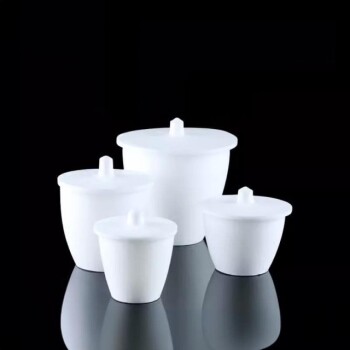
- Custom Machined and Molded PTFE Teflon Parts Manufacturer with PTFE Crucible and Lid
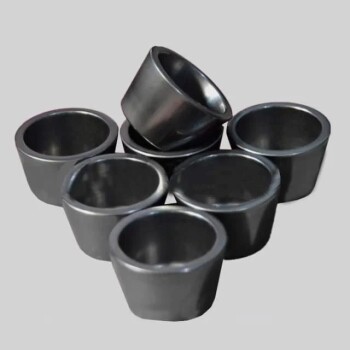
- High Purity Pure Graphite Crucible for Evaporation
- High Purity Pure Graphite Crucible for Electron Beam Evaporation
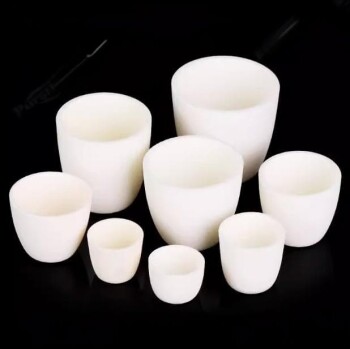
- Engineering Advanced Fine Ceramics Alumina Al2O3 Crucible With Lid Cylindrical Laboratory Crucible
- Arc-Shaped Alumina Ceramic Crucible High Temperature Resistant for Engineering Advanced Fine Ceramics
People Also Ask
- Why is a PTFE crucible preferred for plasma etching? Ensure Chemical Integrity and Targeted Action
- What essential consumables are required for laboratory processes? Expert Guide to PTFE, Ceramics, and Crucibles
- Why are PTFE molds used for dental resin specimens? Ensure Pure Samples and Accurate Testing
- What are the advantages of using PTFE molds for preparing PUA hybrid films? Ensure High Purity and Easy Demolding
- What advantages do PTFE molds offer for composite polymer electrolyte casting? Ensure Defect-Free Membrane Fabrication