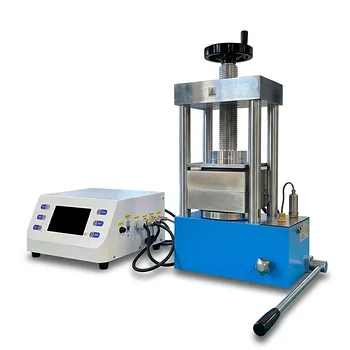
Precise temperature and pressure controls are the defining factors in successfully creating high-conductivity PBAT (polybutylene adipate terephthalate) composites. Specifically, maintaining strict conditions, such as 130 °C and 10 MPa, enables localized melting at microsphere interfaces to ensure tight contact without compromising the structural integrity required for a segregated conductive network.
The ultimate goal is to achieve a delicate balance: inducing sufficient interfacial bonding to create a robust material while preserving the geometry of the microspheres to maintain a continuous electrical path.
The Critical Role of Temperature Stability
In the context of constructing segregated structures, temperature is not simply about melting the polymer; it is about controlling where that melting occurs.
Facilitating Localized Melting
To form a segregated network, the polymer must melt only at specific points.
By maintaining a precise temperature (e.g., 130 °C), the Laboratory Hot Press induces localized melting strictly at the interfaces of the nickel-coated microspheres. This "spot welding" effect binds the particles together without turning the entire composite into a homogenous soup.
Preserving the Segregated Network
If the temperature fluctuates too high, the polymer microspheres will melt completely.
This results in the conductive filler dispersing randomly throughout the matrix rather than staying at the boundaries. The segregated network relies on the microspheres retaining their shape to force the conductive particles into a connected pathway. Precision prevents the destruction of this pathway.
The Necessity of Exact Pressure Application
Pressure acts as the physical force that densifies the material and establishes the electrical connectivity.
Ensuring Tight Interfacial Contact
Conductivity in these composites depends on electron transport across particle boundaries.
A precise pressure setting, such as 10 MPa, forces the microspheres into tight contact. This proximity is essential for reducing contact resistance between the nickel coatings, thereby facilitating high electrical conductivity.
Avoiding Component Damage
While contact is necessary, excessive force is destructive.
If the pressure spikes or is set too high, the microspheres will be crushed or deformed. This disruption breaks the continuous conductive shell, severing the electrical network and rendering the composite ineffective.
Eliminating Porosity
Beyond conductivity, pressure drives densification.
Accurate pressure application promotes particle rearrangement and eliminates internal pores. This ensures the material is mechanically sound and free of voids that could interrupt the conductive network or weaken the composite structure.
Understanding the Trade-offs
Achieving the perfect segregated structure requires navigating a narrow window of operation. Deviating from this window leads to distinct failure modes.
The Consequence of Over-Processing
Applying too much heat or pressure leads to "structural homogenization."
While this might create a very dense, strong plastic, it destroys the segregated network. The conductive fillers become isolated islands rather than a connected web, causing a dramatic drop in electrical conductivity.
The Consequence of Under-Processing
Applying insufficient heat or pressure results in "interfacial failure."
Without enough energy to bond the interfaces or enough force to close the gaps, the material will exhibit poor mechanical strength and high electrical resistance. The electrons simply cannot bridge the physical gaps between the microspheres.
Making the Right Choice for Your Goal
The settings on your Laboratory Hot Press dictate the final properties of your PBAT composite.
- If your primary focus is maximum conductivity: Prioritize pressure precision to ensure tight contact, but keep temperatures at the lower end of the melting range to preserve microsphere geometry.
- If your primary focus is mechanical durability: Prioritize slightly higher temperatures to enhance interfacial bonding, accepting a minor trade-off in the sharpness of the segregated network.
Precision in these variables is not merely a process setting; it is the architect of the material's internal microstructure.
Summary Table:
| Process Parameter | Target Value | Impact on PBAT Composite Structure |
|---|---|---|
| Temperature | 130 °C | Induces localized melting at interfaces while preserving microsphere geometry. |
| Pressure | 10 MPa | Ensures tight contact for electron transport and eliminates internal porosity. |
| Thermal Stability | High | Prevents structural homogenization and loss of the conductive pathway. |
| Pressure Accuracy | High | Avoids crushing microspheres and maintains the integrity of the nickel shell. |
Elevate Your Material Research with KINTEK Precision
Precision is the architect of your material's microstructure. At KINTEK, we understand that achieving the delicate balance of localized melting and densification requires world-class equipment.
Whether you are developing high-conductivity PBAT composites or advanced polymers, our comprehensive range of laboratory hydraulic presses (pellet, hot, isostatic) and high-temperature furnaces provides the exact stability your research demands.
Our value to you:
- Unmatched Accuracy: Systems designed for strict temperature and pressure consistency.
- Versatile Solutions: From high-pressure reactors to crushing and milling systems, we equip your entire workflow.
- Expert Support: We provide the tools—including PTFE products, ceramics, and crucibles—to ensure your segregated networks remain intact.
Contact KINTEK today to find the perfect hot press for your laboratory!
References
- Jianming Yang, Junwei Gu. Layered Structural PBAT Composite Foams for Efficient Electromagnetic Interference Shielding. DOI: 10.1007/s40820-023-01246-8
This article is also based on technical information from Kintek Solution Knowledge Base .
Related Products
- 30T 40T Split Automatic Heated Hydraulic Press Machine with Heated Plates for Laboratory Hot Press
- Heated Hydraulic Press Machine with Heated Plates Split Manual Laboratory Hot Press
- Automatic Heated Hydraulic Press Machine with Heated Plates for Laboratory Hot Press
- Automatic Laboratory Heat Press Machine
- 24T 30T 60T Heated Hydraulic Press Machine with Heated Plates for Laboratory Hot Press
People Also Ask
- What are the advantages of using a laboratory hydraulic press for hot pressing? Achieve Peak Nano-Composite Density
- What are the core advantages of using a laboratory hot press to produce Bi2Se3? Achieve 93% Density & High Conductivity
- Why is a laboratory hydraulic hot press essential for high-density, additive-free Silicon Carbide? Unlock Pure SiC.
- How does a laboratory hydraulic hot press ensure the quality of PHBV/natural fiber composites? Expert Guide
- What is the function of a laboratory hydraulic hot press in the assembly of solid-state photoelectrochemical cells?