Knowledge Why does graphite have a high melting point? The Power of Its Giant Covalent Structure
Author avatar

Tech Team · Kintek Solution

Updated 6 days ago

Why does graphite have a high melting point? The Power of Its Giant Covalent Structure


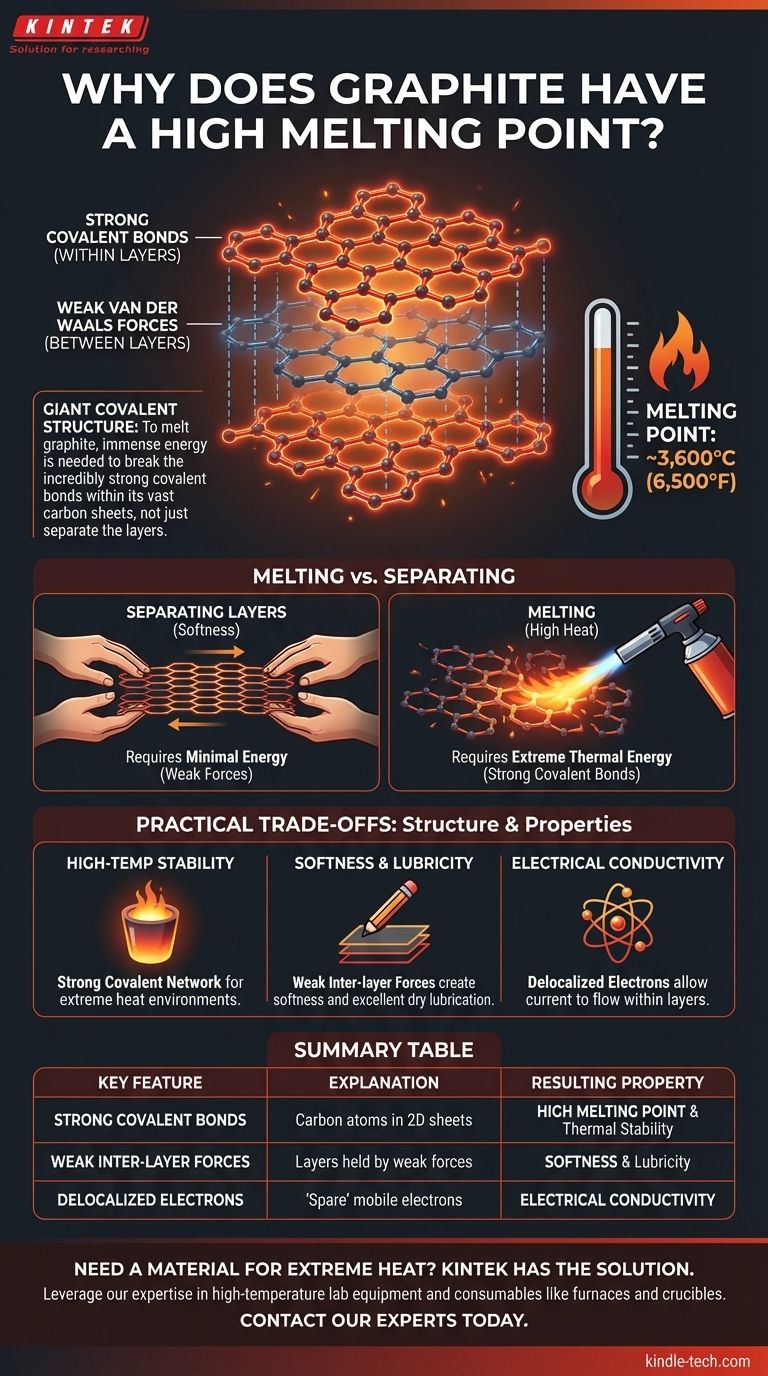
At its core, graphite's exceptionally high melting point (around 3,600°C or 6,500°F) is a direct result of its atomic structure. To melt graphite, you must provide an enormous amount of energy to break the incredibly strong covalent bonds that link its carbon atoms together into vast, two-dimensional sheets.

The crucial insight is that graphite is a giant covalent structure. Melting it doesn't mean simply sliding its layers apart; it means tearing apart the powerful network of carbon-carbon bonds within those layers, a process that requires extreme thermal energy.
Why does graphite have a high melting point? The Power of Its Giant Covalent Structure

The Two-Dimensional Architecture of Graphite

To understand the high melting point, you must first visualize graphite's two distinct types of bonding, which give it a unique combination of properties.

The Strong Covalent Layers

Graphite is composed of countless layers of carbon atoms. Within each individual layer, every carbon atom is joined to three other carbon atoms by strong covalent bonds.

These atoms arrange themselves into a honeycomb-like pattern of interconnected hexagonal rings. This creates a vast, flat, and exceptionally stable sheet known as graphene.

The Weak Inter-Layer Forces

While the bonds within a layer are immensely strong, the forces that hold the different layers together are very weak.

These forces are known as van der Waals forces. They are easily overcome, which allows the layers to slide past one another with minimal effort. This is what gives graphite its characteristic softness and makes it an excellent dry lubricant.

Why This Structure Demands Extreme Heat

The key to graphite's high melting point is understanding what "melting" actually means for a giant covalent structure.

Melting vs. Separating

Melting a substance requires breaking the bonds that hold its atoms or molecules in a fixed lattice, allowing them to move freely as a liquid.

For graphite, this process is not about overcoming the weak van der Waals forces between the layers. It's about supplying enough energy to break the strong covalent bonds within the layers themselves.

The Sheer Energy of Covalent Bonds

Covalent bonds, where atoms share electrons, are among the strongest forms of chemical bonding. Each carbon-carbon bond in graphite is exceptionally stable and requires a massive input of thermal energy to sever.

Because a piece of graphite contains a colossal number of these bonds, an extremely high temperature is needed to break enough of them to transition the entire structure into a liquid state.

Understanding the Practical Trade-offs

Graphite's dual-bonding nature creates a material of contrasts. Its properties are highly dependent on which aspect of its structure is being tested.

High-Temperature Stability

The network of strong covalent bonds makes graphite one of the most thermally stable materials known. This is why it is used for applications like industrial crucibles for melting metals and as a lining for high-temperature furnaces.

Mechanical Softness and Lubricity

Conversely, the weak forces between the layers make graphite mechanically soft and an excellent lubricant. The layers easily shear off, which is the principle behind a graphite pencil leaving a mark on paper.

Electrical Conductivity

The same bonding structure that provides thermal stability also allows graphite to conduct electricity. Each carbon atom has a "spare" delocalized electron that is free to move along the plane of the layer, enabling current to flow. This is a rare property for a non-metal.

How to Apply This to Your Goal

Understanding this structure-property relationship is key to selecting the right material for an application.

  • If your primary focus is thermal resistance: Graphite's giant covalent network makes it a premier choice for high-temperature environments where structural integrity under heat is paramount.
  • If your primary focus is lubricity or softness: The weak inter-layer forces are the key property, making graphite ideal for dry lubricants or writing implements.
  • If your primary focus is electrical conductivity in a lightweight material: Graphite's mobile electrons offer a conductive solution without the weight of most metals.

Ultimately, graphite's high melting point is a direct consequence of the immense strength of the chemical bonds holding its fundamental structure together.

Summary Table:

Key Feature Explanation Resulting Property
Strong Covalent Bonds Carbon atoms form strong covalent bonds in 2D sheets (graphene). High Melting Point & Thermal Stability
Weak Inter-layer Forces Layers are held by weak van der Waals forces. Softness & Lubricity
Delocalized Electrons 'Spare' electrons can move freely within layers. Electrical Conductivity

Need a Material for Extreme Heat? KINTEK Has the Solution.

Understanding the properties of materials like graphite is crucial for selecting the right equipment for your lab. Whether you require high-temperature furnaces with graphite elements, durable crucibles, or other lab equipment built to withstand extreme conditions, KINTEK's expertise is your advantage.

We specialize in providing reliable lab equipment and consumables that leverage the unique properties of advanced materials. Let us help you achieve precision and durability in your high-temperature applications.

Contact our experts today to discuss how our solutions can meet your specific laboratory needs.

Visual Guide
Why does graphite have a high melting point? The Power of Its Giant Covalent Structure Visual Guide

Related Products

People Also Ask

Related Products

Large Vertical Graphite Vacuum Graphitization Furnace

Large Vertical Graphite Vacuum Graphitization Furnace

A large vertical high-temperature graphitization furnace is a type of industrial furnace used for the graphitization of carbon materials, such as carbon fiber and carbon black. It is a high-temperature furnace that can reach temperatures of up to 3100°C.

Graphite Vacuum Continuous Graphitization Furnace

Graphite Vacuum Continuous Graphitization Furnace

High-temperature graphitization furnace is a professional equipment for graphitization treatment of carbon materials. It is a key equipment for the production of high-quality graphite products. It has high temperature, high efficiency and uniform heating. It is suitable for various high-temperature treatments and graphitization treatments. It is widely used in metallurgy, electronics, aerospace, etc. industry.

Vertical High Temperature Graphite Vacuum Graphitization Furnace

Vertical High Temperature Graphite Vacuum Graphitization Furnace

Vertical high temperature graphitization furnace for carbonization and graphitization of carbon materials up to 3100℃.Suitable for shaped graphitization of carbon fiber filaments and other materials sintered in a carbon environment.Applications in metallurgy, electronics, and aerospace for producing high-quality graphite products like electrodes and crucibles.

Graphite Vacuum Furnace Bottom Discharge Graphitization Furnace for Carbon Materials

Graphite Vacuum Furnace Bottom Discharge Graphitization Furnace for Carbon Materials

Bottom-out graphitization furnace for carbon materials, ultra-high temperature furnace up to 3100°C, suitable for graphitization and sintering of carbon rods and carbon blocks. Vertical design, bottom discharging, convenient feeding and discharging, high temperature uniformity, low energy consumption, good stability, hydraulic lifting system, convenient loading and unloading.

Ultra-High Temperature Graphite Vacuum Graphitization Furnace

Ultra-High Temperature Graphite Vacuum Graphitization Furnace

The ultra-high temperature graphitization furnace utilizes medium frequency induction heating in a vacuum or inert gas environment. The induction coil generates an alternating magnetic field, inducing eddy currents in the graphite crucible, which heats up and radiates heat to the workpiece, bringing it to the desired temperature. This furnace is primarily used for graphitization and sintering of carbon materials, carbon fiber materials, and other composite materials.

Horizontal High Temperature Graphite Vacuum Graphitization Furnace

Horizontal High Temperature Graphite Vacuum Graphitization Furnace

Horizontal Graphitization Furnace: This type of furnace is designed with the heating elements placed horizontally, allowing for uniform heating of the sample. It's well-suited for graphitizing large or bulky samples that require precise temperature control and uniformity.

1700℃ Laboratory Quartz Tube Furnace with Alumina Tube Tubular Furnace

1700℃ Laboratory Quartz Tube Furnace with Alumina Tube Tubular Furnace

Looking for a high-temperature tube furnace? Check out our 1700℃ Tube Furnace with Alumina Tube. Perfect for research and industrial applications up to 1700C.

Graphite Vacuum Furnace Negative Material Graphitization Furnace

Graphite Vacuum Furnace Negative Material Graphitization Furnace

Graphitization furnace for battery production has uniform temperature and low energy consumption. Graphitization furnace for negative electrode materials: an efficient graphitization solution for battery production and advanced functions to enhance battery performance.

1200℃ Split Tube Furnace with Quartz Tube Laboratory Tubular Furnace

1200℃ Split Tube Furnace with Quartz Tube Laboratory Tubular Furnace

KT-TF12 split tube furnace: high-purity insulation, embedded heating wire coils, and max. 1200C. Widely used for new materials and chemical vapour deposition.

1200℃ Muffle Furnace Oven for Laboratory

1200℃ Muffle Furnace Oven for Laboratory

Upgrade your lab with our 1200℃ Muffle Furnace. Achieve fast, precise heating with Japan alumina fibers and Molybdenum coils. Features TFT touch screen controller for easy programming and data analysis. Order now!

Vacuum Heat Treat and Pressure Sintering Furnace for High Temperature Applications

Vacuum Heat Treat and Pressure Sintering Furnace for High Temperature Applications

Vacuum pressure sintering furnaces are designed for high temperature hot pressing applications in metal and ceramic sintering. Its advanced features ensure precise temperature control, reliable pressure maintenance, and a robust design for seamless operation.

High Purity Pure Graphite Crucible for Electron Beam Evaporation

High Purity Pure Graphite Crucible for Electron Beam Evaporation

A technology mainly used in the field of power electronics. It is a graphite film made of carbon source material by material deposition using electron beam technology.

High Purity Pure Graphite Crucible for Evaporation

High Purity Pure Graphite Crucible for Evaporation

Vessels for high temperature applications, where materials are kept at extremely high temperatures to evaporate, allowing thin films to be deposited on substrates.

Engineering Advanced Fine Ceramics Alumina Al2O3 Crucible With Lid Cylindrical Laboratory Crucible

Engineering Advanced Fine Ceramics Alumina Al2O3 Crucible With Lid Cylindrical Laboratory Crucible

Cylindrical Crucibles Cylindrical crucibles are one of the most common crucible shapes, suitable for melting and processing a wide variety of materials, and are easy to handle and clean.

Engineering Advanced Fine Ceramics Alumina Crucibles (Al2O3) for Thermal Analysis TGA DTA

Engineering Advanced Fine Ceramics Alumina Crucibles (Al2O3) for Thermal Analysis TGA DTA

TGA/DTA thermal analysis vessels are made of aluminum oxide (corundum or aluminum oxide). It can withstand high temperature and is suitable for analyzing materials that require high temperature testing.

Vacuum Hot Press Furnace Machine for Lamination and Heating

Vacuum Hot Press Furnace Machine for Lamination and Heating

Experience clean and precise lamination with Vacuum Lamination Press. Perfect for wafer bonding, thin-film transformations, and LCP lamination. Order now!

Electron Beam Evaporation Coating Tungsten Crucible and Molybdenum Crucible for High Temperature Applications

Electron Beam Evaporation Coating Tungsten Crucible and Molybdenum Crucible for High Temperature Applications

Tungsten and molybdenum crucibles are commonly used in electron beam evaporation processes due to their excellent thermal and mechanical properties.

Engineering Advanced Fine Alumina Al2O3 Ceramic Crucible for Laboratory Muffle Furnace

Engineering Advanced Fine Alumina Al2O3 Ceramic Crucible for Laboratory Muffle Furnace

Alumina ceramic crucibles are used in some materials and metal melting tools, and flat-bottomed crucibles are suitable for melting and processing larger batches of materials with better stability and uniformity.

Custom Machined and Molded PTFE Teflon Parts Manufacturer with PTFE Crucible and Lid

Custom Machined and Molded PTFE Teflon Parts Manufacturer with PTFE Crucible and Lid

PTFE crucibles, made from pure Teflon, offer chemical inertness and resistance from -196°C to 280°C, ensuring compatibility with a wide range of temperatures and chemicals. These crucibles feature machine-finished surfaces for easy cleaning and prevention of contamination, making them ideal for precise laboratory applications.

High Temperature Resistant Optical Quartz Glass Sheet

High Temperature Resistant Optical Quartz Glass Sheet

Discover the power of optical glass sheets for precise light manipulation in telecommunications, astronomy, and beyond. Unlock advancements in optical technology with exceptional clarity and tailored refractive properties.


Leave Your Message