Knowledge Laboratory Heated Press Why increase the temperature when forging? Achieve Superior Strength and Formability
Author avatar

Tech Team · Kintek Solution

Updated 2 months ago

Why increase the temperature when forging? Achieve Superior Strength and Formability


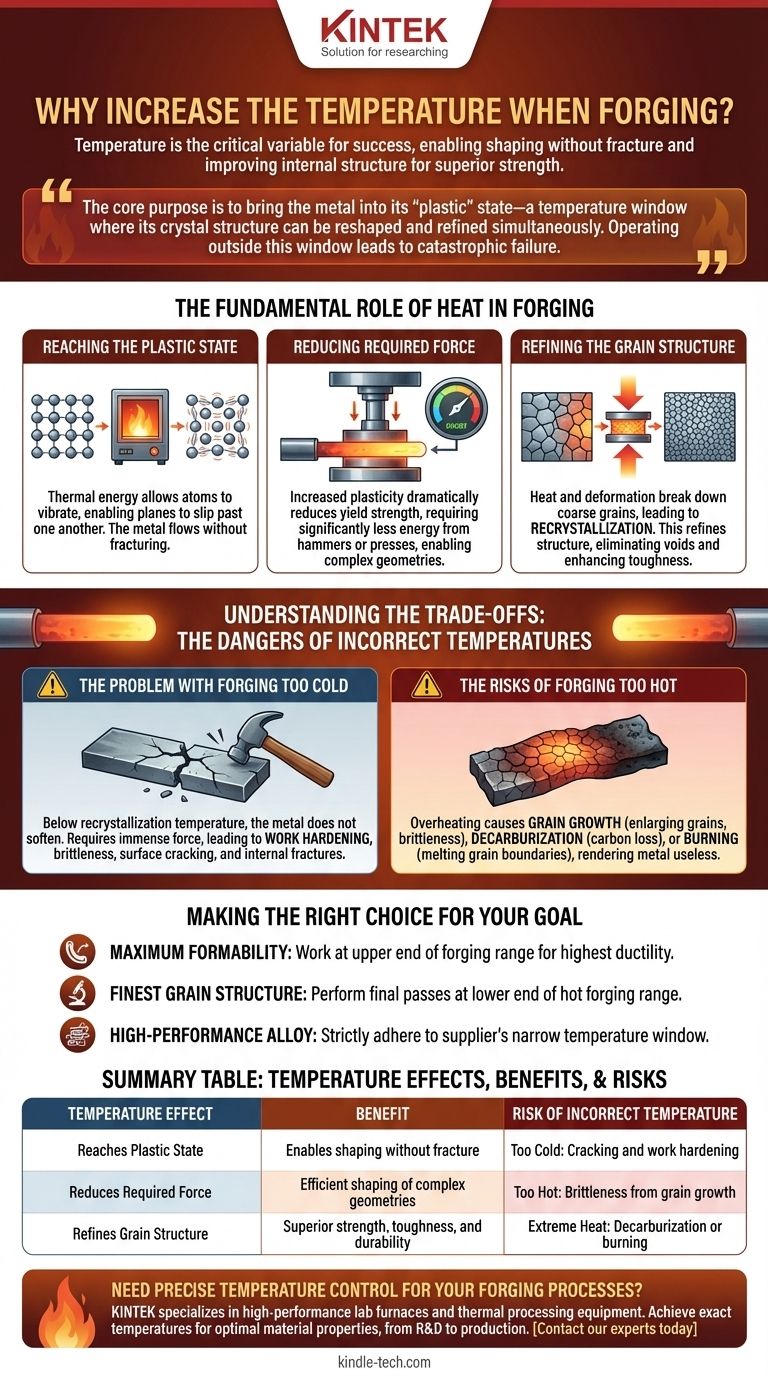
In forging, temperature is the single most critical variable for success. Increasing the temperature of a metal makes it significantly softer and more malleable, allowing it to be shaped with less force and without risk of fracture. This process, known as hot forging, also fundamentally improves the material's internal structure, resulting in a finished component with superior strength and durability.

The core purpose of heating for forging is to bring the metal into its "plastic" state—a temperature window where its crystal structure can be reshaped and refined simultaneously. Operating outside this optimal window, either too hot or too cold, compromises the integrity of the material and can lead to catastrophic failure.
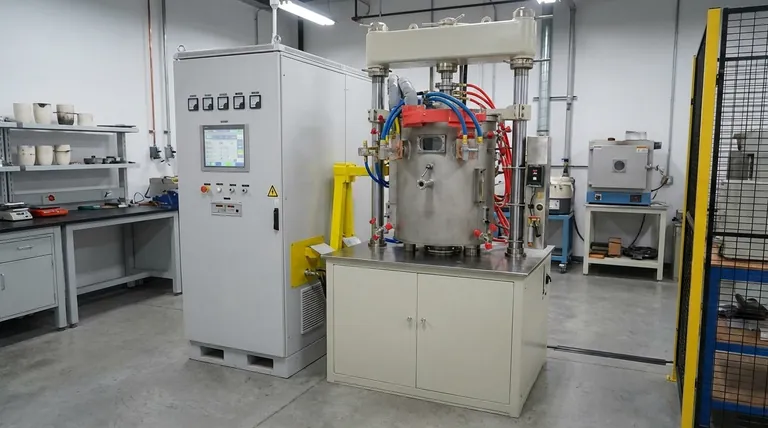
Why increase the temperature when forging? Achieve Superior Strength and Formability

The Fundamental Role of Heat in Forging

Heating a metal workpiece to a specific temperature is not just about making it soft. It's a precise metallurgical process designed to unlock the material's potential for both shaping and structural improvement.

Reaching the Plastic State

Metals are crystalline solids. At room temperature, their atomic structure is rigid, and attempting to deform them excessively will cause them to crack or break.

Heating provides thermal energy, allowing the atoms within this crystal lattice to vibrate and move more freely. This enables planes of atoms to slip past one another under pressure, a phenomenon known as plastic deformation. The metal can now flow like a highly viscous fluid without fracturing.

Reducing Required Force

A direct consequence of increased plasticity is a dramatic reduction in the material's yield strength.

This means significantly less energy is required from hammers, presses, or rollers to shape the workpiece. This makes the forging process more efficient, faster, and allows for the creation of more complex geometries that would be impossible with cold metal.

Refining the Grain Structure

Perhaps the most important benefit of hot forging is its effect on the metal's internal grain structure. Most raw metals have large, inconsistent grains, which can be points of weakness.

The combination of heat and deformation force breaks down these coarse grains. As the metal cools, a new, finer, and more uniform grain structure forms in a process called recrystallization. This refined structure eliminates internal voids and enhances mechanical properties like toughness, ductility, and fatigue resistance.

Understanding the Trade-offs: The Dangers of Incorrect Temperatures

The forging temperature is not a single point but a carefully controlled range. Deviating from this range introduces severe risks.

The Problem with Forging Too Cold

If the metal is not hot enough—below its recrystallization temperature—it will not soften sufficiently.

Attempting to forge in this state requires immense force and can induce work hardening, making the material brittle. This leads to a high risk of surface cracking and internal fractures, compromising the part's structural integrity.

The Risks of Forging Too Hot

Overheating the workpiece is even more dangerous and can cause irreversible damage.

Excessively high temperatures lead to rapid grain growth, where the refined grains begin to enlarge and coalesce, making the material brittle and weak. For steels, it can also cause decarburization (loss of carbon from the surface) or, in the worst case, burning, where the grain boundaries begin to melt, rendering the metal completely useless.

Making the Right Choice for Your Goal

Selecting the correct temperature is a critical decision based on the specific alloy and the desired mechanical properties of the final component.

  • If your primary focus is maximum formability: Work within the upper end of the prescribed forging range to ensure the highest ductility and lowest resistance to shaping.
  • If your primary focus is the finest grain structure: Perform the final forging passes at the lower end of the hot forging range to promote recrystallization without risking excessive grain growth.
  • If you are working with a high-performance alloy: Strictly adhere to the material supplier's specified temperature window, as these materials have very narrow ranges for optimal results.

Ultimately, mastering temperature control is what transforms a simple piece of metal into a resilient, high-performance component.

Summary Table:

Temperature Effect Benefit Risk of Incorrect Temperature
Reaches Plastic State Enables shaping without fracture Too Cold: Cracking and work hardening
Reduces Required Force Efficient shaping of complex geometries Too Hot: Brittleness from grain growth
Refines Grain Structure Superior strength, toughness, and durability Extreme Heat: Decarburization or burning

Need precise temperature control for your forging or heat treatment processes? KINTEK specializes in high-performance lab furnaces and thermal processing equipment designed for metallurgical applications. Our solutions ensure you achieve the exact temperatures required for optimal material properties, from R&D to production.

Contact our experts today to discuss how our equipment can help you forge stronger, more reliable components.

Visual Guide
Why increase the temperature when forging? Achieve Superior Strength and Formability Visual Guide

Related Products

People Also Ask

Related Products

Vacuum Heat Treat Sintering Brazing Furnace

Vacuum Heat Treat Sintering Brazing Furnace

A vacuum brazing furnace is a type of industrial furnace used for brazing, a metalworking process that joins two pieces of metal using a filler metal that melts at a lower temperature than the base metals. Vacuum brazing furnaces are typically used for high-quality applications where a strong, clean joint is required.

High Temperature Muffle Oven Furnace for Laboratory Debinding and Pre Sintering

High Temperature Muffle Oven Furnace for Laboratory Debinding and Pre Sintering

KT-MD High temperature debinding and pre-sintering furnace for ceramic materials with various molding processes. Ideal for electronic components such as MLCC and NFC.

Graphite Vacuum Furnace High Thermal Conductivity Film Graphitization Furnace

Graphite Vacuum Furnace High Thermal Conductivity Film Graphitization Furnace

The high thermal conductivity film graphitization furnace has uniform temperature, low energy consumption and can operate continuously.

Vertical High Temperature Graphite Vacuum Graphitization Furnace

Vertical High Temperature Graphite Vacuum Graphitization Furnace

Vertical high temperature graphitization furnace for carbonization and graphitization of carbon materials up to 3100℃.Suitable for shaped graphitization of carbon fiber filaments and other materials sintered in a carbon environment.Applications in metallurgy, electronics, and aerospace for producing high-quality graphite products like electrodes and crucibles.

Ultra-High Temperature Graphite Vacuum Graphitization Furnace

Ultra-High Temperature Graphite Vacuum Graphitization Furnace

The ultra-high temperature graphitization furnace utilizes medium frequency induction heating in a vacuum or inert gas environment. The induction coil generates an alternating magnetic field, inducing eddy currents in the graphite crucible, which heats up and radiates heat to the workpiece, bringing it to the desired temperature. This furnace is primarily used for graphitization and sintering of carbon materials, carbon fiber materials, and other composite materials.

Large Vertical Graphite Vacuum Graphitization Furnace

Large Vertical Graphite Vacuum Graphitization Furnace

A large vertical high-temperature graphitization furnace is a type of industrial furnace used for the graphitization of carbon materials, such as carbon fiber and carbon black. It is a high-temperature furnace that can reach temperatures of up to 3100°C.

Graphite Vacuum Continuous Graphitization Furnace

Graphite Vacuum Continuous Graphitization Furnace

High-temperature graphitization furnace is a professional equipment for graphitization treatment of carbon materials. It is a key equipment for the production of high-quality graphite products. It has high temperature, high efficiency and uniform heating. It is suitable for various high-temperature treatments and graphitization treatments. It is widely used in metallurgy, electronics, aerospace, etc. industry.

Horizontal High Temperature Graphite Vacuum Graphitization Furnace

Horizontal High Temperature Graphite Vacuum Graphitization Furnace

Horizontal Graphitization Furnace: This type of furnace is designed with the heating elements placed horizontally, allowing for uniform heating of the sample. It's well-suited for graphitizing large or bulky samples that require precise temperature control and uniformity.

Molybdenum Vacuum Heat Treat Furnace

Molybdenum Vacuum Heat Treat Furnace

Discover the benefits of a high-configuration molybdenum vacuum furnace with heat shield insulation. Ideal for high-purity, vacuum environments like sapphire crystal growth and heat treatment.

Dental Porcelain Zirconia Sintering Ceramic Furnace Chairside with Transformer

Dental Porcelain Zirconia Sintering Ceramic Furnace Chairside with Transformer

Experience top-notch sintering with Chairside Sintering Furnace with Transformer. Easy to operate, noise-free pallet, and automatic temperature calibration. Order now!

Vacuum Heat Treat and Pressure Sintering Furnace for High Temperature Applications

Vacuum Heat Treat and Pressure Sintering Furnace for High Temperature Applications

Vacuum pressure sintering furnaces are designed for high temperature hot pressing applications in metal and ceramic sintering. Its advanced features ensure precise temperature control, reliable pressure maintenance, and a robust design for seamless operation.

Laboratory Muffle Oven Furnace Bottom Lifting Muffle Furnace

Laboratory Muffle Oven Furnace Bottom Lifting Muffle Furnace

Efficiently produce batches with excellent temperature uniformity using our Bottom Lifting Furnace. Features two electric lifting stages and advanced temperature control up to 1600℃.

Graphite Vacuum Furnace Bottom Discharge Graphitization Furnace for Carbon Materials

Graphite Vacuum Furnace Bottom Discharge Graphitization Furnace for Carbon Materials

Bottom-out graphitization furnace for carbon materials, ultra-high temperature furnace up to 3100°C, suitable for graphitization and sintering of carbon rods and carbon blocks. Vertical design, bottom discharging, convenient feeding and discharging, high temperature uniformity, low energy consumption, good stability, hydraulic lifting system, convenient loading and unloading.

Vacuum Heat Treat and Molybdenum Wire Sintering Furnace for Vacuum Sintering

Vacuum Heat Treat and Molybdenum Wire Sintering Furnace for Vacuum Sintering

A vacuum molybdenum wire sintering furnace is a vertical or bedroom structure, which is suitable for withdrawal, brazing, sintering and degassing of metal materials under high vacuum and high temperature conditions. It is also suitable for dehydroxylation treatment of quartz materials.

Controlled Nitrogen Inert Hydrogen Atmosphere Furnace

Controlled Nitrogen Inert Hydrogen Atmosphere Furnace

KT-AH Hydrogen atmosphere furnace - induction gas furnace for sintering/annealing with built-in safety features, dual housing design, and energy-saving efficiency. Ideal for lab and industrial use.

Laboratory Rapid Thermal Processing (RTP) Quartz Tube Furnace

Laboratory Rapid Thermal Processing (RTP) Quartz Tube Furnace

Get lightning-fast heating with our RTP Rapid Heating Tube Furnace. Designed for precise, high-speed heating and cooling with convenient sliding rail and TFT touch screen controller. Order now for ideal thermal processing!

1200℃ Muffle Furnace Oven for Laboratory

1200℃ Muffle Furnace Oven for Laboratory

Upgrade your lab with our 1200℃ Muffle Furnace. Achieve fast, precise heating with Japan alumina fibers and Molybdenum coils. Features TFT touch screen controller for easy programming and data analysis. Order now!

1700℃ Controlled Atmosphere Furnace Nitrogen Inert Atmosphere Furnace

1700℃ Controlled Atmosphere Furnace Nitrogen Inert Atmosphere Furnace

KT-17A Controlled atmosphere furnace: 1700℃ heating, vacuum sealing technology, PID temperature control, and versatile TFT smart touch screen controller for laboratory and industrial use.

Vacuum Hot Press Furnace Machine Heated Vacuum Press

Vacuum Hot Press Furnace Machine Heated Vacuum Press

Discover the advantages of Vacuum Hot Press Furnace! Manufacture dense refractory metals & compounds, ceramics, and composites under high temp and pressure.

Vacuum Heat Treat Furnace with Ceramic Fiber Liner

Vacuum Heat Treat Furnace with Ceramic Fiber Liner

Vacuum furnace with polycrystalline ceramic fiber insulation liner for excellent heat insulation and uniform temperature field. Choose from 1200℃ or 1700℃ max. working temperature with high vacuum performance and precise temperature control.


Leave Your Message



















