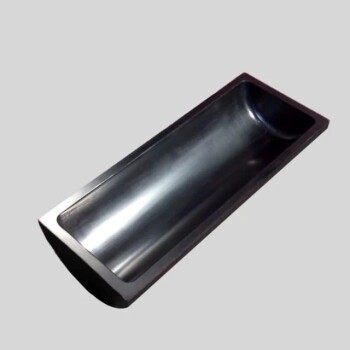
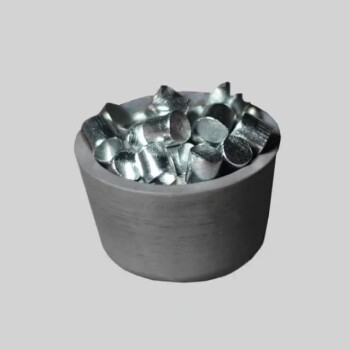
The preferred choice for preparing Al-1wt.%Fe-1wt.%Ni alloy solutions is the clay graphite crucible, primarily due to its ability to preserve the chemical integrity of the melt. This vessel offers a unique combination of superior thermal conductivity and high erosion resistance specifically against reactive aluminum liquids, ensuring the alloy is not contaminated by the container itself.
Core Takeaway The clay graphite crucible acts as a safeguard for metallurgical precision. Its selection is not merely about holding the liquid; it is about preventing the highly reactive molten aluminum from eroding the vessel walls, thereby guaranteeing the structural capability to withstand high heat while maintaining the alloy's strict chemical purity.
The Role of Thermal Performance
Superior Thermal Conductivity
Melting an aluminum-iron-nickel alloy requires precise energy management. Clay graphite crucibles possess superior thermal conductivity, which allows for the efficient transfer of heat from the furnace elements to the alloy mixture.
This efficiency ensures that the Al-1wt.%Fe-1wt.%Ni solution reaches its melting point uniformly. Rapid and even heating is critical to achieving a homogeneous solution without creating hot spots that could alter the material properties.
Thermal Stability at High Temperatures
The preparation of these alloys involves rigorous high-temperature environments. Clay graphite is preferred because of its exceptional thermal stability.
It maintains its structural integrity without warping, cracking, or failing under thermal stress. This stability is essential for safety and for ensuring the process can run to completion without mechanical failure of the containment vessel.
Ensuring Chemical Purity
Resistance to Aluminum Erosion
Molten aluminum is chemically aggressive and tends to attack many standard crucible materials. The clay graphite crucible is specifically noted for its high erosion resistance against aluminum alloy liquids.
Without this specific resistance, the molten aluminum would physically scour the walls of the crucible. This interaction often leads to the degradation of the vessel and a shortened lifespan for the equipment.
Preventing Melt Contamination
The most critical factor in alloy preparation is maintaining the exact stoichiometry—in this case, 98% Aluminum, 1% Iron, and 1% Nickel.
Because the clay graphite crucible resists erosion, it effectively prevents impurities from the container from entering the melt. If the crucible were to degrade, foreign particles would leach into the solution, altering the alloy's composition and rendering the experiment or production run a failure.
Understanding the Operational Environment
The "Atmosphere" Factor
While the primary value of clay graphite in this context is erosion resistance, it is worth noting the properties of graphite in high-temperature settings. Graphite can create a reductive atmosphere, which generally helps minimize oxygen content in the melt.
While this is often utilized in vacuum systems for other alloys (such as Copper-Silver), in the context of Aluminum alloys, this characteristic supports the overall goal of minimizing oxidation and maintaining purity.
Potential Vulnerabilities
Despite their robustness, graphite-based crucibles are generally susceptible to oxidation if exposed to air at high temperatures for prolonged periods without protection.
Furthermore, the "clay" binder is a critical component; it provides structural strength but differentiates the performance from pure graphite. Users must ensure the specific grade of clay graphite selected is rated for the exact temperature range of the Al-Fe-Ni melt to avoid premature degradation.
Making the Right Choice for Your Goal
When selecting a crucible for metallurgical synthesis, align your choice with your primary constraint:
- If your primary focus is Chemical Purity: Prioritize clay graphite for its erosion resistance to prevent the reactive aluminum melt from leaching impurities from the vessel walls.
- If your primary focus is Thermal Efficiency: Rely on clay graphite’s high thermal conductivity to ensure rapid, uniform melting of the Iron and Nickel into the Aluminum matrix.
Ultimately, the clay graphite crucible is the definitive barrier between a successful, pure alloy and a contaminated, failed sample.
Summary Table:
| Feature | Benefit for Al-1wt.%Fe-1wt.%Ni Preparation |
|---|---|
| High Thermal Conductivity | Ensures uniform melting and rapid heat transfer for a homogeneous solution. |
| Erosion Resistance | Protects the vessel walls from chemically aggressive molten aluminum. |
| Thermal Stability | Prevents warping or cracking under extreme metallurgical temperatures. |
| Chemical Purity | Eliminates melt contamination by preventing vessel material leaching. |
| Reductive Atmosphere | Minimizes oxidation during the melting process to preserve alloy integrity. |
Elevate Your Metallurgical Precision with KINTEK
Achieving the perfect stoichiometry in sensitive alloys like Al-Fe-Ni requires more than just skill—it requires the right equipment. KINTEK specializes in high-performance laboratory equipment and consumables designed for the most demanding research environments. From our specialized clay graphite and ceramic crucibles to advanced high-temperature furnaces (muffle, vacuum, and induction melting), we provide the tools you need to ensure chemical purity and thermal efficiency.
Whether you are performing complex alloy synthesis, battery research, or material crushing and milling, KINTEK’s comprehensive portfolio—including hydraulic presses, high-pressure reactors, and cooling solutions—is engineered for excellence.
Ready to optimize your lab's results? Contact KINTEK today to discover how our high-quality consumables and equipment can transform your research outcomes.
References
- Bismarck Luiz Silva, José Eduardo Spinelli. Assessing microstructures and mechanical resistances of as-atomized and as-extruded samples of Al-1wt%Fe-1wt%Ni alloy. DOI: 10.1016/j.jallcom.2016.08.243
This article is also based on technical information from Kintek Solution Knowledge Base .
Related Products
- High Purity Pure Graphite Crucible for Evaporation
- High Purity Pure Graphite Crucible for Electron Beam Evaporation
- Carbon Graphite Boat -Laboratory Tube Furnace with Cover
- Arc-Shaped Alumina Ceramic Crucible High Temperature Resistant for Engineering Advanced Fine Ceramics
- Engineering Advanced Fine Ceramics Alumina Al2O3 Crucible With Lid Cylindrical Laboratory Crucible
People Also Ask
- Why are high-purity graphite crucibles preferred for sulfide solid electrolytes? Achieve Superior Material Purity
- Why is a high-purity graphite crucible required for Chromel-TaC composites? Ensure Peak Purity at 1400°C
- What role do high-purity graphite crucibles play in molten salt corrosion research? Ensure Reactor-Grade Precision
- Why are high-purity graphite crucibles used for magnesium distillation? Ensure 3N8 Purity & Thermal Stability
- Why is a high-purity graphite crucible ideal for nitrogen-doped graphene at 1500 °C? Maximize Purity and Stability