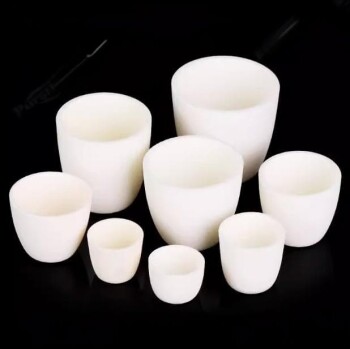
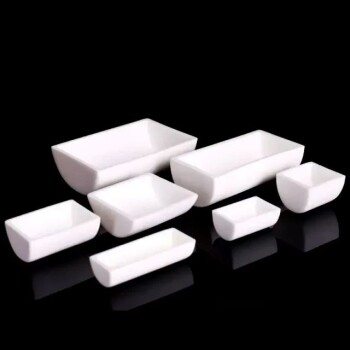
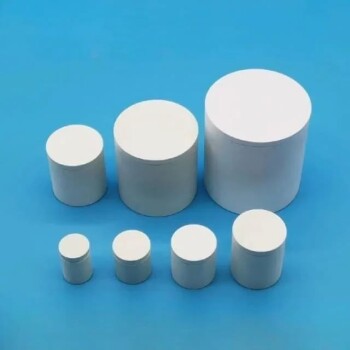
High-purity alumina is selected primarily for its exceptional chemical inertness and thermal stability. In corrosion experiments involving molten KCl-MgCl2 at temperatures between 500°C and 700°C, these crucibles effectively resist erosion. Their primary function is to contain the aggressive salt mixture without reacting with it, ensuring the experimental environment remains pure.
Core Takeaway The integrity of corrosion data relies on a chemically neutral environment. High-purity alumina prevents container components from leaching into the molten salt, ensuring that any observed degradation is solely due to the interaction between the alloy sample and the salt, not an artifact of crucible failure.
The Critical Role of Chemical Inertness
Eliminating External Interference
Molten chloride salts are chemically aggressive, particularly at elevated temperatures. The primary value of high-purity alumina is that it does not react with the KCl-MgCl2 mixture.
By remaining inert, the crucible prevents the leaching of container components into the salt. This is vital because dissolved impurities from a reacting crucible would alter the chemistry of the melt, invalidating the corrosion rates measured on the metal specimen.
Ensuring Accurate Data for Alloys
The ultimate goal of these experiments is often to study materials like 316 stainless steel.
If the crucible were to corrode, it would introduce foreign ions that could accelerate or inhibit the corrosion of the stainless steel. Alumina ensures the data reflects the true interaction between the steel and the specific salt components.
Thermal Stability and Structural Integrity
Withstanding High Operating Temperatures
Experiments with KCl-MgCl2 generally require sustained heating between 500°C and 700°C, with some protocols reaching as high as 800°C.
Alumina maintains its structural integrity across this range without softening or deforming. This stability allows for long-duration tests without the risk of mechanical failure or containment breach.
preventing Physical Penetration
Beyond surface chemistry, the dense material structure of high-purity alumina provides a physical barrier.
This density prevents the molten salt from penetrating the crucible walls. Absorption of salt into the crucible material can change the concentration of the melt over time; alumina’s resistance to penetration ensures the salt volume and composition remain constant throughout the test.
Understanding the Trade-offs
Sensitivity to Basicity
While alumina is excellent for standard chloride mixtures like KCl-MgCl2, it is not a universal solution for all molten salts.
You must be cautious if your experiment involves highly alkaline environments, such as those containing Lithium Oxide (Li2O). In these specific conditions, alumina is susceptible to basic fluxing corrosion, where the crucible itself dissolves. In such cases, alternative materials like high-density MgO are required to prevent contamination.
Making the Right Choice for Your Goal
Selecting the correct crucible material is a balance between temperature requirements and chemical compatibility with specific salt mixtures.
- If your primary focus is standard chloride corrosion (KCl-MgCl2): Use high-purity alumina to ensure maximum chemical inertness and prevent the leaching of impurities into your melt.
- If your primary focus is highly alkaline salts (containing Li2O): Switch to high-density MgO, as alumina will degrade and contaminate the system through basic fluxing.
- If your primary focus is electrochemical simulation: Consider high-purity graphite if you need the container to act as part of an electrochemical circuit, though this changes the chemical dynamic compared to insulating ceramics.
The validity of your corrosion data is defined by the neutrality of your containment vessel.
Summary Table:
| Feature | Advantage for KCl-MgCl2 Experiments |
|---|---|
| Chemical Inertness | Prevents leaching of container components into the salt melt. |
| Thermal Stability | Maintains structural integrity at temperatures between 500°C and 800°C. |
| Dense Structure | Prevents salt penetration, ensuring constant melt volume and composition. |
| Purity Control | Ensures observed corrosion data belongs solely to the alloy sample. |
| Optimal Use Case | Best for standard chloride mixtures; avoid highly alkaline salts like Li2O. |
Elevate Your Material Research with KINTEK Precision
Don't let crucible contamination compromise your corrosion data. KINTEK specializes in high-performance laboratory equipment and consumables designed for the most demanding thermal and chemical environments. Whether you are conducting molten salt experiments or advanced metallurgy, our high-purity alumina and MgO crucibles, ceramics, and high-temperature furnaces provide the reliability your research demands.
From muffle and vacuum furnaces to specialized high-temperature high-pressure reactors, we offer a comprehensive portfolio for battery research, material science, and industrial analysis. Contact KINTEK today to discuss your specific experimental needs and discover how our premium consumables can ensure the integrity of your results.
References
- Na Li, Zhongfeng Tang. Effect of Temperature and Impurity Content to Control Corrosion of 316 Stainless Steel in Molten KCl-MgCl2 Salt. DOI: 10.3390/ma16052025
This article is also based on technical information from Kintek Solution Knowledge Base .
Related Products
- Arc-Shaped Alumina Ceramic Crucible High Temperature Resistant for Engineering Advanced Fine Ceramics
- High Purity Alumina Granulated Powder for Engineering Advanced Fine Ceramics
- High Purity Pure Graphite Crucible for Evaporation
- Engineering Advanced Fine Alumina Al2O3 Ceramic Crucible for Laboratory Muffle Furnace
- High Purity Pure Graphite Crucible for Electron Beam Evaporation
People Also Ask
- Why Use Alumina Crucibles & Powder Burial for NaSICON? Ensure Phase Purity and Prevent Elemental Volatilization
- What is the primary purpose of using alumina crucibles for LLTO ceramics? Optimize Your High-Temperature Sintering
- Why are alumina crucibles and mother powder essential for LATP sintering? Optimize Your Solid Electrolyte Performance
- Why are high-purity alumina crucibles used for liquid lead corrosion experiments? Ensure Data Accuracy at 550°C
- Primary considerations for choosing alumina crucibles and quartz tubes in indium intercalation: Ensure Material Purity