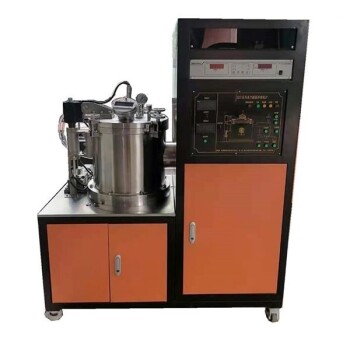
A high-vacuum annealing furnace is strictly required to prevent catastrophic material degradation and ensure structural bonding. Vanadium alloys are chemically active and highly susceptible to oxidation and nitrogen embrittlement when heated above 400°C. The vacuum environment isolates the material from these atmospheric gases during the 800°C heat treatment phase, while simultaneously driving atomic diffusion to strengthen the bond between the steel and vanadium layers.
The Core Takeaway The vacuum environment serves a dual purpose: it acts as a specific shield against embrittlement caused by oxygen and nitrogen absorption, and as a facilitator for atomic diffusion. This process expands the material's transition zone to approximately 22 μm, ensuring the composite layers remain securely bonded and resistant to delamination during service.
Protecting the Material Chemistry
Preventing Embrittlement
Vanadium alloys possess a critical vulnerability: they become highly reactive at elevated temperatures.
Specifically, above 400°C, these alloys will absorb oxygen and nitrogen if exposed to air. This absorption leads to oxidation and nitrogen embrittlement, which compromises the mechanical properties of the material.
Ensuring a Pure Environment
A high-vacuum furnace removes the atmosphere that causes this degradation.
By eliminating oxygen and nitrogen from the heating chamber, the furnace preserves the ductility and integrity of the vanadium. Additionally, the process provides a degassing effect, removing surface impurities and phosphorus chips to ensure a purified, bright finish.
Enhancing Structural Integrity via Diffusion
The Mechanics of Atomic Redistribution
Protection is only half the battle; the second function of the furnace is to fuse the materials.
At the specific annealing temperature of 800°C, the vacuum environment facilitates the redistribution of elements via diffusion. This allows atoms from the steel and vanadium layers to intermingle effectively without interference from oxide layers.
Optimizing the Interface Transition Zone
The ultimate goal of this diffusion is to widen the "transition zone"—the area where the two materials meet.
Without proper vacuum treatment, this zone may be too thin (typically 10-15 μm) to hold up under stress. The high-vacuum annealing process promotes continued atomic diffusion, increasing this interface thickness to approximately 22 μm.
Preventing Delamination
A thicker transition zone directly correlates to bond strength.
By achieving that critical 22 μm thickness, the process effectively eliminates residual stresses at the joint. This significantly enhances the layer bonding strength, ensuring the composite material does not peel apart (delaminate) when subjected to operational loads.
Understanding the Trade-offs
The Necessity of Strict Isolation
The primary "trade-off" in this process is the lack of margin for error regarding atmospheric control.
Unlike standard heat treatments where minor atmospheric fluctuations might be tolerable, any breach in the vacuum integrity during the 800°C phase will result in immediate contamination. The vanadium's sensitivity above 400°C means the vacuum is not optional; it is a binary requirement for success.
Complexity vs. Quality
While vacuum systems add equipment complexity, they offer superior repeatability.
Supplementary data indicates that despite the stringent requirements, vacuum furnaces often lead to cost reductions in the long run. This is achieved by increasing the product qualification rate (fewer rejected parts) and extending the service life of the tool through improved degassing and mechanical function.
Making the Right Choice for Your Goal
When planning the heat treatment of steel-vanadium composites, focus on these control parameters:
- If your primary focus is Durability: Ensure your thermal cycle holds at 800°C long enough to achieve the target 22 μm interface thickness, as this prevents delamination.
- If your primary focus is Material Ductility: Verify that the vacuum level is sufficient to maintain extremely low oxygen partial pressure, preventing the embrittlement that occurs above 400°C.
By strictly controlling the vacuum environment, you transform a potentially brittle composite into a cohesive, high-performance material.
Summary Table:
| Feature | Impact of High-Vacuum Annealing (800°C) |
|---|---|
| Atmospheric Control | Prevents oxygen/nitrogen absorption and brittle phase formation above 400°C |
| Surface Quality | Degassing effect removes impurities for a clean, bright finish |
| Interface Zone | Increases transition zone thickness from ~10-15 μm to ~22 μm |
| Structural Integrity | Enhances atomic diffusion to prevent delamination and bonding failure |
Elevate Your Composite Material Performance with KINTEK
Precision heat treatment is the difference between a high-performance alloy and a brittle failure. KINTEK specializes in advanced laboratory solutions designed for the most demanding metallurgical requirements.
Our comprehensive range of high-temperature vacuum furnaces (including muffle, tube, and atmosphere variants) provides the strict atmospheric control necessary to prevent embrittlement in reactive alloys like vanadium. Beyond thermal processing, we offer high-pressure reactors, crushing and milling systems, and hydraulic presses to support your entire material research workflow.
Ready to optimize your annealing process and achieve superior bonding strength?
References
- Т. А. Нечайкина, A. P. Baranova. Stability of the Transition Zones in a Steel–Vanadium Alloy–Steel Sandwich after Thermomechanical Treatment. DOI: 10.3103/s0967091218060062
This article is also based on technical information from Kintek Solution Knowledge Base .
Related Products
- Laboratory High Pressure Vacuum Tube Furnace
- Vacuum Heat Treat Furnace with Ceramic Fiber Liner
- Vacuum Heat Treat and Pressure Sintering Furnace for High Temperature Applications
- Ultra-High Temperature Graphite Vacuum Graphitization Furnace
- Vacuum Heat Treat and Sintering Furnace with 9MPa Air Pressure
People Also Ask
- What role does a high-vacuum tube furnace play in synthesizing manganese nitride? Achieve Precise Phase & Stoichiometry.
- What is the role of a high-vacuum tube furnace in preparing Co3S4@NiS2/C composite materials? Expert Synthesis Insights
- What is the primary function of a high-vacuum tube furnace in CVD synthesis of Sb-doped Bi2Se3? Precision Growth Control
- Role of High-Pressure Tube Furnace in Ru/OMC Synthesis: Achieve Precise Reduction & Nanostructure Control
- What is the primary function of a high-pressure tube furnace in the preparation of Laver biochar? Expert Pyrolysis Guide