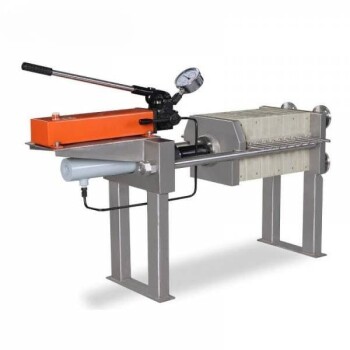
A hydraulic press or pellet machine transforms loose, finely ground mixed powders into high-density pellets to solve two critical operational challenges in vacuum carbothermic magnesium reduction. This mechanical compression is essential to prevent severe damage to the vacuum system caused by airborne particles and to ensure the efficient release of reaction gases.
Core Takeaway While loose powder offers high surface area, it creates mechanical chaos in a vacuum environment. Compressing the material into pellets stabilizes the reactants to protect equipment, while simultaneously creating the necessary physical spacing for magnesium vapor and carbon monoxide to escape efficiently.
Preserving Vacuum System Integrity
The primary mechanical reason for using a hydraulic press is to change the physical behavior of the raw material under vacuum conditions.
Mitigating "Flying" Particles
In a high-vacuum environment, loose, finely ground powders behave unpredictably. Without compression, these light particles are easily lifted by gas currents and suction.
Preventing Pipeline Clogging
If powder becomes airborne, it is drawn directly into the vacuum system's pipelines. Over time, this causes severe clogging, which degrades vacuum pressure and necessitates frequent, costly maintenance shutdowns. High-density pellets are too heavy to become airborne, eliminating this risk.
Enhancing Reaction Dynamics
Beyond equipment protection, the physical shape of the reactant plays a major role in the chemical efficiency of the reduction process.
Improving Gas Permeability
The carbothermic reduction of magnesium generates significant volumes of gas. Specifically, the reaction produces magnesium vapor and carbon monoxide (CO).
Facilitating Smooth Gas Escape
A bed of loose powder packs tightly, trapping these gases and increasing local pressure, which can stifle the reaction. In contrast, a bed of pellets creates natural voids (gaps) between the units. This "breathable" structure allows the Mg vapor and CO to flow freely out of the material layer, driving the reaction forward.
Understanding the Trade-offs
While pelletization is generally superior to using loose powder, it introduces specific variables that must be managed.
increased Process Complexity
Adding a hydraulic press or pellet machine introduces an additional step in the production line. This increases initial capital costs and energy consumption compared to simply loading powder.
Balancing Density
There is a limit to how dense a pellet should be. If a pellet is compressed too tightly, it may reduce the internal porosity required for the reaction to proceed at the center of the pellet. The goal is to achieve enough density to prevent dusting, but enough porosity to allow full conversion.
Optimizing Preparation for Reduction
To maximize the efficiency of your vacuum carbothermic reduction process, consider your specific operational constraints.
- If your primary focus is Equipment Longevity: Prioritize higher pellet density to minimize particle attrition and protect vacuum lines from clogging.
- If your primary focus is Reaction Kinetics: Focus on optimizing the size and shape of the pellets to maximize the permeability of the material layer for faster gas release.
Ultimately, pelletization is not merely a shaping process, but a critical control measure that safeguards your equipment while enabling the necessary gas flow for high-yield reduction.
Summary Table:
| Feature | Loose Powder Reactants | Compressed Pellets (via Hydraulic Press) |
|---|---|---|
| Vacuum System Safety | High risk of particle suction and clogging | Stable, high-density form; protects pipelines |
| Gas Permeability | Poor; traps Mg vapor and CO gas | High; natural voids allow efficient gas escape |
| Reaction Efficiency | Stifled by internal gas pressure | Optimized via breathable material structure |
| Maintenance Needs | Frequent shutdowns for cleaning | Low; minimal dust and debris in system |
Elevate Your Magnesium Reduction Efficiency with KINTEK
Precision pelletization is the backbone of successful vacuum carbothermic reduction. At KINTEK, we specialize in providing high-performance hydraulic presses (pellet, hot, isostatic) and crushing and milling systems designed to transform your raw powders into optimal reaction units.
Our equipment ensures your laboratory or production facility achieves the perfect balance of density and porosity, protecting your vacuum systems from airborne particles while maximizing gas release. Beyond pellet preparation, we offer a comprehensive range of high-temperature furnaces (vacuum, induction melting, tube) and essential consumables to support your entire material research workflow.
Ready to optimize your reduction process and extend your equipment life? Contact KINTEK today to find the perfect pelletizing solution for your lab!
Related Products
- Heated Hydraulic Press Machine with Heated Plates for Vacuum Box Laboratory Hot Press
- Automatic High Temperature Heated Hydraulic Press Machine with Heated Plates for Lab
- Manual High Temperature Heated Hydraulic Press Machine with Heated Plates for Lab
- Heated Hydraulic Press Machine with Integrated Manual Heated Plates for Lab Use
- 24T 30T 60T Heated Hydraulic Press Machine with Heated Plates for Laboratory Hot Press
People Also Ask
- Why is a heated laboratory hydraulic press necessary for composite laminates? Achieve Void-Free Structural Integrity
- How is a heated hydraulic press used for Li-LLZO batteries? Optimize Interfacial Bonding with Thermal-Pressure
- What is the core function of a laboratory heated hydraulic press in CSP? Revolutionize Low-Temp Ceramic Sintering
- What technical conditions does a heated hydraulic press provide for PEO batteries? Optimize Solid-State Interfaces
- What are heated hydraulic presses used for? Molding Composites, Vulcanizing Rubber, and More