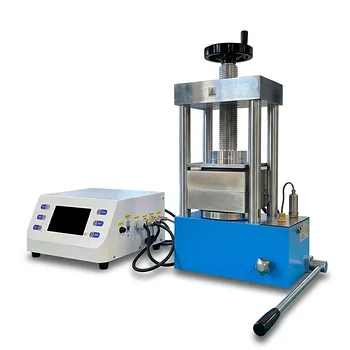
High pressure is the primary mechanism for achieving electrolyte density without heat. A laboratory hydraulic press capable of 500 MPa is required to exploit the high mechanical malleability of sulfide electrolytes (such as Li10SnP2S12). This specific pressure level allows for "cold pressing," which mechanically eliminates pores between particles and drastically reduces resistance, creating a conductive pathway for ions.
Core Takeaway
In All-Solid-State Batteries (ASSBs), the performance bottleneck is often the high resistance found at the boundaries between particles. A 500 MPa press solves this by physically deforming malleable electrolyte particles into a solid, void-free mass, ensuring high ionic conductivity and structural integrity without the damage or complexity of high-temperature sintering.
The Physics of Densification
Exploiting Material Malleability
The 500 MPa requirement is specifically tied to the unique properties of sulfide electrolytes. Unlike rigid ceramics, these materials possess high mechanical malleability.
When subjected to this specific magnitude of pressure, the material effectively flows. This allows loose powder to be compacted into a dense pellet solely through mechanical force.
Eliminating Grain Boundary Resistance
The primary enemy of ion transport in solid batteries is the grain boundary. If particles are loosely packed, the gaps (pores) between them act as barriers to ionic movement.
High-pressure cold pressing collapses these pores. It ensures that the individual grains fuse together, significantly reducing grain boundary resistance and creating a continuous path for lithium ions.
Avoiding Thermal Degradation
Many solid electrolyte materials are sensitive to high temperatures. Traditional sintering (using heat to fuse particles) can degrade these materials or cause unwanted chemical reactions.
By using 500 MPa of pressure, researchers achieve densification via cold pressing. This bypasses the need for thermal sintering, preserving the chemical stability of the electrolyte while still achieving the necessary density.
Interface Engineering and Assembly
Optimizing Solid-Solid Contact
In liquid batteries, the electrolyte wets the electrode surface, ensuring perfect contact. In ASSBs, you are trying to mate two rigid solids.
Continuous stacking pressure minimizes microscopic voids at these interfaces. This forces intimate physical contact between the cathode, electrolyte, and anode, which is critical for reducing interfacial contact resistance.
Precise Graded Pressure Control
Applying 500 MPa instantly can be destructive. Advanced presses allow for graded pressure control (stepwise application).
For example, a protocol might apply 100 MPa to form the initial electrolyte layer, followed by 370 MPa or higher to bond the entire stack. This prevents structural damage or cracking that often results from sudden, excessive force.
Creating Multi-Functional Composites
High-pressure pressing facilitates the creation of tri-layer composites. This involves integrating different powders—such as an inner layer for conductivity and outer layers for stability—into a single unit.
Stepwise pressing fuses these distinct layers into a cohesive pellet. This inhibits the growth of metal dendrites (which cause short circuits) by ensuring strong interfacial bonding between the layers.
Understanding the Trade-offs
Sulfides vs. Oxides (Cold Press vs. Sintering)
It is critical to distinguish between electrolyte types. For sulfides, 500 MPa achieves the final conductive state via cold pressing.
However, for harder oxide/ceramic electrolytes (like LATP or RPPOs), this pressure is used to create a "green body." While it reduces porosity, these materials typically still require a subsequent sintering (heating) stage to achieve maximum conductivity. The press here is a preparatory tool, not the final densification step.
The Risk of Over-Pressurization
While high pressure is necessary, it is not universally beneficial. Excessive pressure applied incorrectly can fracture the electrolyte layer or crush the electrode active materials.
This necessitates a press with high precision. The ability to control the ramp rate and hold time is just as important as the maximum pressure capability.
Making the Right Choice for Your Goal
To maximize the utility of a 500 MPa hydraulic press, tailor your approach to the specific material chemistry you are investigating.
- If your primary focus is Sulfide Electrolytes: Prioritize the press's ability to maintain high pressure (500 MPa) for extended periods to achieve full cold-pressing densification without heat.
- If your primary focus is Oxide/Ceramic Electrolytes: Focus on the press's ability to form uniform "green bodies" that will reduce porosity during the subsequent sintering phase.
- If your primary focus is Full Cell Assembly: Utilize graded pressure protocols (e.g., stepping from low to high pressure) to ensure tight interfacial contact without cracking the layers.
Ultimately, the 500 MPa capability is not just about force; it is about mechanically bridging the gap between loose powder and a high-performance, conductive solid.
Summary Table:
| Feature | Sulfide Electrolytes | Oxide/Ceramic Electrolytes |
|---|---|---|
| Primary Mechanism | Cold Pressing (Mechanical Flow) | Green Body Formation + Sintering |
| Pressure Target | ~500 MPa for full density | High pressure for initial compaction |
| Grain Boundaries | Mechanically fused | Thermally fused (Sintering) |
| Thermal Risk | High (Degrades easily) | Low (Requires heat for bonding) |
| Benefit of 500 MPa | Eliminates resistance without heat | Minimizes porosity before firing |
Elevate Your Battery Research with KINTEK Precision
Achieving the perfect 500 MPa cold-pressing density is critical for high-performance All-Solid-State Battery (ASSB) development. KINTEK specializes in advanced laboratory equipment, offering high-precision hydraulic presses (pellet, hot, and isostatic) designed specifically for the rigorous demands of material densification and interface engineering.
Whether you are working with malleable sulfides or forming green bodies for oxide ceramics, our systems provide the graded pressure control and stability needed to reduce interfacial resistance and prevent structural cracking. Beyond presses, explore our comprehensive range of high-temperature furnaces, high-pressure reactors, and battery research tools tailored for cutting-edge energy storage innovation.
Ready to optimize your assembly process? Contact KINTEK today to find the ideal pressing solution for your lab!
Related Products
- Laboratory Hydraulic Press Split Electric Lab Pellet Press
- Hydraulic Diaphragm Lab Filter Press for Laboratory Filtration
- Heated Hydraulic Press Machine with Integrated Manual Heated Plates for Lab Use
- Laboratory Hydraulic Press Lab Pellet Press Machine for Glove Box
- Automatic Laboratory Hydraulic Pellet Press Machine for Lab Use
People Also Ask
- What role does a laboratory hydraulic press play in platinum recovery research? Enhancing Sample Precision
- What are the specific applications of a lab hydraulic press in biochar evaluation? Optimize density and data accuracy.
- What are the roles of a laboratory hydraulic press and stainless steel molds in the preparation of graphite samples?
- What is the role of a laboratory hydraulic press in electrode prep? Maximize Energy Density & Sealing Precision
- Why must a laboratory hydraulic press equipped with cylindrical molds be used when preparing BZY green bodies? High Density