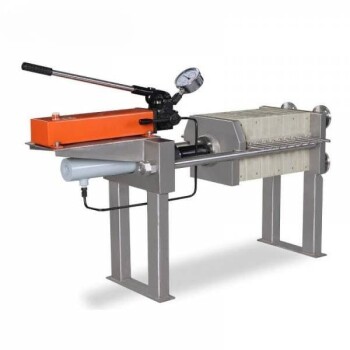
The precision of pressure application is the defining factor in the successful fabrication of Membrane Electrode Assemblies (MEA) for Electrochemical Hydrogen Compressors (EHC). A laboratory hydraulic press is essential because it provides the exact force and dwell time required to laminate the catalyst layer, gas diffusion layer, and proton exchange membrane into a single, cohesive unit.
Core Takeaway The hydraulic press ensures the structural survival and electrochemical efficiency of the MEA by creating a high-quality interface between material layers. This tight physical contact minimizes electrical resistance and fortifies the assembly against operating pressure differentials as high as 70–100 MPa.
The Critical Role of Lamination
Establishing Intimate Physical Contact
The primary function of the hydraulic press is to laminate the distinct layers of the MEA—the catalyst layer, gas diffusion layer, and proton exchange membrane.
By applying uniform force, the press eliminates microscopic gaps between these components. This ensures that the chemically active layers remain in tight physical contact, which is the prerequisite for effective proton exchange.
Reducing Interfacial Contact Resistance
Efficiency in an EHC is often lost at the boundaries between layers.
The high-pressure lamination process significantly lowers interfacial contact resistance. By maximizing the contact area between the catalyst and the diffusion layers, the press ensures that electron and proton transfer occurs with minimal impedance.
Withstanding Extreme Pressure Differentials
Electrochemical Hydrogen Compressors operate under punishing conditions, often generating pressure differentials of 70–100 MPa.
An MEA that is loosely assembled will delaminate or deform under these stresses. The hydraulic press creates a mechanical bond strong enough to maintain structural integrity, preventing the layers from separating during high-pressure operation.
Precise Control of Dwell Time
Applying pressure is not instantaneous; the material requires time to bond and settle.
Laboratory hydraulic presses allow for precise "dwelling" control—holding the specific pressure for a set duration. This prevents material "spring-back" and ensures the bond is permanent before the load is released.
Understanding the Trade-offs
The Risk of Over-Compression
While high pressure is necessary for a good bond, there is a distinct upper limit.
Excessive force can crush the porous structure of the gas diffusion layer or mechanically puncture the delicate proton exchange membrane. This damage restricts gas flow and can lead to immediate short-circuiting of the cell.
Uniformity vs. localized Stress
If the press platens are not perfectly parallel, pressure will be applied unevenly.
This results in "hot spots" of over-compression and areas of weak bonding within the same assembly. Inconsistent lamination leads to uneven current distribution and premature failure of the MEA during operation.
Making the Right Choice for Your Goal
Selecting the correct parameters for your hydraulic press depends on the specific operational demands of your EHC.
- If your primary focus is High-Pressure Durability: Prioritize higher bonding pressures and longer dwell times to ensure the laminate withstands 70–100 MPa differentials without separating.
- If your primary focus is Electrochemical Efficiency: Optimize for the lowest pressure that achieves sufficient bonding to minimize contact resistance without compromising the porosity of the diffusion layers.
The laboratory hydraulic press is not merely an assembly tool; it is the instrument that determines the ultimate limit of your compressor's efficiency and lifespan.
Summary Table:
| Parameter | Importance in MEA Fabrication | Impact on EHC Performance |
|---|---|---|
| Pressure Precision | Uniform lamination of catalyst and membrane layers | Minimizes interfacial resistance and electrical loss |
| Dwell Time Control | Allows materials to bond and settle permanently | Prevents material spring-back and structural delamination |
| Structural Integrity | Creates bonds capable of withstanding 70–100 MPa | Ensures durability under extreme operating differentials |
| Uniformity | Avoids localized stress and 'hot spots' | Ensures even current distribution and longer cell lifespan |
Elevate Your Electrochemical Research with KINTEK Precision
Fabricating high-performance Membrane Electrode Assemblies (MEA) requires the uncompromising accuracy that only professional-grade equipment can provide. KINTEK specializes in advanced laboratory solutions designed for the most demanding energy research applications. Our high-precision hydraulic presses (pellet, hot, and isostatic) are engineered to provide the exact force and dwell time control necessary to optimize your EHC efficiency and durability.
Beyond lamination, KINTEK offers a comprehensive ecosystem for electrochemical innovation, including:
- Electrolytic cells and electrodes for advanced testing.
- High-temperature high-pressure reactors and autoclaves for extreme condition simulation.
- Crushing, milling, and sieving systems for catalyst preparation.
- Specialized PTFE products, ceramics, and crucibles for chemical compatibility.
Ready to achieve superior bonding and structural integrity in your lab? Contact KINTEK today to find the perfect hydraulic press and consumables for your hydrogen research and material processing needs.
References
- Jiexin Zou, Haijiang Wang. Electrochemical Compression Technologies for High-Pressure Hydrogen: Current Status, Challenges and Perspective. DOI: 10.1007/s41918-020-00077-0
This article is also based on technical information from Kintek Solution Knowledge Base .
Related Products
- Laboratory Hydraulic Press Lab Pellet Press Machine for Glove Box
- Laboratory Hydraulic Press Split Electric Lab Pellet Press
- Laboratory Hydraulic Press Lab Pellet Press for Button Battery
- Automatic Laboratory Hydraulic Press for XRF & KBR Pellet Press
- Automatic Laboratory Hydraulic Pellet Press Machine for Lab Use
People Also Ask
- What is the function of a laboratory hydraulic press in W-Cu composites? Control Porosity and Material Ratio
- What is the role of a laboratory hydraulic press in the initial stages of Li6PS5Cl preparation? Key to Green Pellets
- What role does a laboratory hydraulic press play in triboelectric testing? Achieve Precision Alloy Sample Prep
- How can a laboratory hydraulic press be applied to chitosan for wastewater treatment? Optimize Pores & Strength
- How do a precision laboratory hydraulic press and specialized molds contribute to the fabrication of spherical ceramic samples? Achieving High-Density Material Precision