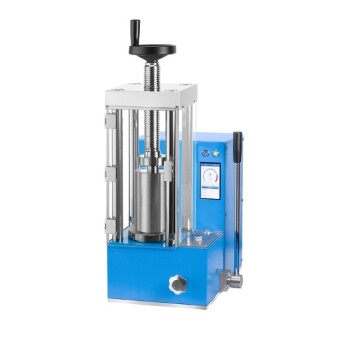
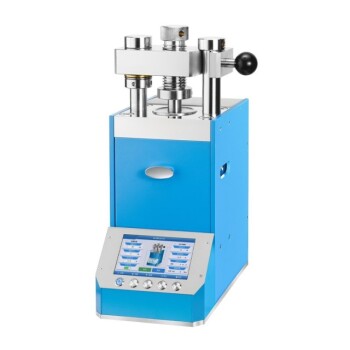
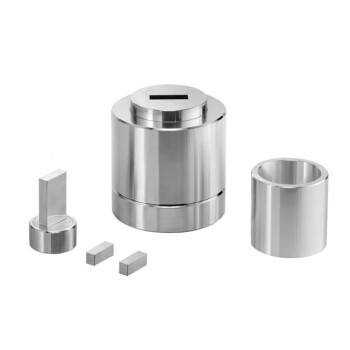
A laboratory hydraulic press is the critical enabler of ion transport in all-solid-state lithium-selenium batteries. It functions by applying precise, high-tonnage pressure to compress loose cathode composites and solid electrolyte powders into dense, unified structures. This mechanical force is necessary to eliminate microscopic voids between particles, ensuring the physical continuity required for the battery to operate.
In solid-state battery assembly, physical contact equals electrochemical performance. The hydraulic press forces solid particles into an intimate interface, drastically reducing porosity and lowering charge transfer resistance to facilitate lithium-ion movement.
The Core Challenge: Solid-Solid Interfaces
Overcoming the Lack of Wettability
Unlike liquid electrolytes, which naturally flow into pores and wet electrode surfaces, solid electrolytes are rigid. They cannot spontaneously fill gaps between particles.
Without external force, the interface between the cathode and the electrolyte remains full of voids. These voids act as insulators, blocking the path of lithium ions.
Establishing Ion Transport Channels
The primary role of the hydraulic press is to mechanically bridge these gaps. By compacting the materials, the press creates a continuous path for ions to travel.
This "cold pressing" process ensures effective lithium-ion transport. It creates the robust solid-solid contact necessary to reduce interfacial impedance.
The Densification Process
Creating Dense Bilayer and Trilayer Structures
The press is used to mold complex powder mixtures into cohesive pellets. It compresses cathode composite powders and solid electrolyte powders into dense bilayer or trilayer stacks.
This layering must be physically tight to function. The pressure bonds these distinct layers into a single, integrated unit.
Reducing Porosity
High-tonnage pressure densifies the material, specifically targeting components like Li6PS5Cl-based composites. This transforms loose powder into low-porosity membranes.
Minimizing porosity is fundamental to battery health. It maximizes the active area available for chemical reactions and prevents structural failure.
Pre-forming Green Bodies
Beyond electrochemical performance, the press provides structural integrity. It applies uniaxial pressure to create a "green body"—a pre-formed pellet with enough strength to be handled.
This allows the unit to maintain its geometric shape. It creates operational integrity for subsequent steps, such as encapsulation or secondary densification.
Understanding the Trade-offs
Precision vs. Force
While high pressure is required, it must be applied with precision. The goal is to achieve densification without crushing the active materials or damaging the crystal structure of the electrolyte.
For example, creating a coin cell often requires specific pressures (approximately 10 MPa) to optimize contact without inducing mechanical failure.
Interfacial Impedance
If the pressure is insufficient, the contact area between particles will be too small. This results in high charge transfer resistance, severely limiting the battery's charge and discharge performance.
Conversely, achieving the lowest possible impedance requires maximizing density. The hydraulic press is the primary tool for tuning this variable.
Optimizing Your Assembly Process
To ensure your lithium-selenium test units function correctly, you must view the hydraulic press not just as a shaping tool, but as a device that determines the internal resistance of your cell.
- If your primary focus is electrochemical efficiency: Apply sufficient pressure to maximize the density of the electrolyte membrane, as this directly reduces interfacial impedance and boosts ion transport.
- If your primary focus is sample handling and integrity: Use the press to establish a robust "green body" that can withstand transfer and encapsulation without crumbling or delaminating.
The success of a solid-state battery relies entirely on how effectively you can force two solids to behave as a continuous medium.
Summary Table:
| Feature | Role in Battery Assembly | Benefit to Solid-State Cells |
|---|---|---|
| High-Tonnage Force | Eliminates microscopic voids | Reduces charge transfer resistance |
| Densification | Compresses loose powders into pellets | Lowers porosity for better ion flow |
| Layer Integration | Bonds cathode and electrolyte stacks | Creates a unified bilayer/trilayer structure |
| Uniaxial Pressure | Pre-forms stable "green bodies" | Ensures structural integrity for handling |
| Interface Optimization | Maximizes solid-solid contact | Facilitates efficient lithium-ion transport |
Maximize Your Battery Research Efficiency with KINTEK
Precise densification is the key to minimizing interfacial impedance in all-solid-state batteries. KINTEK specializes in high-performance laboratory equipment, including specialized hydraulic presses (pellet, hot, isostatic) designed to create dense, low-porosity structures for lithium-selenium battery test units.
From high-temperature furnaces and crushing systems to high-pressure reactors and specialized battery research tools, our comprehensive portfolio supports every stage of your material science workflow. Let our experts help you achieve the perfect solid-solid interface for your next breakthrough.
Ready to optimize your assembly process? Contact us today to find the perfect laboratory press for your lab!
Related Products
- Laboratory Hydraulic Press Lab Pellet Press for Button Battery
- Electric Lab Cold Isostatic Press CIP Machine for Cold Isostatic Pressing
- Laboratory Hydraulic Press Split Electric Lab Pellet Press
- Warm Isostatic Press for Solid State Battery Research
- Laboratory Hydraulic Press Lab Pellet Press Machine for Glove Box
People Also Ask
- Why use a lab hydraulic press for 380 MPa Ti-Al alloy compaction? Unlock superior density and structural integrity.
- Why is a high-precision laboratory hydraulic press necessary for radiation-shielding? Ensure Data Accuracy & Density
- What is the function of a laboratory hydraulic press in preparing La2FeCrO6? Ensure High-Density Ceramic Pellets
- Why is a laboratory hydraulic press required during the preparation of Ti3AlC2 precursor pellets?
- How does the laboratory hydraulic press contribute to the preparation of solid targets for laser ablation?