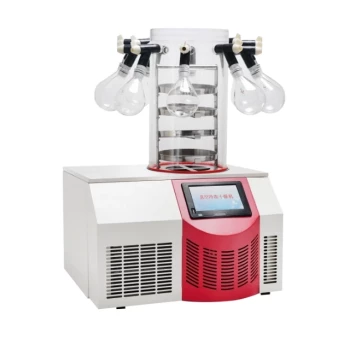
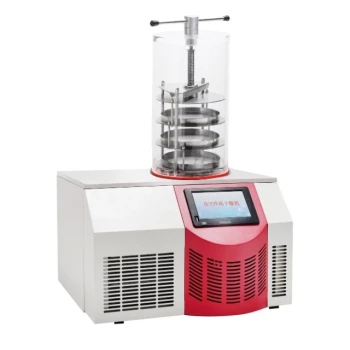
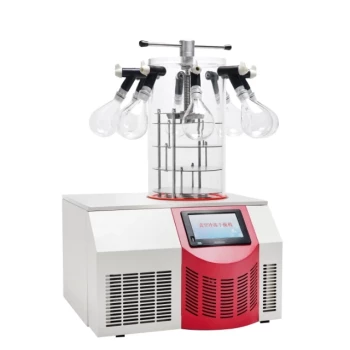
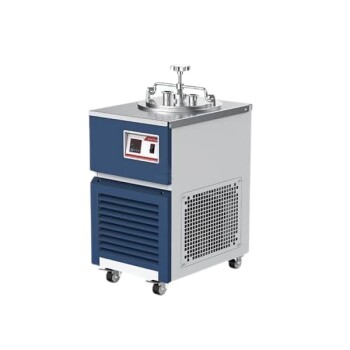
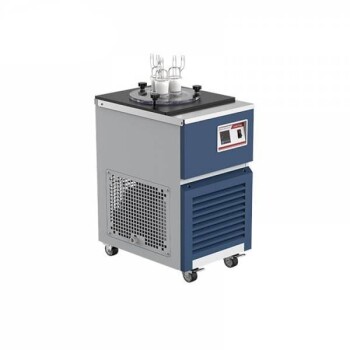
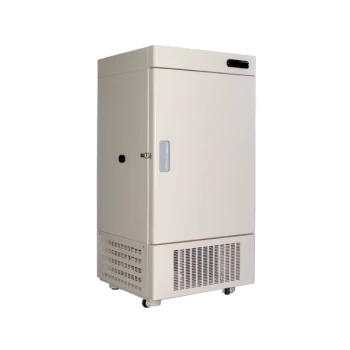
The decisive factor is the preservation of microstructure. A laboratory vacuum freeze dryer is preferred for Montmorillonite and titanium dioxide (TiO2) composites because it removes moisture via sublimation rather than evaporation. Unlike blast drying ovens, which rely on heat, freeze drying prevents the physical collapse of the material's framework and the clumping of nanoparticles, ensuring the final product retains the specific surface area required for high performance.
Core Takeaway While standard heat drying often damages delicate nanomaterials, vacuum freeze drying locks in the composite's optimal structure. It effectively prevents the collapse of Montmorillonite layers and the agglomeration of titanium dioxide, resulting in a highly porous material essential for efficient molecular adsorption and catalysis.
The Mechanism of Preservation
The Role of Sublimation
The fundamental advantage of a vacuum freeze dryer is its ability to bypass the liquid phase of water.
By freezing the material and then reducing the pressure, ice transforms directly into water vapor (sublimation). This avoids the high surface tension forces associated with liquid evaporation, which are the primary cause of material shrinkage during drying.
Avoiding Thermal Damage
Blast drying ovens rely on applying heat to evaporate solvents.
For sensitive composites, this thermal stress can alter the chemical and physical state of the components. Freeze drying eliminates this risk by operating at low temperatures, ensuring the material’s original synthesis characteristics remain intact.
Impact on Component Integrity
Protecting the Montmorillonite Structure
Montmorillonite is defined by its unique layered structure.
When subjected to the high temperatures of a blast drying oven, these layers frequently suffer from shrinkage and structural collapse. Freeze drying preserves the spacing between these layers, maintaining the material's expanded framework.
Preventing TiO2 Agglomeration
Titanium dioxide nanoparticles are highly prone to "hard agglomeration."
Under the heat of a drying oven, these nanoparticles tend to fuse into larger clusters, drastically reducing their effectiveness. Vacuum freeze drying keeps the particles dispersed, preventing them from fusing together and preserving their individual nanoscale properties.
Performance Outcomes
Maximizing Specific Surface Area
The combination of open Montmorillonite layers and dispersed TiO2 nanoparticles creates a material with a high specific surface area.
This porosity is the critical metric for these composites. A denser, collapsed material produced by heat drying would have significantly less surface area available for chemical reactions.
Enhancing Adsorption and Diffusion
The preserved porous structure directly translates to better performance in applications like wastewater treatment.
For example, when treating pollutants like phenol, the open structure facilitates easier diffusion and adsorption of molecules onto the catalyst surface. If the structure had collapsed during oven drying, the active sites would be inaccessible.
Understanding the Trade-offs
The Case for Heat Treatment
While freeze drying is preferred for surface area, it is not the universal solution for every synthesis step.
Blast drying ovens are superior for processes requiring thermal aging. Prolonged exposure to specific temperatures can promote further hydrolysis and strengthen the chemical bonds between precursors and the carrier surface.
Balancing Stability vs. Porosity
If the primary goal is maximizing mechanical stability or bond strength between the TiO2 and the support, a drying oven might be necessary.
However, for applications prioritizing adsorption capacity and catalytic activity, the loss of surface area caused by heat usually outweighs the benefits of thermal aging.
Making the Right Choice for Your Goal
To select the correct drying method, you must identify the critical performance metric for your specific composite material.
- If your primary focus is Adsorption and Catalytic Activity: Use a vacuum freeze dryer to maximize specific surface area and prevent particle agglomeration.
- If your primary focus is Structural Bonding: Use a drying oven to promote thermal aging and strengthen the attachment of precursors to the carrier.
Ultimately, for high-performance Montmorillonite/TiO2 composites, freeze drying is the superior choice because it prioritizes the accessibility of active sites over simple solvent removal.
Summary Table:
| Feature | Vacuum Freeze Dryer | Blast Drying Oven |
|---|---|---|
| Drying Mechanism | Sublimation (Solid to Gas) | Evaporation (Liquid to Gas) |
| Temperature Range | Low/Sub-zero temperatures | High/Elevated temperatures |
| Microstructure | Preserves layers & porosity | Causes shrinkage & collapse |
| Particle State | Prevents TiO2 agglomeration | Risk of nanoparticle fusing |
| Key Outcome | High specific surface area | Enhanced thermal bonding |
| Best Application | Catalysis & Adsorption | Structural aging & stability |
Elevate your material synthesis with KINTEK’s precision drying solutions. Whether you require high-performance vacuum freeze dryers to preserve delicate nanostructures or advanced blast drying ovens for thermal aging, KINTEK provides the specialized laboratory equipment needed for superior results. From high-temperature furnaces and hydraulic presses to our industry-leading freeze dryers and cooling solutions, we empower researchers to achieve maximum surface area and catalytic efficiency. Contact KINTEK today to find the perfect equipment for your Montmorillonite and titanium dioxide research!
References
- Li Zhang, Keiko Sasaki. Fabrication of Adsorbed Fe(III) and Structurally Doped Fe(III) in Montmorillonite/TiO2 Composite for Photocatalytic Degradation of Phenol. DOI: 10.3390/min11121381
This article is also based on technical information from Kintek Solution Knowledge Base .
Related Products
- Benchtop Laboratory Vacuum Freeze Dryer
- High Performance Laboratory Freeze Dryer
- High Performance Laboratory Freeze Dryer for Research and Development
- Benchtop Laboratory Freeze Dryer for Lab Use
- Vacuum Cold Mounting Machine for Sample Preparation
People Also Ask
- What are the technical advantages of using a laboratory freeze dryer for porous carbon precursors? Preserve 3D Networks
- How do laboratory freeze dryers support scientific research? Preserve Sample Integrity for Reproducible Results
- Why is a laboratory freeze dryer preferred over traditional heating? Preserve Biochar Structure & Maximize Porosity
- What types of liquid samples can be processed using a laboratory freeze dryer? Preserve Your Sensitive Materials
- What role do laboratory freeze dryers play in the food industry? Unlock Superior Food Preservation