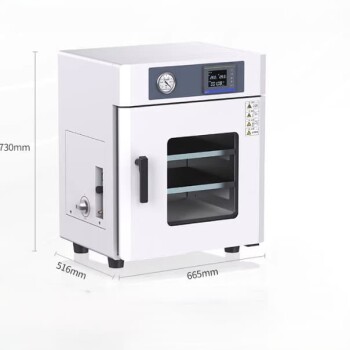
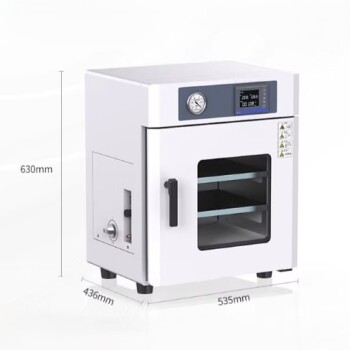
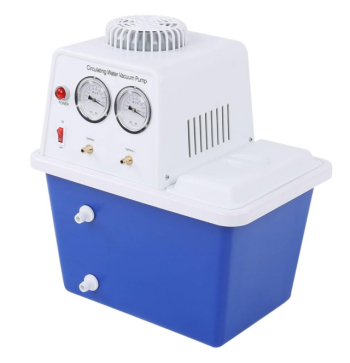
A laboratory vacuum oven is essential for this process because it lowers the environmental pressure, allowing residual solvents like ethanol or water to evaporate rapidly at mild temperatures, often around 45°C. This technique is critical for acid-functionalized nanoparticles because it thoroughly removes solvents from deep pores without subjecting the material to high heat that would destroy its chemical structure.
Core Takeaway The primary function of vacuum drying in this context is to decouple drying speed from high heat. By reducing the solvent's boiling point, the oven prevents the thermal degradation and cross-linking of sensitive acid functional groups, ensuring the nanoparticles retain their maximum number of catalytic active sites.
The Mechanics of Preservation
Lowering the Boiling Point
The fundamental principle driving this process is the relationship between pressure and vaporization. By reducing the pressure inside the chamber, the boiling point of solvents like water and ethanol drops significantly.
Gentle Evaporation
This allows evaporation to occur efficiently at temperatures as low as 45°C. In a standard oven, achieving similar drying rates would require much higher temperatures, which poses a severe risk to chemically modified nanomaterials.
Deep Pore Cleaning
Nanoparticles often possess complex, porous structures where solvents can become trapped. The vacuum environment effectively pulls these residual solvents out of the pores, ensuring the material is completely dry rather than just superficially dry.
Protecting Chemical Functionality
Preventing Thermal Degradation
Acid-functionalized nanoparticles, such as those with sulfonic acid groups, are thermally sensitive. High temperatures can cause these functional groups to decompose, effectively stripping the nanoparticle of its intended chemical properties.
Avoiding Surface Cross-Linking
One of the specific risks identified in the primary literature is surface cross-linking. When exposed to excessive heat, functional groups on the surface of the nanoparticles may react with one another.
Maximizing Active Sites
Cross-linking reduces the availability of "free" functional groups. By drying at low temperatures under vacuum, these side reactions are prevented, maximizing the retention of catalytic active sites available for future reactions.
Physical and Environmental Safeguards
Preventing Oxidation
In addition to thermal protection, the vacuum environment removes oxygen from the drying chamber. This prevents potential oxidation of the material surface, which is critical for maintaining high purity.
Maintaining Morphology
High-heat drying often leads to thermal sintering, where particles fuse together, or the collapse of delicate microsphere structures. Vacuum drying preserves the original morphology and prevents agglomeration, ensuring the high surface area of the nanoparticles is maintained.
Understanding the Trade-offs
Equipment Complexity and Maintenance
Unlike standard convection ovens, vacuum ovens require a vacuum pump system. This introduces complexity regarding pump oil maintenance and the need to ensure chemical compatibility between the pump seals and the solvents being evaporated (e.g., acidic vapors or harsh organic solvents).
Risk of Powder Loss
Because the material is often a fine powder, sudden changes in pressure can cause the nanoparticles to become airborne and sucked into the vacuum line. Careful control of the vacuum release and venting valves is required to prevent sample loss.
Making the Right Choice for Your Goal
When processing functionalized nanomaterials, the drying method dictates the final quality of your catalyst.
- If your primary focus is Catalytic Activity: Prioritize the lowest effective temperature (e.g., 45°C) to prevent cross-linking of sulfonic acid groups and maximize active site retention.
- If your primary focus is Structural Integrity: Rely on the vacuum environment to prevent sintering and agglomeration, preserving the porous morphology of the particles.
- If your primary focus is Chemical Purity: Ensure the vacuum seal is tight to exclude oxygen, preventing oxidation impurities during the drying phase.
By utilizing a vacuum oven, you effectively trade thermal stress for mechanical pressure control, securing the chemical potency of your nanoparticles.
Summary Table:
| Feature | Vacuum Oven Benefit | Impact on Nanoparticles |
|---|---|---|
| Temperature | Lowered boiling point (e.g., 45°C) | Prevents thermal degradation & functional group loss |
| Pressure | Reduced environmental pressure | Accelerates solvent removal from deep pores |
| Environment | Oxygen-free chamber | Eliminates oxidation & maintains chemical purity |
| Morphology | Gentle, low-heat drying | Prevents sintering, agglomeration & structural collapse |
Maximize Your Material’s Catalytic Potential with KINTEK
Preserving the integrity of sensitive acid-functionalized nanoparticles requires more than just heat—it requires precise control. KINTEK specializes in high-performance laboratory vacuum ovens designed to protect your samples from thermal degradation while ensuring thorough solvent removal.
Our extensive portfolio of lab equipment and consumables includes:
- Advanced Drying Solutions: High-precision vacuum ovens and cold traps for delicate materials.
- Material Processing: High-temperature furnaces (muffle, tube, vacuum) and high-pressure reactors.
- Sample Preparation: Crushing, milling systems, and hydraulic presses for pelletizing.
- Specialized Consumables: PTFE products, ceramics, and crucibles for harsh chemical environments.
Don’t risk losing your active sites to surface cross-linking or oxidation. Contact KINTEK today to find the perfect drying solution for your advanced nanomaterial research and production.
References
- D. Wang, Keith L. Hohn. Acid-Functionalized Nanoparticles for Pretreatment of Wheat Straw. DOI: 10.4236/jbnb.2012.33032
This article is also based on technical information from Kintek Solution Knowledge Base .
Related Products
- 56L Vertical Laboratory Vacuum Drying Oven
- 23L Laboratory Vacuum Drying Oven
- Laboratory Scientific Electric Heating Blast Drying Oven
- Laboratory Sterilizer Lab Autoclave Pulsating Vacuum Desktop Steam Sterilizer
- High Temperature Muffle Oven Furnace for Laboratory Debinding and Pre Sintering
People Also Ask
- Why is a laboratory vacuum drying oven recommended for rice straw residues? Protect Your Biomass Integrity
- What role does a laboratory vacuum drying oven play in the preparation of modified multi-walled carbon nanotubes?
- What is the importance of using a laboratory vacuum drying oven? Preserving Slow-Release Microcapsule Integrity
- Why is a Laboratory Vacuum Drying Oven recommended for PBAT microspheres? Protect Sensitive Polymer Integrity
- What role does a laboratory vacuum drying oven play in processing nanoparticle powder samples? Protect Sample Integrity