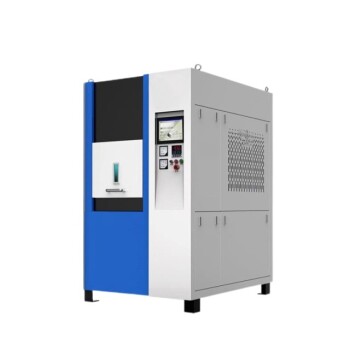
The primary role of the plasma arc remelting furnace in the Japan Titanium Society (JTS) process is to separate titanium from molten salts. Because the JTS process yields titanium powder suspended in salts, the furnace provides the intense, concentrated heat necessary to melt the metal into dense ingots without boiling the surrounding salts or exposing the titanium to atmospheric contamination.
By delivering precise thermal energy, the plasma arc furnace allows titanium to melt at temperatures below the boiling point of the salt mixture, solving the complex problem of extracting pure metal from a chemical suspension.
The Mechanics of Separation
Handling the Salt Suspension
In the JTS process, the raw output is not a solid block of metal, but rather titanium powder suspended within molten salts.
To make this material useful, the titanium must be extracted and consolidated. The plasma arc furnace is specifically employed to transition the titanium from a suspended powder into a usable solid form.
The Role of Concentrated Heat
The furnace generates an intense and concentrated heat source.
This intensity is critical because it targets the metal directly, allowing for rapid phase changes that less focused heating methods might fail to achieve.
Critical Thermal Dynamics
Melting Without Boiling
The defining advantage of using a plasma arc in this context is temperature management. The furnace allows the titanium metal to melt while keeping the temperature below the boiling point of the surrounding salts.
This thermal precision prevents the salts from vaporizing violently, which would complicate the separation process and potentially damage the equipment.
Condensation into Ingots
Once melted, the titanium separates completely from the residual salts.
The molten metal then condenses into dense titanium ingots. This step transforms the loose powder into a solid, structural material ready for further processing.
Ensuring Material Purity
Atmospheric Protection
Titanium is highly reactive at high temperatures, making it susceptible to degradation from oxygen and nitrogen in the air.
The plasma arc remelting process ensures the metal is protected from atmospheric contamination. This results in a final ingot that maintains the high purity levels required for industrial applications.
Understanding the Operational Trade-offs
Precision Requirements
While effective, this process relies on a narrow thermal window. Operators must ensure the heat is sufficient to melt the titanium but not so intense that it exceeds the salt's boiling threshold.
Complexity of Separation
Achieving complete separation is dependent on the stability of the arc. Any fluctuation in heat intensity could theoretically leave residual salts trapped within the metal or result in incomplete ingot formation.
Implications for Process Design
If your primary focus is material purity:
- This furnace is essential because it shields the reactive molten titanium from atmospheric contaminants during consolidation.
If your primary focus is recovery efficiency:
- The plasma arc is the optimal choice for maximizing yield, as it consolidates suspended powder into dense ingots without losing material to salt vaporization.
The plasma arc remelting furnace is not just a heat source; it is a precision separation tool that bridges the gap between raw chemical output and structural metal.
Summary Table:
| Feature | Benefit in JTS Process |
|---|---|
| Concentrated Heat | Rapidly melts titanium powder into dense, usable ingots |
| Thermal Precision | Keeps temperature below salt boiling point to prevent vaporization |
| Atmospheric Shielding | Protects reactive titanium from oxygen and nitrogen contamination |
| Phase Separation | Effectively extracts pure metal from complex chemical salt suspensions |
Elevate Your Material Purity with KINTEK
Are you looking to optimize your metal extraction or high-temperature processing? KINTEK specializes in advanced laboratory equipment designed for the most demanding applications. Whether you need precise vacuum or atmosphere furnaces, high-performance induction melting systems, or specialized high-temperature reactors, we provide the tools necessary to achieve superior material integrity.
From titanium processing to battery research, our comprehensive range of high-temperature solutions, crushing systems, and cooling equipment empowers labs to reach new levels of efficiency. Contact us today to discuss how our expert-grade furnaces and consumables can refine your industrial processes and maximize your yields.
References
- Nyasha Matsanga, Willie Nheta. An Overview of Thermochemical Reduction Processes for Titanium Production. DOI: 10.3390/min15010017
This article is also based on technical information from Kintek Solution Knowledge Base .
Related Products
- Spark Plasma Sintering Furnace SPS Furnace
- Vacuum Arc Induction Melting Furnace
- Non Consumable Vacuum Arc Induction Melting Furnace
- Vacuum Heat Treat Furnace and Levitation Induction Melting Furnace
- Lab-Scale Vacuum Induction Melting Furnace
People Also Ask
- What is SPS sintering method? A Guide to High-Speed, High-Performance Material Fabrication
- Why are Spark Plasma Sintering (SPS) furnaces or hot presses utilized in the preparation of Li3PS4 solid electrolytes?
- What is the difference between spark plasma sintering and flash sintering? A Guide to Advanced Sintering Methods
- What technical advantages does a Spark Plasma Sintering (SPS) furnace offer for LZP ceramics? Enhance Ionic Conductivity
- What is the theory of spark plasma sintering? A Guide to Rapid, Low-Temperature Densification