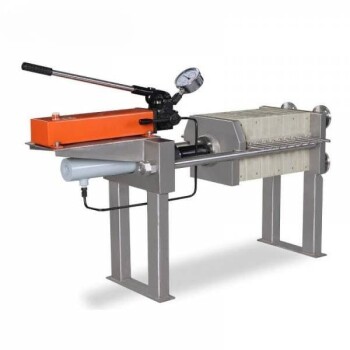
Applying pressure up to 1.0 GPa is essential to drive the plastic deformation and rearrangement of copper nanoparticles. This intense mechanical force acts as the primary catalyst for densification, allowing the material to reach relative densities as high as 96.60% by effectively eliminating internal pore defects.
Nanostructured powders possess significant resistance to consolidation that lower pressures cannot overcome. Increasing pressure to 1.0 GPa provides the necessary energy to mechanically fuse discrete particles into a high-quality, dense bulk material.
The Mechanism of Densification
Driving Force for Particle Movement
The laboratory hydraulic press provides the fundamental driving force required to transform loose powder into a solid mass.
Without this external force, the friction and geometric interactions between nanoparticles prevent them from settling into a compact structure.
Plastic Deformation and Rearrangement
Research demonstrates that as pressure increases from 0.250 GPa to 1.000 GPa, the behavior of the copper nanoparticles changes drastically.
At these high pressures, the particles undergo significant plastic deformation, physically changing shape to accommodate one another.
Simultaneously, the particles experience rearrangement, shifting positions to fill the voids that naturally exist in a loose powder bed.
The Impact on Material Quality
Maximizing Relative Density
The direct correlation between pressure and density is critical for material performance.
By utilizing pressures up to 1.0 GPa, researchers can achieve a relative density of approximately 96.60%.
This creates a bulk material that is nearly as dense as solid, cast copper, which is the ultimate goal of powder metallurgy.
Minimizing Internal Defects
A primary reason for using such high pressure is the reduction of pore defects.
Low-pressure consolidation leaves air gaps (pores) inside the material, which act as weak points and stress concentrators.
High pressure collapses these pores, resulting in a cohesive structure with superior mechanical integrity.
Operational Trade-offs and Equipment Demands
Requirement for Specialized Molds
Applying 1.0 GPa is not without engineering challenges, particularly regarding the containment vessels.
High-strength pressure molds are mandatory; standard molds may deform or fracture under GPa-level pressures, especially if high temperatures are also involved.
Complexity of Atmosphere Control
The process often requires transferring powders between inert environments, such as a glove box and a vacuum hot press.
The molds must serve a dual purpose: withstanding the crushing force of the press while maintaining a perfect seal to prevent the copper nanopowders from oxidizing in the air.
This adds a layer of complexity, as the mold material must be mechanically robust yet capable of precise sealing.
Making the Right Choice for Your Project
High pressure is a tool to achieve specific material properties, but it dictates your equipment selection.
- If your primary focus is maximum structural integrity: You must utilize a press capable of 1.0 GPa to achieve >96% density and ensure plastic deformation eliminates pore defects.
- If your primary focus is equipment longevity: You must select high-strength mold materials explicitly rated for GPa-level loads to prevent catastrophic failure during the pressing cycle.
Success in processing nanostructured copper lies in balancing the need for extreme force with the mechanical limits of your containment tooling.
Summary Table:
| Parameter | Influence at 0.25 GPa | Influence at 1.0 GPa |
|---|---|---|
| Relative Density | Lower / Incomplete | Up to 96.60% (High Density) |
| Particle Behavior | Minimal movement | Significant plastic deformation |
| Pore Defects | High residual porosity | Effectively eliminated |
| Mechanical Integrity | Weak / Prone to failure | Superior cohesive strength |
| Tooling Requirement | Standard molds | High-strength specialized molds |
Elevate Your Material Research with KINTEK Precision Solutions
Unlock the full potential of your nanostructured materials with KINTEK’s high-performance laboratory equipment. Whether you are processing copper powders at GPa-level pressures or conducting advanced powder metallurgy, our manual and automatic hydraulic presses (pellet, hot, and isostatic) provide the consistent force required for maximum densification.
Why choose KINTEK?
- Robust Engineering: Our presses and specialized molds are designed to withstand extreme loads without deformation.
- Comprehensive Lab Portfolio: Beyond pressing, we offer high-temperature furnaces, high-pressure reactors, and essential consumables like ceramics and crucibles.
- Expert Support: We help researchers select the right tools for battery research, crushing, milling, and vacuum processes.
Ensure superior mechanical integrity for your projects today. Contact KINTEK for a customized solution and expert consultation!
Related Products
- Laboratory Hydraulic Press Lab Pellet Press Machine for Glove Box
- Laboratory Hydraulic Press Split Electric Lab Pellet Press
- Automatic Laboratory Hydraulic Press for XRF & KBR Pellet Press
- Laboratory Hydraulic Press Lab Pellet Press for Button Battery
- Automatic Laboratory Hydraulic Pellet Press Machine for Lab Use
People Also Ask
- What is the function of a laboratory hydraulic press in W-Cu composites? Control Porosity and Material Ratio
- What is the role of a laboratory hydraulic press in the initial stages of Li6PS5Cl preparation? Key to Green Pellets
- What role does a laboratory hydraulic press play in triboelectric testing? Achieve Precision Alloy Sample Prep
- How can a laboratory hydraulic press be applied to chitosan for wastewater treatment? Optimize Pores & Strength
- How do a precision laboratory hydraulic press and specialized molds contribute to the fabrication of spherical ceramic samples? Achieving High-Density Material Precision