Knowledge Why is a roller press machine required for CuMH solid-state membranes? Expert Insights on Flexible Electrolyte Forming
Author avatar

Tech Team · Kintek Solution

Updated 4 days ago

Why is a roller press machine required for CuMH solid-state membranes? Expert Insights on Flexible Electrolyte Forming


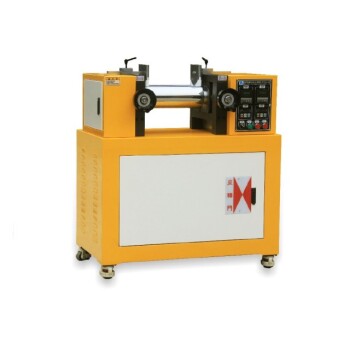
The roller press machine serves as the essential forming mechanism that converts a raw mixture of Copper Maleate Hydrate (CuMH) and binder into a functional, flexible solid-state membrane. By applying continuous mechanical pressure to a viscous slurry, it transforms loose particle agglomerates into a cohesive, dense, and uniformly thin film.

The roller press does not merely flatten the material; it creates the necessary microstructure. It provides the mechanical shear and pressure required to bind the CuMH particles and PTFE binder into a stable, processable sheet with a target thickness of approximately 30 μm.

From Slurry to Solid Structure

Handling the Viscous Mixture

The preparation of CuMH electrolytes begins with a viscous slurry mixed with a Polytetrafluoroethylene (PTFE) binder.

This mixture is not a simple liquid that can be poured; it consists of loose agglomerates that lack structural integrity on their own.

The Role of Repeated Rolling

The roller press subjects this mixture to repeated rolling actions.

This process exerts mechanical pressure that forces the binder and the active material to integrate.

Transformation into a Thin Film

The primary function of this step is to transform the loose mixture into a unified body.

The result is a continuous thin film, typically achieved at a precise thickness of around 30 μm.

Why Rolling is Critical for Performance

Achieving Mechanical Stability

Without the roller press, the CuMH mixture would remain a loose powder or a brittle cake.

The rolling process imparts the mechanical stability necessary for the membrane to be handled, cut, and assembled without crumbling.

Ensuring Flexibility

A key requirement for modern solid-state electrolytes is flexibility.

The shear forces applied during rolling allow the PTFE binder to create a fibrous network, resulting in a flexible film rather than a rigid, brittle plate.

Uniformity and Processability

For a solid-state battery to function reliably, the electrolyte layer must be uniform.

The roller press ensures a consistent density across the entire film, which is vital for consistent ionic conductivity and preventing short circuits.

Understanding the Trade-offs

Roller Press vs. Hydraulic Press

It is important to distinguish between rolling and static pressing.

A laboratory hydraulic press is often used for densifying solvent-cast polymer films using heat and static pressure to eliminate pores.

However, for the specific CuMH/PTFE slurry described, the roller press is superior because the rolling action provides the shear force needed to fibrillate the binder, creating a flexible network that static pressure alone may not achieve.

Complexity of Control

Using a roller press introduces variables that must be tightly managed.

Operators must precisely control the gap distance and pressure to achieve the target 30 μm thickness without tearing the film or causing density gradients.

Making the Right Choice for Your Goal

To ensure the success of your solid-state electrolyte preparation, match your equipment to your binder system and structural requirements.

  • If your primary focus is creating flexible CuMH membranes: Utilize a roller press to fibrillate the PTFE binder and transform the viscous slurry into a continuous, thin sheet (approx. 30 μm).
  • If your primary focus is densifying solvent-cast polymer films: Utilize a hydraulic press to apply heat and static pressure, ensuring pore elimination and precise geometric consistency (e.g., 50 μm).

The roller press is the definitive tool for bridging the gap between a raw chemical slurry and a mechanically robust, flexible electrolyte component.

Summary Table:

Feature Roller Press (Rolling) Hydraulic Press (Static)
Mechanism Continuous shear force & rolling pressure Static vertical pressure & heat
Material State Viscous slurry with PTFE binder Solvent-cast polymer films
Key Outcome Fibrillation of binder for flexibility Densification and pore elimination
Structural Result 30 μm flexible, continuous membrane Uniform, dense, rigid/semi-rigid film
Best Used For CuMH/PTFE flexible membranes Post-casting film densification

Elevate Your Solid-State Battery Research with KINTEK

Precision in membrane thickness and flexibility is the cornerstone of high-performance solid-state electrolytes. KINTEK specializes in advanced laboratory equipment designed to bridge the gap from chemical slurry to functional components.

Whether you need a high-precision roller press for binder fibrillation or a robust hydraulic press (pellet, hot, or isostatic) for film densification, our expert-grade tools ensure the mechanical stability and ionic conductivity your research demands.

Beyond forming, explore our comprehensive range of high-temperature furnaces (muffle, vacuum, CVD), crushing systems, and specialized battery research tools tailored for the most demanding lab environments.

Ready to optimize your CuMH membrane preparation?
Contact KINTEK today to find the perfect equipment solution for your laboratory.

Related Products

People Also Ask

Related Products

Laboratory Hydraulic Press Split Electric Lab Pellet Press

Laboratory Hydraulic Press Split Electric Lab Pellet Press

Efficiently prepare samples with a split electric lab press - available in various sizes and ideal for material research, pharmacy, and ceramics. Enjoy greater versatility and higher pressure with this portable and programmable option.

Laboratory Hydraulic Press Lab Pellet Press Machine for Glove Box

Laboratory Hydraulic Press Lab Pellet Press Machine for Glove Box

Controlled environment lab press machine for glove box. Specialized equipment for material pressing and shaping with high precision digital pressure gauge.

Manual High Temperature Heated Hydraulic Press Machine with Heated Plates for Lab

Manual High Temperature Heated Hydraulic Press Machine with Heated Plates for Lab

The High Temperature Hot Press is a machine specifically designed for pressing, sintering and processing materials in a high temperature environment. It is capable of operating in the range of hundreds of degrees Celsius to thousands of degrees Celsius for a variety of high temperature process requirements.

Heated Hydraulic Press Machine with Heated Plates for Vacuum Box Laboratory Hot Press

Heated Hydraulic Press Machine with Heated Plates for Vacuum Box Laboratory Hot Press

The lab press for vacuum box is a specialized piece of equipment designed for laboratory use. Its main purpose is to press pills and powders according to specific requirements.

Automatic High Temperature Heated Hydraulic Press Machine with Heated Plates for Lab

Automatic High Temperature Heated Hydraulic Press Machine with Heated Plates for Lab

The High Temperature Hot Press is a machine specifically designed for pressing, sintering and processing materials in a high temperature environment. It is capable of operating in the range of hundreds of degrees Celsius to thousands of degrees Celsius for a variety of high temperature process requirements.

Automatic Heated Hydraulic Press Machine with Heated Plates for Laboratory Hot Press

Automatic Heated Hydraulic Press Machine with Heated Plates for Laboratory Hot Press

The Automatic High Temperature Heat Press is a sophisticated hydraulic hot press designed for efficient temperature control and product quality processing.

Manual Lab Heat Press

Manual Lab Heat Press

Manual hydraulic presses are mainly used in laboratories for various applications such as forging, molding, stamping, riveting and other operations. It allows the creation of complex shapes while saving material.

Hydraulic Diaphragm Lab Filter Press for Laboratory Filtration

Hydraulic Diaphragm Lab Filter Press for Laboratory Filtration

Hydraulic diaphragm lab press filter is one type lab scale filter press, it takes small footprint, and higher pressing power.

Heated Hydraulic Press Machine with Heated Plates Split Manual Laboratory Hot Press

Heated Hydraulic Press Machine with Heated Plates Split Manual Laboratory Hot Press

Efficiently prepare your samples with our Split Manual Heated Lab Press. With a pressure range up to 40T and heating plates up to 300°C, it's perfect for various industries.

Automatic Laboratory Hydraulic Pellet Press Machine for Lab Use

Automatic Laboratory Hydraulic Pellet Press Machine for Lab Use

Experience efficient sample preparation with our Automatic Lab Press Machine. Ideal for material research, pharmacy, ceramics, and more. Features a compact size and hydraulic press functionality with heating plates. Available in various sizes.

Laboratory Manual Hydraulic Pellet Press for Lab Use

Laboratory Manual Hydraulic Pellet Press for Lab Use

Efficient Manure Lab Hydraulic Press with Safety Cover for sample preparation in material research, pharmacy, and electronic industries. Available in 15T to 60T.

Cold Isostatic Pressing Machine CIP for Small Workpiece Production 400Mpa

Cold Isostatic Pressing Machine CIP for Small Workpiece Production 400Mpa

Produce uniformly high-density materials with our Cold Isostatic Press. Ideal for compacting small workpieces in production settings. Widely used in powder metallurgy, ceramics, and biopharmaceutical fields for high-pressure sterilization and protein activation.

24T 30T 60T Heated Hydraulic Press Machine with Heated Plates for Laboratory Hot Press

24T 30T 60T Heated Hydraulic Press Machine with Heated Plates for Laboratory Hot Press

Looking for a reliable Hydraulic Heated Lab Press? Our 24T / 40T model is perfect for material research labs, pharmacy, ceramics, and more. With a small footprint and the ability to work inside a vacuum glove box, it's the efficient and versatile solution for your sample preparation needs.

Warm Isostatic Press WIP Workstation 300Mpa for High Pressure Applications

Warm Isostatic Press WIP Workstation 300Mpa for High Pressure Applications

Discover Warm Isostatic Pressing (WIP) - A cutting-edge technology that enables uniform pressure to shape and press powdered products at a precise temperature. Ideal for complex parts and components in manufacturing.

Laboratory Manual Hydraulic Pellet Press for Lab Use

Laboratory Manual Hydraulic Pellet Press for Lab Use

Efficient sample preparation with small footprint Manual Lab Hydraulic Press. Ideal for material researching labs, pharmacy, catalytic reaction, and ceramics.

Manual Heated Hydraulic Press Machine with Heated Plates for Laboratory Hot Press

Manual Heated Hydraulic Press Machine with Heated Plates for Laboratory Hot Press

The Manual Heat Press is a versatile piece of equipment suitable for a variety of applications, operated by a manual hydraulic system that applies controlled pressure and heat to the material placed on the piston.

Automatic Heated Hydraulic Press Machine with Heated Plates for Laboratory Hot Press 25T 30T 50T

Automatic Heated Hydraulic Press Machine with Heated Plates for Laboratory Hot Press 25T 30T 50T

Efficiently prepare your samples with our Automatic Heated Lab Press. With a pressure range up to 50T and precise control, it's perfect for various industries.

Metallographic Specimen Mounting Machine for Laboratory Materials and Analysis

Metallographic Specimen Mounting Machine for Laboratory Materials and Analysis

Precision metallographic mounting machines for labs—automated, versatile, and efficient. Ideal for sample prep in research and quality control. Contact KINTEK today!

Automatic Laboratory Heat Press Machine

Automatic Laboratory Heat Press Machine

Precision automatic heat press machines for labs—ideal for material testing, composites, and R&D. Customizable, safe, and efficient. Contact KINTEK today!

Manual Cold Isostatic Pressing Machine CIP Pellet Press

Manual Cold Isostatic Pressing Machine CIP Pellet Press

Lab Manual Isostatic Press is a high-efficient equipment for sample preparation widely used in material research, pharmacy, ceramics, and electronic industries. It allows for precision control of the pressing process and can work in a vacuum environment.


Leave Your Message