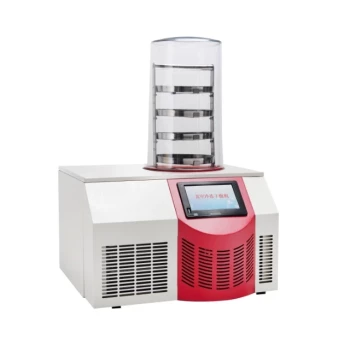
A vacuum drying oven is the single most critical tool for preserving the chemical integrity of ferrate(VI) during synthesis. Because ferrate(VI) is inherently unstable and sensitive to heat, standard drying methods would destroy the product before it could be used. The vacuum oven solves this by allowing for moisture removal at temperatures low enough to prevent decomposition.
Core Takeaway: By creating a low-pressure environment, the vacuum drying oven significantly lowers the boiling point of solvents. This allows for the rapid removal of moisture and residual chemicals without exposing the thermosensitive ferrate(VI) to the destructive heat or atmospheric air found in conventional drying processes.
The Challenge: Ferrate(VI) Instability
High Thermal Sensitivity
Ferrate(VI) is characterized as a highly thermosensitive compound. Unlike stable salts that can endure high heat, ferrate(VI) degrades rapidly if exposed to elevated temperatures.
This sensitivity makes standard thermal drying impossible. Any attempt to remove solvents using high heat will break down the molecular structure of the compound, rendering it useless.
Chemical Decomposition in Air
Beyond heat sensitivity, ferrate(VI) is chemically unstable when exposed to air, particularly when heated.
The presence of oxygen and atmospheric moisture acts as a catalyst for decomposition. Therefore, the drying environment must exclude these external factors to maintain the compound's purity.
How the Vacuum Solution Works
Lowering Solvent Boiling Points
The primary mechanism of the vacuum oven is pressure reduction. By lowering the pressure inside the chamber, the boiling point of liquids decreases.
This physical principle allows water and residual solvents to evaporate at extremely low temperatures. Instead of needing 100°C to remove water, the process can occur at much cooler, safer temperatures.
Rapid Evaporation
The vacuum environment does not just lower the temperature requirement; it facilitates rapid removal of solvents.
This speed is crucial. By minimizing the time the crystals are processing, the window for potential degradation is drastically reduced, effectively preserving the activity of the solid product.
Common Pitfalls: Why Standard Ovens Fail
The Trade-off of Temperature vs. Dryness
In a conventional oven, you must trade chemical stability for dryness. To remove moisture effectively at standard pressure, you must raise the temperature.
However, for ferrate(VI), this trade-off is unacceptable. High temperatures trigger immediate thermal degradation. You may achieve a dry powder, but it will likely be chemically inactive.
The Risk of Oxidation
Standard drying relies on circulating hot air. For oxidation-prone materials like ferrate(VI), this constant supply of oxygen is detrimental.
The vacuum oven mitigates this by removing the air from the chamber. This isolation protects the crystals from oxidative stress, ensuring the final product retains its required electrochemical and chemical properties.
Making the Right Choice for Your Synthesis
To ensure the successful preparation of ferrate(VI), prioritize equipment that offers precise environmental control.
- If your primary focus is Chemical Activity: Use a vacuum oven to ensure the material is dried at the lowest possible temperature to prevent thermal degradation.
- If your primary focus is Purity: Rely on the vacuum environment to minimize contact with air, preventing oxidative decomposition during the final processing stages.
Ultimately, the vacuum drying oven is not just a drying tool; it is a stabilization chamber that safeguards the reactivity of ferrate(VI).
Summary Table:
| Feature | Standard Drying Oven | Vacuum Drying Oven |
|---|---|---|
| Drying Mechanism | Convection/Hot Air Circulation | Low-Pressure Vaporization |
| Temperature Impact | High heat required (risk of decomposition) | Low-temperature drying (preserves stability) |
| Atmospheric Contact | Constant exposure to O2 and moisture | Isolated, oxygen-free environment |
| Solvent Removal | Slower; potential for residue | Rapid; high-efficiency evaporation |
| Material Suitability | Heat-stable materials | Thermosensitive & oxidation-prone compounds |
Elevate Your Material Synthesis with KINTEK Precision
Don't let thermal degradation compromise your ferrate(VI) research. KINTEK specializes in advanced laboratory solutions designed for the most sensitive chemical processes. Our high-performance vacuum drying ovens provide the precise temperature control and pressure stability needed to safeguard your product's chemical activity.
From high-temperature furnaces and vacuum systems to high-pressure reactors and battery research tools, KINTEK delivers the equipment essential for modern laboratory excellence. Ensure the purity of your results today.
Ready to optimize your drying process? Contact KINTEK for a custom solution!
References
- Alexis Munyengabe, Caliphs Zvinowanda. Production, Characterization and Application of Ferrate(VI) in Water and Wastewater Treatments. DOI: 10.30744/brjac.2179-3425.rv-19-2019
This article is also based on technical information from Kintek Solution Knowledge Base .
Related Products
- 56L Vertical Laboratory Vacuum Drying Oven
- 23L Laboratory Vacuum Drying Oven
- Laboratory Scientific Electric Heating Blast Drying Oven
- Benchtop Laboratory Vacuum Freeze Dryer
- Dental Porcelain Zirconia Sintering Ceramic Vacuum Press Furnace
People Also Ask
- Why is a laboratory vacuum drying oven recommended for rice straw residues? Protect Your Biomass Integrity
- What role does a laboratory vacuum drying oven play in the preparation of modified multi-walled carbon nanotubes?
- What is the importance of using a laboratory vacuum drying oven? Preserving Slow-Release Microcapsule Integrity
- Why is a Laboratory Vacuum Drying Oven recommended for PBAT microspheres? Protect Sensitive Polymer Integrity
- What role does a laboratory vacuum drying oven play in processing nanoparticle powder samples? Protect Sample Integrity