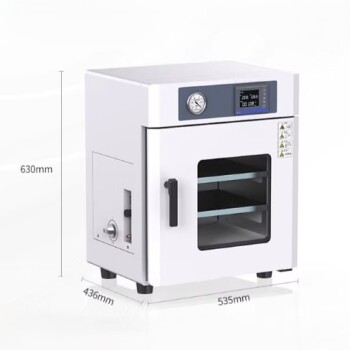
A vacuum drying oven is strictly required in supported catalyst synthesis to decouple drying speed from high temperatures. It allows for the rapid removal of moisture and residual solvents at significantly lower temperatures, which is critical for preventing the oxidation of active metals and ensuring the structural integrity of the catalyst support.
Core Takeaway: By lowering the boiling point of solvents, vacuum drying prevents the "capillary action" that draws active ingredients to the surface during standard drying. This ensures a uniform distribution of active sites within the pores and protects oxygen-sensitive materials from deactivation.
Preserving Physical Structure and Distribution
Preventing Solvent Migration
In supported catalysts prepared via the impregnation method, the drying phase is the most critical step for uniformity. If you dry at atmospheric pressure, the evaporating solvent moves outward, carrying dissolved active components with it.
A vacuum drying oven prevents this migration by removing solvents rapidly at low temperatures. This locks the active components deep within the pores of the support (such as alumina), ensuring a uniform distribution rather than a crust of active material on the outer surface.
Maintaining Pore Structure
Many advanced catalyst supports, such as Metal-Organic Frameworks (MOFs) or activated carbon, have delicate microporous structures. High heat can cause these frameworks to collapse or organic ligands to degrade.
Vacuum drying reduces the internal pressure, allowing solvents to volatilize without the high thermal energy that destroys these structures. This gentle process maintains the integrity of the porosity, which is essential for the catalyst's surface area and reactivity.
Minimizing Particle Agglomeration
When moisture evaporates violently at high temperatures, it can force particles to clump together. This agglomeration reduces the effective surface area of the catalyst powder.
By controlling the temperature and pressure, vacuum drying prevents these violent transitions. This results in a catalyst powder with a uniform particle size distribution, which is vital for consistent performance in reactor beds.
Protecting Chemical Activity
Preventing Oxidation
Certain catalysts, particularly those involving zero-valent iron (nZVI) or other non-noble metals, are highly sensitive to oxygen. Standard drying involves heating the material in air, which leads to rapid oxidation and immediate loss of catalytic activity.
A vacuum drying oven inherently creates a low-oxygen environment. This protects the chemical reduction capacity of the metal, ensuring it remains in its active zero-valent state for processes like Fenton cycles.
Activation of Active Sites
For catalysts like Double Metal Cyanide (DMC), the presence of residual water or volatile organic compounds (VOCs) can physically block active sites.
Vacuum drying at moderate temperatures (e.g., 80 °C) effectively strips these impurities away. This "wakes up" or activates the catalyst, preventing deactivation and ensuring high conversion efficiency in subsequent chemical reactions.
Common Pitfalls and Trade-offs
The Risk of Bypassing Pretreatment
It is a common mistake to assume the high-temperature calcination step (firing) will handle all drying needs. This is dangerous.
If wet material enters a high-temperature stage directly, water will vaporize instantly (flash evaporation). This can mechanically shatter the pore structure of the carrier or interfere with chemical equilibriums, such as during ammonia nitridation.
Operational Complexity
While superior to atmospheric ovens for quality, vacuum drying requires careful monitoring. The pressure must be reduced at a controlled rate to avoid "bumping" (sudden boiling), which can physically eject catalyst material from the container.
Making the Right Choice for Your Goal
The type of drying you select dictates the final quality of your catalyst.
- If your primary focus is Uniformity (Impregnation): You must use vacuum drying to stop the migration of active metals to the particle surface.
- If your primary focus is Reactivity (Zero-Valent Metals): You must use vacuum drying to eliminate oxygen and prevent the active metal from oxidizing into rust.
- If your primary focus is Structure (MOFs/Porous Supports): You must use vacuum drying to lower the thermal stress and prevent the collapse of micropores.
Summary: Vacuum drying is not just a faster way to dry; it is a mechanism to freeze the catalyst's internal architecture in place while stripping away the solvents that would otherwise compromise it.
Summary Table:
| Feature | Impact on Catalyst Quality | Benefit of Vacuum Drying |
|---|---|---|
| Solvent Migration | Causes crusting on support surfaces | Low-temp removal locks active sites in pores |
| Pore Structure | High heat collapses delicate MOFs/carriers | Preserves porosity and high surface area |
| Chemical State | Air exposure oxidizes zero-valent metals | Low-oxygen environment prevents deactivation |
| Particle Size | High-temp drying causes clumping | Maintains uniform particle size distribution |
| Active Sites | Impurities block reaction sites | Effectively strips VOCs/water to activate catalyst |
Elevate Your Catalyst Synthesis with KINTEK Precision
Don't compromise your catalyst's performance with subpar drying methods. KINTEK specializes in advanced laboratory equipment, offering high-performance vacuum drying ovens and high-temperature furnaces designed to protect your material’s structural integrity and chemical activity.
Whether you are working on MOFs, zero-valent metals, or complex impregnation methods, our solutions ensure uniform distribution and prevent oxidation. Beyond drying, KINTEK provides a comprehensive range of crushing systems, hydraulic presses, and high-pressure reactors to support your entire research workflow.
Ready to optimize your lab's results? Contact our experts today to find the perfect drying and processing solution for your target applications.
References
- Pekka Peljo, Hubert H. Girault. All-vanadium dual circuit redox flow battery for renewable hydrogen generation and desulfurisation. DOI: 10.1039/c5gc02196k
This article is also based on technical information from Kintek Solution Knowledge Base .
Related Products
- 56L Vertical Laboratory Vacuum Drying Oven
- 23L Laboratory Vacuum Drying Oven
- Laboratory Scientific Electric Heating Blast Drying Oven
- Benchtop Laboratory Vacuum Freeze Dryer
- Dental Porcelain Zirconia Sintering Ceramic Vacuum Press Furnace
People Also Ask
- Why is a laboratory vacuum drying oven recommended for rice straw residues? Protect Your Biomass Integrity
- What role does a laboratory vacuum drying oven play in the preparation of modified multi-walled carbon nanotubes?
- What is the importance of using a laboratory vacuum drying oven? Preserving Slow-Release Microcapsule Integrity
- Why is a Laboratory Vacuum Drying Oven recommended for PBAT microspheres? Protect Sensitive Polymer Integrity
- What role does a laboratory vacuum drying oven play in processing nanoparticle powder samples? Protect Sample Integrity