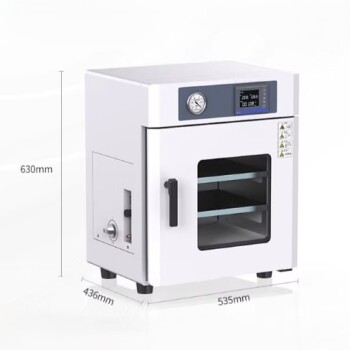
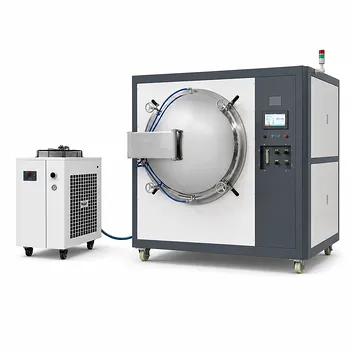
A Vacuum Drying Oven is the critical tool used to convert the hydrated precursor (Na3B24H23·xH2O) into pure, anhydrous Na3B24H23 powder. This equipment allows for the application of high heat (typically 150 °C) to drive out stubborn water molecules while maintaining a dynamic vacuum to protect the material. The vacuum environment is essential because it prevents the oxidation and unwanted side reactions that would inevitably occur if the material were heated in standard air.
The removal of lattice water is a strict prerequisite for material success. Without the protective environment of a vacuum oven, you cannot achieve the structural purity required for high ionic conductivity in the final solid electrolyte.
The Dual Function of the Vacuum Oven
Eliminating Lattice Water
The precursor material does not merely have surface moisture; it contains lattice water incorporated into its crystal structure.
Removing this water requires elevated temperatures, such as 150 °C.
The vacuum oven facilitates this deep drying process, ensuring the water is physically desorbed and evacuated from the system.
Preventing Chemical Degradation
Heating complex borohydrides in the presence of oxygen is risky.
At high temperatures, these materials are susceptible to oxidation and other side reactions.
The vacuum environment removes air from the chamber, creating an inert processing zone that preserves the chemical integrity of the Na3B24H23.
Why Purity Matters for the End Application
The Link to Conductivity
The ultimate goal of this synthesis is to create a solid electrolyte.
The primary reference indicates that obtaining pure anhydrous powder is necessary to achieve high ionic conductivity.
Residual water or oxide impurities acts as contaminants that impede the flow of ions, drastically reducing the effectiveness of the final battery component.
Ensuring Consistency
Reliable synthesis requires a reproducible process.
Using a vacuum drying oven under dynamic conditions ensures that every batch undergoes the same rigorous purification.
This consistency is vital for moving from experimental synthesis to reliable application in solid-state batteries.
Understanding the Trade-offs
Temperature Sensitivity
While heat is necessary to remove water, precision is key.
The process typically targets 150 °C; deviations significantly higher could potentially destabilize the material structure itself.
You must balance the thermal energy required for dehydration against the thermal stability limit of the anhydrous compound.
Vacuum Integrity
The process relies entirely on the quality of the "dynamic vacuum."
If the vacuum pump is underpowered or if there are leaks, the partial pressure of oxygen may rise.
Even a small compromise in vacuum integrity during the heating phase can lead to partial oxidation, rendering the batch unsuitable for high-performance electrolytes.
Making the Right Choice for Your Goal
To ensure you synthesize a viable solid electrolyte, apply these principles:
- If your primary focus is Maximum Ionic Conductivity: Prioritize the duration and quality of the vacuum phase to ensure absolutely zero lattice water remains in the crystal structure.
- If your primary focus is Process Safety: Monitor the temperature ramp strictly to ensure the material reaches 150 °C without overshooting, preventing thermal degradation.
Anhydrous Na3B24H23 is high-performing only when it is chemically pure; the vacuum drying oven is the specific instrument that makes this purity possible.
Summary Table:
| Feature | Role in Na3B24H23 Synthesis | Benefit to Material Quality |
|---|---|---|
| High Heat (150 °C) | Drives out stubborn lattice water | Ensures successful conversion to anhydrous powder |
| Dynamic Vacuum | Removes air and moisture vapor | Prevents oxidation and chemical degradation |
| Inert Environment | Protects borohydrides during heating | Preserves chemical integrity and structural purity |
| Process Control | Balances thermal energy vs stability | Minimizes risk of thermal destabilization |
Elevate Your Material Research with KINTEK
Achieving the structural purity required for high-performance solid electrolytes like Na3B24H23 demands precision equipment. KINTEK specializes in advanced laboratory solutions designed for rigorous synthesis environments.
From high-performance vacuum drying ovens and high-temperature furnaces (muffle, tube, atmosphere) to essential battery research tools and high-purity ceramic crucibles, we provide the technology needed to ensure maximum ionic conductivity and process consistency.
Ready to optimize your synthesis results? Contact our laboratory equipment experts today to find the perfect drying and thermal processing solution for your research.
Related Products
- 56L Vertical Laboratory Vacuum Drying Oven
- 23L Laboratory Vacuum Drying Oven
- Laboratory Scientific Electric Heating Blast Drying Oven
- Benchtop Laboratory Vacuum Freeze Dryer
- Dental Porcelain Zirconia Sintering Ceramic Vacuum Press Furnace
People Also Ask
- Why is a laboratory vacuum drying oven recommended for rice straw residues? Protect Your Biomass Integrity
- What role does a laboratory vacuum drying oven play in the preparation of modified multi-walled carbon nanotubes?
- What is the importance of using a laboratory vacuum drying oven? Preserving Slow-Release Microcapsule Integrity
- Why is a Laboratory Vacuum Drying Oven recommended for PBAT microspheres? Protect Sensitive Polymer Integrity
- What role does a laboratory vacuum drying oven play in processing nanoparticle powder samples? Protect Sample Integrity