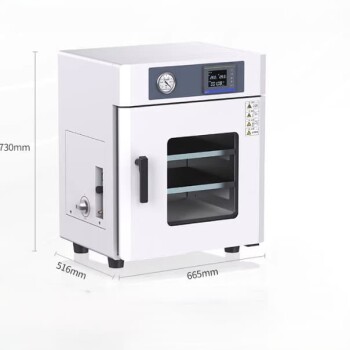
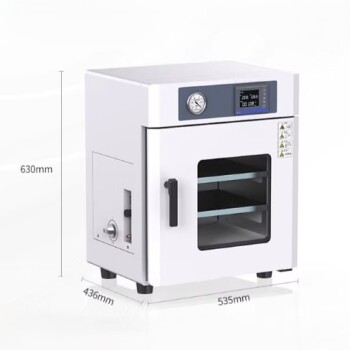
The utilization of a vacuum drying oven for Niobium-Tungsten (Nb-W) alloy powders is critical to safely remove residual process control agents like anhydrous ethanol without compromising the material's chemical integrity. By operating at low temperatures (approximately 90°C) under negative pressure, the oven isolates the powder from oxygen, ensuring the material dries completely while maintaining the high purity achieved during mechanical alloying.
Mechanical alloying creates highly reactive, fine metal powders that are prone to rapid degradation in air. The vacuum drying oven is the specific tool used to remove liquid solvents without triggering the immediate oxidation that would occur in a standard atmosphere.
The Physical State of Mechanically Alloyed Powders
High Surface Energy and Reactivity
Mechanical alloying does not just mix metals; it physically alters them. The process generates nanocrystalline powders with significantly increased surface area and internal defects.
The Vulnerability to Oxidation
According to metallurgical principles, this refined structure results in extremely high surface energy and chemical activity. Consequently, these powders become hypersensitive to their environment, reacting almost instantly with oxygen if exposed to air.
The Function of the Vacuum Environment
Isolating from Oxygen
The primary purpose of the vacuum oven is oxygen exclusion. If you were to heat these high-activity powders in a standard oven, the heat would act as a catalyst for oxidation, effectively ruining the raw material before sintering begins.
Efficient Solvent Removal
The process relies on negative pressure to lower the boiling point of liquids. This allows residual agents, such as anhydrous ethanol used during milling, to evaporate efficiently at lower temperatures (e.g., 90°C).
Preserving Material Purity
By combining low heat with a vacuum seal, the oven ensures the final powder remains in a pure metallic state. This prevents the formation of oxide layers that would degrade the mechanical properties of the final alloy.
Critical Considerations and Trade-offs
Equipment Integrity is Paramount
The effectiveness of this process relies entirely on the quality of the vacuum seal. Even a minor leak during the heating phase can be catastrophic, as it introduces oxygen to highly reactive powders at elevated temperatures, accelerating contamination.
Batch Processing Limitations
Unlike continuous conveyor dryers, vacuum drying is typically a batch process. This ensures maximum control over the atmosphere but can create a bottleneck in high-throughput manufacturing scenarios where speed is prioritized over absolute purity.
Making the Right Choice for Your Process
To maximize the quality of your Nb-W alloy production, consider your specific processing goals:
- If your primary focus is Material Purity: Prioritize a high-vacuum system to completely eliminate oxygen exposure, as the high surface energy of the powder makes it unforgiving to atmospheric leaks.
- If your primary focus is Solvent Removal: Utilize the negative pressure capability to dry powders at the lowest possible temperature, preventing thermal alteration of the nanostructure.
Success in processing Nb-W alloys depends on treating the drying phase not just as a cleaning step, but as a critical preservation step for the material's reactivity.
Summary Table:
| Feature | Impact on Nb-W Alloy Powders |
|---|---|
| Vacuum Atmosphere | Isolates reactive nanocrystalline powders from oxygen to prevent oxidation. |
| Negative Pressure | Lowers the boiling point of solvents like ethanol for efficient removal at ~90°C. |
| Low-Temperature Drying | Preserves high surface energy and nanostructure without thermal degradation. |
| Batch Control | Ensures maximum purity and process integrity for highly sensitive metal powders. |
Elevate Your Advanced Material Processing with KINTEK
Precision is non-negotiable when dealing with high-reactivity materials like Nb-W alloy powders. KINTEK specializes in high-performance laboratory equipment designed to preserve the integrity of your research and production.
Our comprehensive range of vacuum drying ovens, high-temperature furnaces, and crushing and milling systems provides the controlled environments necessary to prevent oxidation and ensure material purity. Whether you require advanced centrifugal milling, high-pressure reactors, or precision cooling solutions, KINTEK delivers the reliability and technical excellence your lab demands.
Ready to optimize your alloying workflow? Contact our technical experts today to find the perfect equipment solution tailored to your specific material requirements.
Related Products
- 56L Vertical Laboratory Vacuum Drying Oven
- 23L Laboratory Vacuum Drying Oven
- Laboratory Scientific Electric Heating Blast Drying Oven
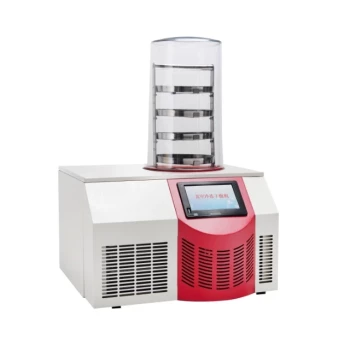
- Benchtop Laboratory Vacuum Freeze Dryer
- Dental Porcelain Zirconia Sintering Ceramic Vacuum Press Furnace
People Also Ask
- Why is a laboratory vacuum drying oven recommended for rice straw residues? Protect Your Biomass Integrity
- What role does a laboratory vacuum drying oven play in the preparation of modified multi-walled carbon nanotubes?
- What is the importance of using a laboratory vacuum drying oven? Preserving Slow-Release Microcapsule Integrity
- Why is a Laboratory Vacuum Drying Oven recommended for PBAT microspheres? Protect Sensitive Polymer Integrity
- What role does a laboratory vacuum drying oven play in processing nanoparticle powder samples? Protect Sample Integrity