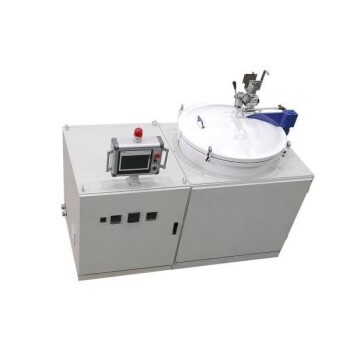
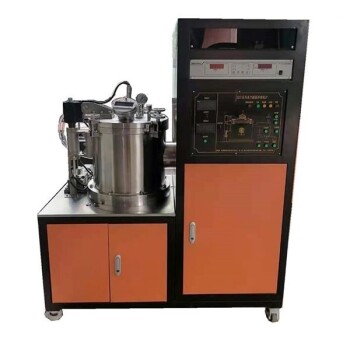
Active metals possess a high chemical affinity for oxygen, making traditional flame brazing destructive to the integrity of the joint. A vacuum furnace is strictly necessary because it creates an environment that prevents these metals from instantly oxidizing or absorbing gases at high temperatures, ensuring the filler metal can physically bond to the substrate.
The Core Insight Vacuum brazing is not merely a cleaner alternative to flame brazing; it is a chemical necessity for active metals. By maintaining a vacuum level between $10^{-3}$ and $10^{-5}$ mbar, the process eliminates the oxygen required for oxide formation, allowing for fluxless, non-porous, and metallurgically sound joints.
The Chemistry of Active Metals
The Barrier of Oxidation
Active metals, such as Titanium (Ti) and Aluminum (Al), are defined by their tendency to react chemically when exposed to air, water, or acids.
In traditional flame brazing, the heat accelerates this reaction, causing severe oxidation on the metal surface almost instantly.
A vacuum furnace prevents this by evacuating the air, reducing oxygen content to negligible parts per million (PPM) levels where these reactions cannot occur.
Preventing Gas Absorption
Beyond surface oxidation, active metals act like sponges for gases at brazing temperatures.
If exposed to the atmosphere of a flame, the base metal will absorb nitrogen, hydrogen, and oxygen, which embrittles the material and weakens the component.
The vacuum environment effectively excludes these gases, preserving the structural integrity of the base metal.
Achieving a Metallurgical Bond
Ensuring Proper Wetting
For a braze to hold, the molten filler metal must flow over and adhere to (wet) the base metal.
Oxide films are the enemy of wetting; they act as a physical shield that prevents the filler from touching the substrate.
By preventing the formation of these films, a vacuum furnace ensures that active brazing fillers—such as those containing Titanium or Zirconium—can directly contact and bond with the substrate.
Reducing Joint Porosity
Flame brazing often traps gases or volatile impurities within the joint, leading to voids or bubbles (porosity) when the metal creates a seal.
The vacuum environment actively facilitates the removal of volatile impurities and trace gases from within the brazing seam.
This results in a denser, stronger joint, which is particularly critical for components with complex geometries that trap gas easily.
The Operational Advantages
Fluxless Processing
Traditional brazing often requires aggressive chemical fluxes to strip away oxides, which can leave corrosive residues.
Vacuum brazing Aluminum and other active metals is inherently fluxless because the environment itself inhibits oxide formation.
This eliminates post-braze cleaning steps and removes the risk of flux entrapment inside the joint.
Understanding the Trade-offs
Equipment Complexity and Cost
While chemically superior, vacuum brazing requires significant capital investment compared to a torch setup.
The system relies on complex hardware, such as cold-wall retorts, graphite hot zones, and ultra-clean cryopumps or turbopumps, to maintain high vacuum levels.
Processing Speed
Vacuum brazing is a batch process that includes pump-down times and controlled heating/cooling profiles.
This makes it significantly slower per cycle than continuous or manual flame brazing methods.
Making the Right Choice for Your Goal
Whether you choose vacuum brazing depends on the material chemistry and the criticality of the application.
- If your primary focus is working with Reactive Metals (Ti, Al, Zr): You must use vacuum brazing to prevent immediate oxidation and embrittlement that flame brazing cannot control.
- If your primary focus is Geometric Complexity: You should prioritize vacuum brazing to ensure gas is removed from blind holes and internal passages, reducing porosity.
- If your primary focus is Cleanliness: You should select vacuum processing to achieve a flux-free joint that requires no post-process chemical cleaning.
Vacuum brazing is the only method that converts the chemical volatility of active metals from a liability into a manageable, high-quality joining process.
Summary Table:
| Feature | Traditional Flame Brazing | Vacuum Furnace Brazing |
|---|---|---|
| Environment | Atmospheric (Oxygen-rich) | High Vacuum ($10^{-3}$ to $10^{-5}$ mbar) |
| Oxidation Risk | Very High (Active metals oxidize instantly) | Negligible (Protects metal integrity) |
| Flux Requirement | Necessary (Leaves corrosive residues) | Fluxless (Cleaner, no post-cleaning) |
| Joint Quality | High Porosity / Brittle joints | High Density / Metallurgically sound |
| Best For | Non-reactive metals, simple repairs | Titanium, Aluminum, Complex geometries |
Elevate Your Metal Joining Precision with KINTEK
Don't let oxidation compromise the integrity of your critical components. KINTEK specializes in advanced thermal processing solutions, providing high-performance vacuum furnaces, atmosphere furnaces, and high-temperature reactors tailored for the most demanding laboratory and industrial applications. Whether you are brazing active metals like Titanium and Aluminum or conducting advanced material research, our equipment ensures uniform heating, precise atmosphere control, and superior metallurgical results.
From high-vacuum systems to essential consumables like ceramics and crucibles, KINTEK offers the comprehensive expertise your lab deserves. Optimize your brazing process—contact us today!
References
- Byungmin Ahn. Recent Advances in Brazing Fillers for Joining of Dissimilar Materials. DOI: 10.3390/met11071037
This article is also based on technical information from Kintek Solution Knowledge Base .
Related Products
- Vacuum Heat Treat Sintering Brazing Furnace
- 2200 ℃ Tungsten Vacuum Heat Treat and Sintering Furnace
- Non Consumable Vacuum Arc Induction Melting Furnace
- Vacuum Heat Treat and Pressure Sintering Furnace for High Temperature Applications
- 600T Vacuum Induction Hot Press Furnace for Heat Treat and Sintering
People Also Ask
- What are the specific functions of introducing reducing atmospheres or inert gas environments in vacuum brazing?
- How does a vacuum brazing furnace work? Achieve Superior, Flux-Free Metal Joining
- Can brazing be used for ferrous metals? Yes, and here's how to ensure a strong joint.
- What is the cost of a vacuum brazing furnace? A guide to key factors and investment strategy
- What is vacuum heat treatment process? Achieve Superior Control, Cleanliness, and Quality