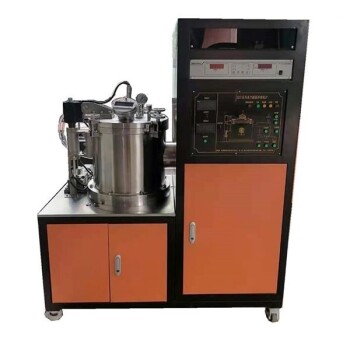
A vacuum furnace is strictly necessary to create a controlled environment with extremely low oxygen partial pressure, specifically below $5.5 \times 10^{-8}$ torr. This precise atmosphere prevents further, uncontrolled oxidation of aluminum-titanium oxides and protects the coating from impurities that typically react at high temperatures. Furthermore, this environment lowers the energy barrier for crystallization, allowing the amorphous coating to transform into a pure Al2TiO5 phase at 700°C.
The vacuum environment serves a dual purpose: it acts as a barrier against atmospheric contamination and as a facilitator for atomic rearrangement, enabling the formation of a pure crystalline structure without requiring excessive thermal energy.
The Critical Role of Oxygen Control
Preventing Uncontrolled Oxidation
The primary function of the vacuum furnace is to maintain an oxygen partial pressure below $5.5 \times 10^{-8}$ torr.
At high temperatures, materials are highly reactive; without this vacuum, the aluminum-titanium oxides would undergo further, unintended oxidation.
Eliminating Impurities
Standard annealing environments often introduce atmospheric contaminants that degrade coating performance.
A high-vacuum environment ensures that the coating remains chemically pure by removing gases that would otherwise react with the surface.
Facilitating Phase Transformation
Rearranging Atomic Structure
Amorphous coatings are defined by their lack of long-range order, possessing only short-range ordered structures.
The vacuum environment facilitates the physical rearrangement of atoms within these structures. This rearrangement is the mechanism that drives the transition from a disordered amorphous state to a stable, crystalline state.
Lowering Thermal Requirements
In a standard environment, higher temperatures might be required to force this crystallization, risking damage to the substrate or coating.
Under high vacuum, this transformation into pure crystalline Al2TiO5 occurs effectively at a relatively low temperature of 700°C, avoiding the need for excessive thermal energy.
Understanding the Trade-offs
Equipment Precision vs. Complexity
While necessary, relying on high-vacuum annealing introduces operational complexity compared to standard atmospheric furnaces.
The system must be capable of sustaining pressures below the critical threshold ($10^{-8}$ torr); even a minor leak or pump inefficiency can raise oxygen levels enough to stall crystallization or introduce impurities.
Thermal Interdiffusion Risks
While the primary goal for Al2TiO5 is crystallization, vacuum annealing generally promotes diffusion at interfaces.
In other coating systems (such as Chromium on Zirconium or Ti/Cr on SiC), this heat treatment promotes grain growth or interface mixing. You must monitor your specific substrate to ensure that the 700°C temperature does not trigger unwanted diffusion reactions between the Al2TiO5 coating and the underlying material.
Making the Right Choice for Your Project
To ensure the success of your annealing process, consider the following based on your specific engineering goals:
- If your primary focus is Phase Purity: Ensure your vacuum system can consistently hold pressure below $5.5 \times 10^{-8}$ torr to prevent the formation of secondary oxide phases.
- If your primary focus is Energy Efficiency: Utilize the vacuum's ability to facilitate crystallization at 700°C to minimize thermal load on your heating elements and substrates.
By strictly controlling the vacuum environment, you convert a disordered coating into a robust, crystalline shield without compromising its chemical integrity.
Summary Table:
| Feature | Requirement/Impact | Benefit |
|---|---|---|
| Oxygen Partial Pressure | < 5.5 × 10⁻⁸ torr | Prevents uncontrolled oxidation |
| Annealing Temperature | 700°C | Lower energy barrier for crystallization |
| Atmospheric Control | High Vacuum | Eliminates impurities and contamination |
| Phase Transformation | Amorphous to Crystalline | Achieves pure Al2TiO5 structure |
| Material Integrity | Controlled Environment | Prevents unwanted interdiffusion |
Elevate Your Material Research with KINTEK Precision
Achieving the perfect crystalline Al2TiO5 phase requires more than just heat—it requires the uncompromising atmosphere control of a high-performance vacuum furnace. KINTEK specializes in advanced laboratory equipment, offering a comprehensive range of high-temperature vacuum and atmosphere furnaces designed to maintain the ultra-low oxygen levels your coatings demand.
Whether you are performing complex phase transformations or sensitive annealing, our portfolio—including crushing and milling systems, hydraulic presses, and specialized ceramic crucibles—provides the end-to-end reliability your lab needs. Let our technical experts help you select the ideal furnace to ensure chemical integrity and energy efficiency in your next project.
Ready to optimize your annealing process? Contact KINTEK today for a tailored solution!
References
- Sebastian Öhman, Mats Boman. Selective kinetic growth and role of local coordination in forming Al<sub>2</sub>TiO<sub>5</sub>-based coatings at lower temperatures. DOI: 10.1039/d1ma00428j
This article is also based on technical information from Kintek Solution Knowledge Base .
Related Products
- Vacuum Heat Treat Furnace with Ceramic Fiber Liner
- Controlled Nitrogen Inert Hydrogen Atmosphere Furnace
- Vacuum Heat Treat and Molybdenum Wire Sintering Furnace for Vacuum Sintering
- 600T Vacuum Induction Hot Press Furnace for Heat Treat and Sintering
- Vacuum Arc Induction Melting Furnace
People Also Ask
- What is a vacuum heat treatment furnace? The Ultimate Guide to Controlled Atmosphere Processing
- How does a vacuum heat treatment work? Achieve Superior Material Properties in a Pristine Environment
- What is a vacuum heat treatment furnace? Achieve Unmatched Purity and Control
- What is vacuum heat treatment process? Achieve Superior Control, Cleanliness, and Quality
- What is the temperature of vacuum heat treatment? Achieve Superior Material Properties & Pristine Finishes