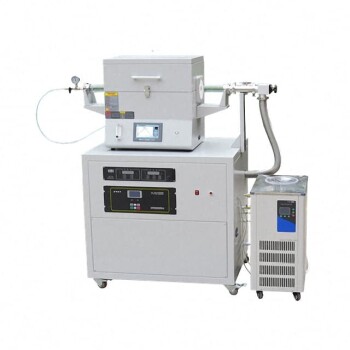
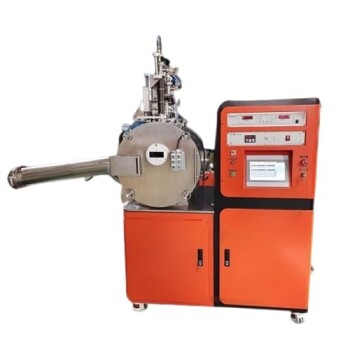
A vacuum or controlled atmosphere is mandatory for quenching Si-Cr spring steel to prevent surface oxidation and decarburization. These chemical changes at high temperatures compromise the material's surface integrity, which is the primary factor determining fatigue resistance and overall service life in critical applications like railway fasteners.
To maintain the mechanical properties of Si-Cr spring steel, the furnace environment must isolate the metal from reactive gases. Failure to control the atmosphere results in surface degradation that leads to premature fatigue failure under cyclic loading.
The Chemical Reactivity of Silicon and Chromium
High-Temperature Sensitivity
Silicon (Si) and Chromium (Cr) are highly chemically active alloying elements. When heated to quenching temperatures in a standard atmosphere, these elements react rapidly with oxygen.
Prevention of Oxide Scale
Exposure to oxygen creates surface oxidation, or scale. This scale not only alters the dimensions of precision components but can also trap impurities that degrade the mechanical performance of the steel matrix.
Intermetallic Phase Stability
In specialized alloys, maintaining a vacuum ensures the formation of pure intermetallic phases. This prevents the raw materials from oxidizing before they can achieve the desired metallurgical structure.
Protecting Surface Integrity and Fatigue Resistance
The Danger of Decarburization
High temperatures in an uncontrolled environment lead to decarburization, where carbon atoms migrate out of the steel surface. This creates a "soft skin" on the component that lacks the intended hardness and strength.
Impact on Fatigue Life
For components like railway spring fasteners, the surface carbon content directly determines fatigue resistance. A decarburized surface acts as a failure point where microscopic cracks can easily initiate under stress.
Ensuring Service Longevity
Using a tube furnace with atmosphere control ensures the required surface quality is met. This technical precision is what allows high-stress spring components to meet their intended service life without catastrophic failure.
Engineering the Controlled Environment
Sealing with Stainless Steel Flanges
To establish a reliable vacuum or controlled atmosphere, tube furnaces utilize 304 stainless steel sealing flanges. These components provide the airtight seal necessary to maintain consistent pressure levels throughout the heating cycle.
Selecting the Right Working Tube
The choice of tube material—such as quartz glass, corundum, or metal—depends on the specific quenching temperature and chemical environment required. Quartz is often used for its thermal shock resistance, while corundum handles higher temperatures.
Vacuum Pressure Levels
Depending on the sensitivity of the Si-Cr alloy, different levels of vacuum (rough, fine, or high) may be required. These environments are achieved through specialized vacuum pumps that remove oxygen and other reactive compounds from the heating chamber.
Understanding the Trade-offs
Vacuum vs. Inert Gas Atmosphere
While a high vacuum provides the most complete protection against oxidation, it requires more complex pumping systems and longer processing times. A controlled atmosphere using inert gases like Argon or Nitrogen can be faster but requires high gas purity to prevent trace oxidation.
Equipment Complexity and Cost
Implementing atmosphere control increases the initial setup cost and requires regular maintenance of seals and sensors. However, the cost of material failure in critical infrastructure, such as railways, far outweighs the investment in controlled heating equipment.
Cooling Rate Constraints
Quenching in a vacuum can sometimes result in slower cooling rates compared to liquid media. Engineers must balance the need for surface protection with the cooling velocity required to achieve the desired martensitic structure in the spring steel.
How to Apply This to Your Project
When quenching Si-Cr spring steel, your choice of atmosphere should be dictated by the final application of the component and the sensitivity of your specific alloy.
- If your primary focus is maximum fatigue resistance: Utilize a high vacuum environment to completely eliminate decarburization and ensure the highest surface integrity.
- If your primary focus is high-volume production efficiency: Use a controlled inert gas atmosphere (Argon or Nitrogen) with high-quality sealing flanges to protect against scale while maintaining faster cycle times.
- If your primary focus is precision dimensions: Opt for a tube furnace with a quartz or corundum tube to prevent surface scaling that would otherwise require secondary machining.
Technical excellence in spring steel performance is impossible to achieve without the rigorous isolation provided by a vacuum or controlled furnace atmosphere.
Summary Table:
| Feature | Impact of Atmosphere Control | Consequence of Failure |
|---|---|---|
| Surface Oxidation | Prevents oxide scale formation; maintains purity | Dimensional changes and impurity trapping |
| Decarburization | Preserves surface carbon content and hardness | "Soft skin" formation and reduced strength |
| Fatigue Life | Ensures high resistance to cyclic loading | Premature failure in critical applications |
| Material Integrity | Protects Si and Cr alloying elements | Chemical reactivity leads to surface degradation |
Optimize Your Heat Treatment Precision with KINTEK
Don’t let oxidation or decarburization compromise the integrity of your Si-Cr spring steel. KINTEK specializes in advanced laboratory equipment designed for the most demanding thermal processes. Our high-performance tube furnaces—available with quartz, corundum, or metal tubes and high-grade 304 stainless steel flanges—provide the airtight environment necessary for superior quenching results.
Whether you need high-temperature furnaces (muffle, vacuum, CVD, PECVD), hydraulic presses, or specialized high-pressure reactors and autoclaves, KINTEK delivers the technical excellence required for critical research and manufacturing. Enhance your material properties and ensure maximum fatigue resistance today.
Ready to elevate your lab’s capabilities? Contact our technical experts now to find the perfect thermal solution for your project!
References
- Yao Lu, Zhengyi Jiang. Optimising Two-Stage Vacuum Heat Treatment for a High-Strength Micro-Alloyed Steel in Railway Spring Clip Application: Impact on Microstructure and Mechanical Performance. DOI: 10.3390/ma16144921
This article is also based on technical information from Kintek Solution Knowledge Base .
Related Products
- Vacuum Sealed Continuous Working Rotary Tube Furnace Rotating Tube Furnace
- Laboratory High Pressure Vacuum Tube Furnace
- Vacuum Hot Press Furnace Heated Vacuum Press Machine Tube Furnace
- Vacuum Heat Treat and Molybdenum Wire Sintering Furnace for Vacuum Sintering
- Split Chamber CVD Tube Furnace with Vacuum Station Chemical Vapor Deposition System Equipment Machine
People Also Ask
- What are the advantages of using a rotary tube furnace for MoVOx catalysts? Elevate Uniformity and Crystallinity
- What are the process advantages of using a rotary tube furnace for WS2 powder? Achieve Superior Material Crystallinity
- Why is a vacuum tube furnace with argon protection required for RGO/Cu? Ensure Conductivity and Material Purity
- Why is a rotary tube furnace preferred over a fixed tube furnace for the carbonization of asphaltenes? Superior Quality
- Why is a rotary tube furnace recommended for the calcination stage of potassium vanadium oxide catalysts? Optimize Purity