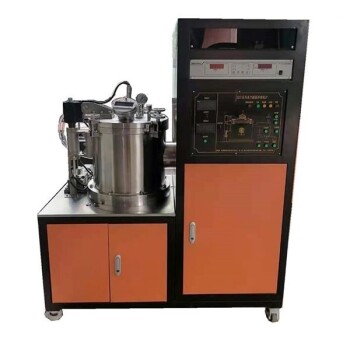
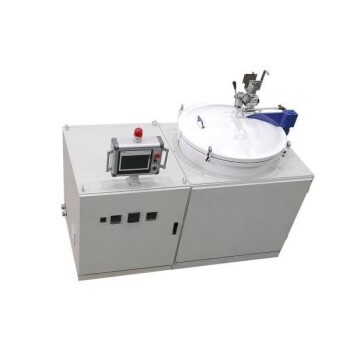
A vacuum tube furnace is the critical bridge between raw mechanical processing and successful material consolidation for high-entropy alloys. It serves two simultaneous functions: it removes residual solvents like ethanol in an oxygen-free environment to prevent oxidation, and it applies controlled heat to release internal mechanical stresses, preventing the powder from cracking during subsequent pressing steps.
Core Takeaway High-energy ball milling leaves alloy powders in a chemically reactive and mechanically stressed state. A vacuum tube furnace is required to safely dry and anneal these powders, as it eliminates the oxygen that destroys nanoscale purity and relaxes the internal tension that leads to structural failure during molding.
Preserving Chemical Integrity
The Risk of Nanoscale Oxidation
Ball milling significantly reduces particle size, often creating nanoscale powders with massive surface areas.
This reduction process makes the powders highly active chemically.
If exposed to air during drying, these reactive surfaces will oxidize immediately, degrading the quality of the final alloy.
Oxygen-Free Solvent Removal
The primary function of the vacuum tube furnace is to remove residual liquid media, such as ethanol, used during the milling process.
Because this occurs in a vacuum, the oxygen partial pressure is kept extremely low.
This allows the liquid to evaporate without allowing oxygen atoms to interact with the metal, preserving the metallic state of the powder.
Ensuring Mechanical Stability
Accumulation of Internal Stress
Mechanical alloying is a violent process that introduces severe physical strain into the material.
The powder particles accumulate significant internal stress as they are repeatedly fractured and cold-welded.
Leaving this stress unresolved creates a material that is unstable and difficult to work with.
Preventing Fabrication Failures
Controlled heat treatment within the furnace acts as a stress-relief anneal.
This eliminates the stored energy and stress concentrations within the particles.
If this step is skipped, the powder is liable to crack or fail during mold loading and pressing, resulting in a defective bulk material.
Understanding the Trade-offs
Thermal Management vs. Grain Growth
While heat is necessary for stress relief and drying, it must be carefully controlled.
Excessive temperatures or prolonged exposure can trigger unwanted grain growth, negating the benefits of the nanostructure achieved during milling.
Degassing Requirements
Simple drying is sometimes insufficient if process control agents (like stearic acid) were used.
You may need to run the furnace at higher temperatures (e.g., 400°C) to fully degrade and remove these organic contaminants, rather than just evaporating solvents like ethanol.
Making the Right Choice for Your Goal
To maximize the quality of your high-entropy alloy, tailor your furnace profile to your specific material constraints:
- If your primary focus is chemical purity: Ensure your vacuum system is rated to lower the oxygen partial pressure significantly below the oxidation threshold of your most reactive element (e.g., Titanium or Aluminum).
- If your primary focus is mechanical consolidation: Prioritize a heat treatment schedule that ensures complete stress relaxation to prevent cracking, even if it requires a longer cycle time.
The vacuum tube furnace determines whether your high-energy milling efforts result in a high-performance alloy or a compromised oxide ceramic.
Summary Table:
| Feature | Function in HEA Processing | Benefit to Material |
|---|---|---|
| Vacuum Environment | Oxygen-free solvent removal | Prevents nanoscale oxidation and preserves purity |
| Controlled Heating | Stress-relief annealing | Eliminates internal strain and prevents cracking |
| Thermal Precision | Regulated temperature profiles | Minimizes unwanted grain growth and retains nanostructure |
| Degassing Capability | Organic contaminant removal | Ensures clean bonding during subsequent consolidation |
Elevate Your Material Research with KINTEK's Advanced Thermal Solutions
Precision is paramount when transitioning from high-energy ball milling to final material consolidation. KINTEK specializes in high-performance laboratory equipment designed to protect the integrity of your high-entropy alloys. Our comprehensive range of vacuum tube furnaces, atmosphere furnaces, and rotary furnaces provides the oxygen-free environments and precise thermal control needed to prevent oxidation and ensure perfect stress relaxation.
Beyond heating, KINTEK supports your entire workflow with advanced crushing and milling systems, hydraulic pellet presses, and high-temperature high-pressure reactors. Whether you are developing next-generation alloys or conducting complex battery research, our expert team is ready to provide the durable tools and consumables—from ceramics to crucibles—your lab requires.
Don't let oxidation or mechanical failure compromise your research. Contact KINTEK today to find the ideal furnace and processing solution for your lab!
References
- S. Sivasankaran, Abdel-baset H. Mekky. Influence of Oxide Dispersions (Al2O3, TiO2, and Y2O3) in CrFeCuMnNi High-Entropy Alloy on Microstructural Changes and Corrosion Resistance. DOI: 10.3390/cryst13040605
This article is also based on technical information from Kintek Solution Knowledge Base .
Related Products
- Vacuum Sealed Continuous Working Rotary Tube Furnace Rotating Tube Furnace
- Laboratory High Pressure Vacuum Tube Furnace
- Laboratory Vacuum Tilt Rotary Tube Furnace Rotating Tube Furnace
- Split Chamber CVD Tube Furnace with Vacuum Station Chemical Vapor Deposition System Equipment Machine
- 1200℃ Controlled Atmosphere Furnace Nitrogen Inert Atmosphere Furnace
People Also Ask
- What are the advantages of using a rotary tube furnace for MoVOx catalysts? Elevate Uniformity and Crystallinity
- What are the process advantages of using a rotary tube furnace for WS2 powder? Achieve Superior Material Crystallinity
- Why is a vacuum tube furnace with argon protection required for RGO/Cu? Ensure Conductivity and Material Purity
- Why is a rotary tube furnace preferred over a fixed tube furnace for the carbonization of asphaltenes? Superior Quality
- Why is a rotary tube furnace recommended for the calcination stage of potassium vanadium oxide catalysts? Optimize Purity