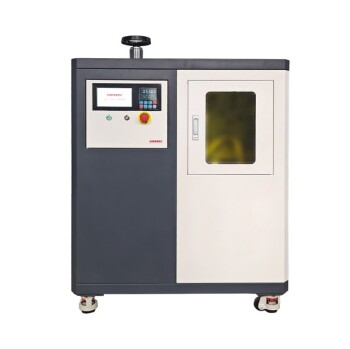
Graphite Paper serves as a critical protective interface and release agent. Specifically, it is inserted between the AZ31 magnesium alloy plates and the upper and lower press heads of the vacuum hot-pressing mold. Its primary function is to physically isolate the metal matrix from the machinery, preventing adhesion and chemical interactions under extreme heat and pressure.
Core Takeaway High-temperature manufacturing creates the ideal conditions for metals to chemically bond with processing equipment. Graphite Paper acts as an inert barrier that prevents diffusion reactions, ensuring the final composite sheet remains intact and can be easily removed from the mold without damaging the sample or the expensive press heads.
The Role of Graphite Paper in Composite Assembly
Preventing Adhesion and Diffusion
During the hot-pressing process, the AZ31 magnesium alloy is subjected to high temperatures and significant pressure. Under these conditions, metals naturally seek to bond with contacting surfaces.
Without a barrier, the magnesium alloy would undergo diffusion reactions with the mold press heads. This would cause the composite sheet to effectively weld itself to the tooling, making removal impossible without destroying the part.
Acting as a Release Agent
Graphite Paper functions similarly to a non-stick coating in cooking. It provides a layer of lubrication between the composite materials and the rigid mold components.
This lubrication ensures that once the sintering process is complete, the composite sheet can be demolded successfully. It allows the sample to slip free from the press heads, preserving the geometric integrity of the sheet.
Protecting Manufacturing Equipment
Beyond protecting the sample, the paper serves as a sacrificial layer for the machinery.
Press heads and punches are precision tools that are expensive to replace. By preventing the metal matrix from sticking to these components, the graphite paper protects the mold surfaces from damage and buildup, significantly extending the service life of the tooling.
Common Pitfalls and Considerations
The Risk of Barrier Failure
While graphite paper is effective, it is a consumable isolation layer. If the paper tears or shifts during the assembly of the AZ31/UCF/AZ31 stack, the protective barrier is compromised.
Even a small gap in coverage can lead to localized welding between the AZ31 and the press head. This often results in surface defects on the composite sheet or localized damage to the press head that requires resurfacing.
Surface Integrity Dependence
The quality of the demolded surface is directly dependent on the presence of this isolation layer.
Supplementary data indicates that proper isolation prevents chemical reactions that would otherwise degrade the sample's surface. Therefore, the consistent application of graphite paper is non-negotiable for maintaining the surface quality and structural density of the finished composite.
Ensuring Process Success
To maximize the quality of your AZ31/UCF/AZ31 composite sheets, prioritize the correct application of the isolation layer.
- If your primary focus is Sample Integrity: Ensure the Graphite Paper completely covers the contact area to prevent diffusion reactions that scar the magnesium surface.
- If your primary focus is Equipment Maintenance: Utilize Graphite Paper to prevent residue buildup on press heads, thereby reducing downtime for mold cleaning and repair.
By serving as an inert buffer, Graphite Paper transforms a potentially destructive chemical environment into a controlled, repeatable manufacturing process.
Summary Table:
| Key Function | Role of Graphite Paper in Hot-Pressing |
|---|---|
| Isolation Barrier | Prevents chemical diffusion between AZ31 magnesium alloy and mold press heads. |
| Release Agent | Acts as a high-temperature lubricant for clean, damage-free sample demolding. |
| Equipment Protection | Sacrificial layer that prevents metal adhesion to expensive precision tooling. |
| Surface Integrity | Ensures a smooth finish and prevents surface defects or localized welding. |
Maximize Your Material Processing Efficiency with KINTEK
Precision in high-temperature manufacturing requires both expertise and the right equipment. KINTEK specializes in advanced laboratory solutions, providing high-performance vacuum hot-pressing systems and hydraulic presses (pellet, hot, isostatic) designed for complex composite assembly like AZ31/UCF/AZ31.
Our comprehensive range includes:
- High-Temperature Furnaces (Muffle, Vacuum, CVD/PECVD) for controlled sintering.
- Precision Tooling and essential consumables like PTFE products, ceramics, and crucibles.
- High-Pressure Reactors and Autoclaves for demanding research environments.
Whether you are focusing on sample integrity or extending the service life of your equipment, KINTEK's technical specialists are here to support your lab's success. Contact us today to discover how our high-quality equipment and consumables can elevate your research and production outcomes.
Related Products
- Automatic Heated Hydraulic Press Machine with Heated Plates for Laboratory Hot Press 25T 30T 50T
- Manual High Temperature Heated Hydraulic Press Machine with Heated Plates for Lab
- Touchscreen Automatic Vacuum Heat Press
- 30T 40T Split Automatic Heated Hydraulic Press Machine with Heated Plates for Laboratory Hot Press
- Vacuum Hot Press Furnace Machine Heated Vacuum Press
People Also Ask
- Why is the heating function of a laboratory hydraulic press essential for MEA assembly in DEFC? Optimize Cell Bonding
- What technical conditions does a heated hydraulic press provide for PEO batteries? Optimize Solid-State Interfaces
- How is a heated hydraulic press used for Li-LLZO batteries? Optimize Interfacial Bonding with Thermal-Pressure
- What role does a heated hydraulic press play in Cold Sintering (CSP)? Enhancing LATP-Halide Densification
- What are heated hydraulic presses used for? Molding Composites, Vulcanizing Rubber, and More