Scaling up the volume of a cubic press is fundamentally restricted by the relationship between anvil surface area and the force required to generate pressure. To increase the internal sample volume, you must enlarge the face of the anvils; however, maintaining high pressure across this larger surface area demands a massive, often impractical increase in the applied force.
Core Takeaway: Increasing the volume of a cubic press requires either exponentially more force to drive larger anvils or a shift to complex, hard-to-manufacture geometries like dodecahedrons to optimize the surface-area-to-volume ratio.
The Physics of Scaling Up
To understand the difficulty of scaling, one must look at the mechanical relationship between force, pressure, and surface area.
The Force-Area Constraint
Pressure is defined as force divided by area. In a cubic press, the pressure is generated by anvils pushing against the sample volume.
If you simply make the anvils larger to accommodate a bigger sample, you increase the surface area. To maintain the same pressure on that larger area, the machine must generate significantly more force.
The Hydraulic Limitation
This requirement for increased force creates a cascading engineering challenge.
Building a frame and hydraulic system capable of delivering this increased tonnage safely and reliably becomes exponentially more difficult and expensive as the anvil size grows.
The Geometric Alternative
Engineers have attempted to bypass the force limitation by changing the shape of the press entirely, but this introduces its own set of problems.
Optimizing the Volume Ratio
One method to increase volume without simply enlarging the square anvils is to change the geometry to a higher-order platonic solid, such as a dodecahedron.
By using more anvils to converge on the center, you decrease the surface-area-to-volume ratio. This theoretically allows for a larger internal volume relative to the surface area being pressed.
The Manufacturing Barrier
While geometrically superior, this approach is complex and difficult to manufacture.
Coordinating the precise convergence of many anvils (more than the standard six in a cubic press) requires incredibly tight tolerances. Manufacturing the machinery to align these multiple components perfectly is often cost-prohibitive or technically infeasible for mass production.
Understanding the Trade-offs
When evaluating high-pressure apparatus designs, you are essentially balancing mechanical simplicity against potential sample size.
Simplicity vs. Capacity
The standard cubic press (six anvils) is popular because it is mechanically simpler to build and align.
However, this simplicity comes with a hard ceiling on volume. You cannot simply "size up" the machine without hitting the force constraints mentioned above.
Innovation vs. Reliability
Moving to complex geometries (like the dodecahedron) solves the volume issue on paper but compromises reliability.
The complexity of the system increases the likelihood of mechanical failure or alignment errors, making it a risky choice for consistent industrial applications.
Making the Right Choice for Your Goal
Whether you stick with a standard cubic design or explore complex alternatives depends on your specific limitations.
- If your primary focus is reliability and cost-efficiency: Stick to standard cubic geometries, accepting that the sample volume will be limited by the maximum force your hydraulics can generate.
- If your primary focus is maximizing sample volume: Investigate higher-order multi-anvil systems (like dodecahedral presses), but be prepared for significant challenges in manufacturing and maintenance.
Scaling a cubic press is rarely a linear process; it requires overcoming the physics of force application or mastering the complexity of advanced geometry.
Summary Table:
| Feature | Standard Cubic Press (6 Anvils) | High-Order Multi-Anvil (e.g., Dodecahedron) |
|---|---|---|
| Scalability | Limited by hydraulic force requirements | Better volume-to-surface area ratio |
| Mechanical Complexity | Lower; easier to align | Higher; requires extreme tolerances |
| Cost Efficiency | High (for standard sizes) | Low (due to custom manufacturing) |
| Reliability | High; consistent results | Moderate; prone to alignment errors |
| Main Constraint | Physics of force/pressure | Manufacturing and maintenance |
Maximize Your High-Pressure Research with KINTEK
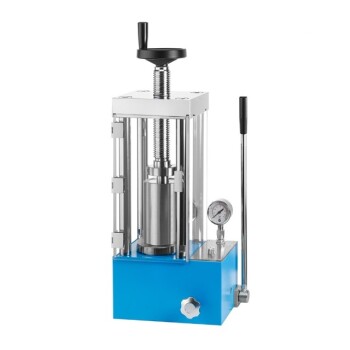
Overcoming the physical limits of material synthesis requires precision-engineered equipment. KINTEK specializes in advanced laboratory solutions, including high-performance hydraulic presses (pellet, hot, isostatic) and custom-engineered systems designed to meet the rigorous demands of high-pressure environments.
Whether you are scaling up production or refining laboratory-scale samples, our expertise in crushing and milling systems, high-temperature furnaces, and specialized consumables (PTFE, ceramics, crucibles) ensures your lab operates at peak efficiency.
Ready to optimize your press performance? Contact KINTEK today to discuss our range of laboratory equipment and research consumables tailored to your specific goals.
Related Products
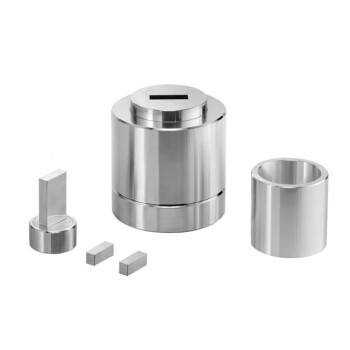
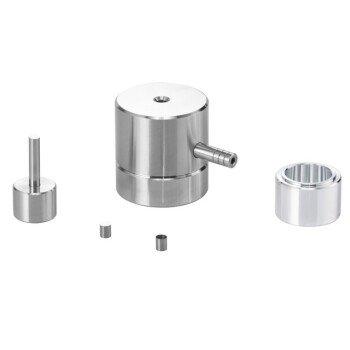
- Cylindrical Press Mold with Scale for Lab
- Cylindrical Lab Electric Heating Press Mold for Laboratory Applications
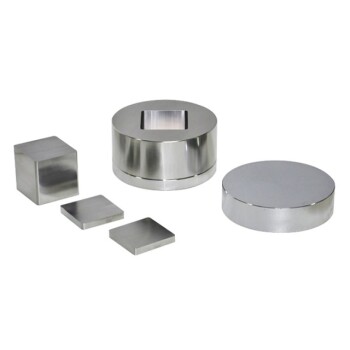
- Assemble Square Lab Press Mold for Laboratory Applications
- Cylindrical Press Mold for Lab Applications
- Square Lab Press Mold for Laboratory Applications
People Also Ask
- How to use a press mold? Master the Art of Creating Consistent Ceramic Forms
- Why are pressure molds with non-conductive resin inner walls required for battery testing? Ensure Data Accuracy
- What is the press mould method? A Guide to Consistent, Detailed Ceramic Forms
- What is the process of mold press? A Step-by-Step Guide to Compression Molding
- What is the primary function of mold pressing for LAGP powders? Achieve High-Performance Solid Electrolytes