Applying a forming pressure of 300 to 450 MPa is critical for overcoming internal mechanical resistance. Specifically, this pressure range is required to surmount the friction between sulfide particles and counteract their natural tendency to spring back, known as elastic recovery. By forcing the Li6PS5Cl powder to deform and pack tightly, you transform loose material into a cohesive, structurally sound pellet.
To achieve high ionic conductivity, you must eliminate the physical gaps between particles. The pressure of 300–450 MPa forces the material to undergo plastic deformation, closing internal voids and creating the continuous pathways required for efficient lithium-ion transport.
The Mechanics of Densification
Overcoming Particle Friction and Elasticity
At the microscopic level, sulfide powder particles resist compaction. Friction prevents them from sliding past one another into a tighter arrangement.
Furthermore, these particles possess elastic recovery, meaning they tend to return to their original shape after pressure is released. A pressure of 300 to 450 MPa is the threshold required to overcome these forces and lock the particles into a new, compressed state.
Achieving Plastic Deformation
To create a functional electrolyte, mere contact between particles is insufficient. You need plastic deformation, where the particles permanently change shape to fit together like puzzle pieces.
This high-pressure application crushes the particles against one another. This minimizes the gaps (porosity) that naturally exist in loose powder, driving the pellet toward a solid, dense mass.
The Impact on Performance
Establishing Ion Transport Channels
The primary function of the electrolyte is to move lithium ions. Voids and pores act as barriers to this movement, increasing resistance.
By applying 300 to 450 MPa, you ensure continuous lithium-ion transport channels. The tight packing minimizes grain boundary resistance, allowing ions to flow freely through the material rather than navigating around empty spaces.
Ensuring Mechanical Strength
Beyond electrochemical performance, the pellet must be physically robust. A loosely packed pellet will crumble during handling or assembly.
The deformation caused by this pressure range interlocks the particles, providing the necessary mechanical strength. This results in a stable pellet that maintains its integrity during subsequent processing steps or cell assembly.
Understanding the Trade-offs
Cold Pressing vs. Theoretical Density
While 300 to 450 MPa is effective for creating strong pellets, cold pressing alone may not always achieve 100% of the theoretical density.
Some internal pores may remain "stubborn" and difficult to close without the addition of heat. While the specified pressure creates a highly conductive pellet, it is effectively balancing mechanical integrity with the limits of room-temperature deformation.
The Role of Temperature
It is important to note that pressure requirements can change if temperature is introduced. A temperature-controlled hydraulic press can promote fusion and plastic deformation more easily than cold pressing.
However, in the absence of heat (cold pressing), maintaining high pressure (up to 450 MPa or even higher in some contexts) becomes the primary lever for eliminating voids and achieving a relative density that approaches the theoretical maximum.
Making the Right Choice for Your Goal
When determining the exact pressure setting for your hydraulic press, consider your immediate processing objectives:
- If your primary focus is creating a "Green Pellet" for further processing: Apply approximately 300 MPa to pre-compact the powder into a shape that has sufficient handling strength for subsequent hot-pressing or sintering.
- If your primary focus is maximizing conductivity without heat: Aim for the higher end of the range (450 MPa or higher) to maximize plastic deformation and achieve relative densities over 90% solely through mechanical force.
Ultimately, the pressure you apply is the defining factor in converting a non-conductive powder into a high-performance solid-state electrolyte.
Summary Table:
| Factor | Required Pressure | Primary Outcome |
|---|---|---|
| Particle Friction | 300 - 450 MPa | Overcomes resistance to sliding and packing |
| Elastic Recovery | 300 - 450 MPa | Prevents material spring-back after release |
| Plastic Deformation | 300 - 450 MPa | Closes internal voids for dense pathways |
| Green Pellet Handling | ~300 MPa | Provides mechanical strength for processing |
| Max Conductivity | 450+ MPa | Maximizes density (>90%) in cold pressing |
Elevate Your Solid-State Battery Research with KINTEK
Precision is paramount when working with sensitive sulfide electrolytes like Li6PS5Cl. KINTEK provides the high-performance laboratory equipment necessary to achieve the extreme pressures required for superior ionic conductivity.
Our specialized range includes:
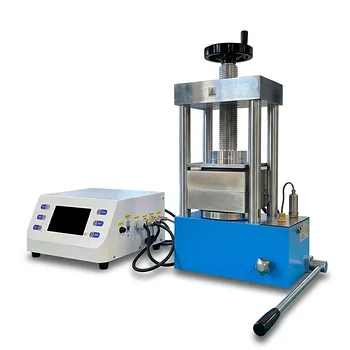
- Advanced Hydraulic Presses: Manual, electric, and isostatic models capable of reaching and maintaining precise pressures up to 450 MPa and beyond.
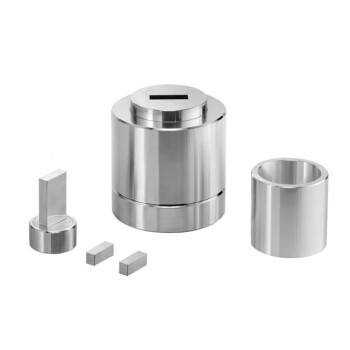
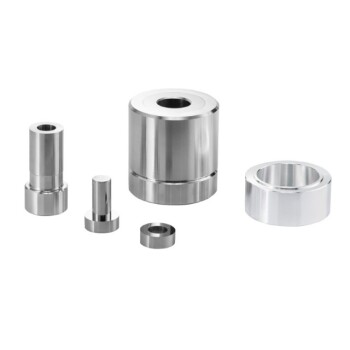
- High-Performance Pelleting Tools: Precision-engineered pellet dies and heated presses to facilitate plastic deformation.
- Comprehensive Battery Research Tools: From vacuum furnaces and glovebox-compatible equipment to high-temperature reactors.
Don't let internal resistance hinder your material performance. Contact KINTEK today to find the perfect pressing solution for your lab!
Related Products
- Automatic Laboratory Hydraulic Pellet Press Machine for Lab Use
- Laboratory Hydraulic Press Split Electric Lab Pellet Press
- Laboratory Manual Hydraulic Pellet Press for Lab Use
- Automatic Laboratory Hydraulic Press for XRF & KBR Pellet Press
- kbr pellet press 2t
People Also Ask
- What is the role of a laboratory hydraulic pellet press and stainless steel molds in the fabrication of RuO2/NbC anodes?
- What role does a laboratory pellet press play in the enhancement of biomass energy products? Optimize Fuel Efficiency
- What is the purpose of using a laboratory pellet press when evaluating the electronic conductivity of carbon powders? Guide
- How does a laboratory hydraulic pellet press contribute to SiCw/2024 aluminum composite preforms? Optimize Densification
- What is the significance of applying 200 MPa of pressure with a laboratory hydraulic pellet press for composite ceramics?