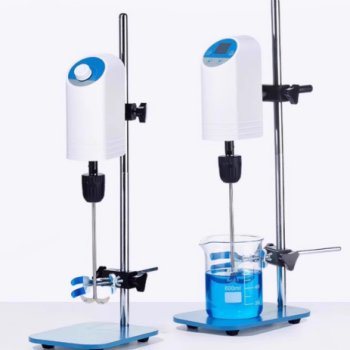
The primary function of a magnetic stirring device in an electrolytic reactor is to enforce chemical homogeneity across the solution. By continuously circulating the electrolyte, the device ensures that critical components like silver nitrate and sodium thiosulfate remain uniformly distributed, which is the physical prerequisite for consistent electrodeposition.
The core purpose of stirring is to eliminate concentration polarization. By constantly refreshing the electrolyte near the electrodes, you prevent ion depletion zones, ensuring the resulting nano-silver coating is dense, uniform in size, and free from irregular accumulation.
The Mechanics of Kinetic Control
Eliminating Concentration Polarization
During electrodeposition, silver ions are rapidly consumed at the electrode surface. Without intervention, this creates a zone of depletion known as concentration polarization.
A magnetic stirrer mitigates this by continuously transporting fresh ions from the bulk solution to the electrode interface. This ensures the reaction rate remains limited by the surface chemistry, not by a lack of available ions.
Ensuring Component Homogeneity
The electrolyte is a complex mixture containing sources of silver (such as silver nitrate) and stabilizing agents (such as sodium thiosulfate).
Stirring prevents these heavier components from settling or segregating. It guarantees that the reducing agents and silver ions maintain thorough contact throughout the duration of the process, which is essential for consistent reaction kinetics.
Impact on Particle Morphology
Achieving Uniform Particle Size
The physical movement of the fluid directly dictates the quality of the solid structure. Optimization of these kinetic conditions leads to a narrow size distribution of the silver nanoparticles.
When the supply of ions is consistent, the nucleation and growth rates of the particles remain constant across the entire substrate.
Preventing Localized Accumulation
Without adequate mixing, deposition becomes chaotic, leading to "hot spots" where silver builds up unevenly.
Magnetic stirring ensures a dense distribution of particles on surfaces, such as NiTi wire, while specifically avoiding localized accumulation or clumping. This results in a smooth, functional coating rather than a rough, dendritic one.
Understanding the Trade-offs
The Necessity of Optimization
While stirring is essential, it acts as a variable that must be precisely tuned. The primary reference highlights the "optimization" of kinetic conditions, implying that arbitrary stirring speeds are insufficient.
Thermal and Kinetic Balance
As noted in supplementary contexts, these reactors often manage temperature alongside stirring. If the stirring is too aggressive or the temperature fluctuates, it can disrupt the morphological uniformity. The goal is a steady state where mixing kinetics align perfectly with the chemical reduction rate.
How to Apply This to Your Project
If your primary focus is Structural Integrity: Ensure the stirring speed is sufficient to eliminate concentration gradients, creating a dense coating without porous defects.
If your primary focus is Functional Performance: Prioritize optimized kinetic conditions to achieve a uniform particle size, which maximizes the active surface area and antibacterial efficiency.
Control the fluid dynamics, and you control the quality of the nano-structure.
Summary Table:
| Feature | Impact of Magnetic Stirring | Benefit for Nano-Silver |
|---|---|---|
| Ion Distribution | Eliminates concentration polarization | Prevents ion depletion at electrode surfaces |
| Chemical Mix | Maintains electrolyte homogeneity | Ensures consistent reaction kinetics throughout |
| Morphology | Prevents localized accumulation | Produces a dense, smooth, and uniform coating |
| Particle Size | Stabilizes nucleation and growth rates | Achieves narrow and precise size distribution |
Elevate Your Nano-Material Precision with KINTEK
Consistency is the hallmark of high-performance electrochemistry. At KINTEK, we specialize in the advanced laboratory equipment necessary to master your kinetic conditions. From precision electrolytic cells and electrodes to specialized magnetic stirring systems and temperature-controlled reactors, our solutions are designed to eliminate variables and deliver uniform results.
Whether you are coating NiTi wires or developing next-generation battery research tools, KINTEK provides the high-quality consumables—including PTFE products, ceramics, and crucibles—to support your most demanding workflows.
Ready to optimize your electrodeposition process? Contact KINTEK today to discover how our integrated laboratory solutions can enhance your research and production efficiency.
References
- F.J. Gil, Andreu Puigdollers Pérez. New Bactericide Orthodonthic Archwire: NiTi with Silver Nanoparticles. DOI: 10.3390/met10060702
This article is also based on technical information from Kintek Solution Knowledge Base .
Related Products
- Laboratory Small Constant Temperature Heated Magnetic Stirrer Heater and Stirrer
- Custom PTFE Teflon Parts Manufacturer for Magnetic Stirring Bar
- Electrolytic Electrochemical Cell Gas Diffusion Liquid Flow Reaction Cell
- High Performance Laboratory Stirrers for Diverse Applications
- Mini SS High Pressure Autoclave Reactor for Laboratory Use
People Also Ask
- What role does a magnetic stirrer with heating play in ZnO nanoparticle synthesis? Precision Control for Quality Results
- What role does a constant temperature heating magnetic stirrer play in MFC-HAp synthesis? Achieve Material Homogeneity
- What is the function of a laboratory magnetic stirrer in Ni–Cr–P electrodeposition? Optimize Ion Transport & Coating
- Why is a laboratory magnetic stirrer required for benzoic acid esters? Boost Reaction Speed & Yield with High RPM
- What role does a laboratory magnetic stirrer play in TiO2 and TiO2-Ag sol preparation? Master Chemical Kinetics