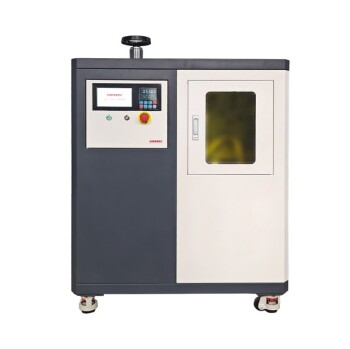
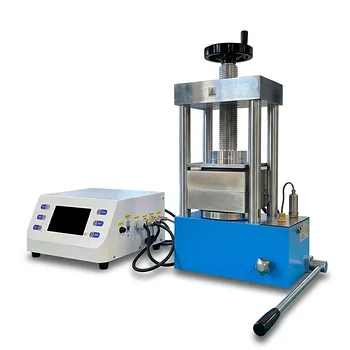
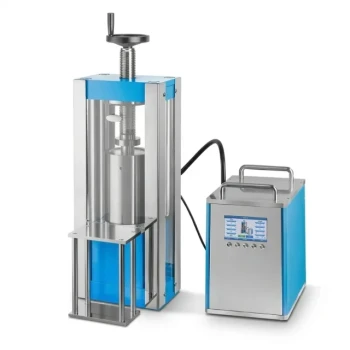
Mechanical alloying creates a precursor material, not a finished product: it yields loose powder that completely lacks the structural integrity required for functional use. To transform these separate particles into a usable component, it is necessary to use Hot Isostatic Pressing (HIP) or Spark Plasma Sintering (SPS) to apply a specific synergy of heat and pressure. This consolidation process forces the particles to bond physically and chemically, converting a loose pile of dust into a dense, solid bulk alloy.
The Core Transformation Mechanical alloying establishes the chemical composition of Multi-Principal Element Alloys, but it leaves the material in a porous, disconnected state. HIP and SPS are the essential bridge between raw material and application, using high temperature and pressure to drive the diffusion bonding required for high density and superior mechanical performance.
The Physical Necessity of Consolidation
Bridging the Structural Gap
Mechanical alloying results in loose powder raw materials. While these powders contain the correct mixture of elements, they possess no mechanical strength or cohesion on their own.
Without a consolidation step, the material cannot hold a shape or bear a load. It remains a collection of discrete particles rather than a unified solid.
The Mechanism of Densification
HIP and SPS equipment create a synergistic environment of high temperature and high pressure. This combination is critical because neither factor is sufficient on its own to fully consolidate these complex alloys.
Under these conditions, the material undergoes plastic deformation and diffusion bonding. This forces the individual powder particles to merge at the atomic level, effectively welding them together into a single unit.
Achieving Near-Full Density
The primary physical goal of this process is the elimination of macro-segregation and micro-porosity. These defects are unavoidable inherent byproducts of powder metallurgy.
By applying uniform pressure (isostatic pressing), the equipment squeezes out residual pores. This brings the material to a near-full dense state, which is a prerequisite for reliable material performance.
Enhancing Material Performance
Optimization of Mechanical Properties
The transformation from powder to solid via HIP/SPS directly correlates to the alloy's final strength. This process secures the highest possible density, which translates to higher static, dynamic, yield, and tensile strength.
Microstructural Control
Beyond simple hardening, these processes refine the internal structure of the alloy. HIP creates a homogeneous annealed microstructure that eliminates segregation.
Critically, it achieves this uniformity without unwanted grain growth, preserving the favorable characteristics developed during the initial alloying phase.
Durability and Resistance
The elimination of impurities and pores leads to significant improvements in durability. Consolidated parts exhibit maximum abrasion resistance and higher corrosion resistance.
Furthermore, the removal of micro-shrinkage and porosity dramatically improves fatigue resistance, ensuring the part does not fail under repeated stress cycles.
Understanding the Process Requirements
The Necessity of Extreme Parameters
Achieving these results is not a passive process; it requires aggressive environmental controls. Equipment must sustain high temperatures (e.g., 1180°C) and uniform high pressures (e.g., 175 MPa) simultaneously.
The Dependency on Specialized Equipment
You cannot achieve this level of density through simple sintering (heat only) or cold pressing (pressure only). The process relies on the synergy of both forces.
This means that producing functional Multi-Principal Element Alloys is inextricably linked to the availability of advanced consolidation machinery like HIP or SPS.
Making the Right Choice for Your Goal
While mechanical alloying creates the potential for high-performance materials, HIP and SPS realize that potential. Your approach to these processes should be guided by your specific requirements.
- If your primary focus is structural integrity: Prioritize HIP to eliminate micro-porosity and maximize static and tensile strength through diffusion bonding.
- If your primary focus is part longevity: Use these consolidation methods to ensure a homogeneous microstructure, which directly increases corrosion and fatigue resistance.
- If your primary focus is manufacturing efficiency: Leverage HIP to produce near-net shaped parts, reducing the need for extensive post-processing machining.
Success in using Multi-Principal Element Alloys relies not just on mixing the right elements, but on rigorously consolidating them into a unified, dense solid.
Summary Table:
| Feature | Mechanical Alloying Result | After HIP/SPS Consolidation |
|---|---|---|
| Material Form | Loose powder (precursor) | Solid, dense bulk alloy |
| Structural State | Porous & disconnected | Near-full density (99%+) |
| Mechanical Strength | Zero (no cohesion) | High tensile & yield strength |
| Microstructure | Discrete particles | Homogeneous & grain-refined |
| Durability | Vulnerable to oxidation | High fatigue & corrosion resistance |
Transform your alloy powders into high-performance structural components with KINTEK's advanced consolidation solutions. As specialists in laboratory equipment, KINTEK offers state-of-the-art Hot Isostatic Presses (HIP) and Spark Plasma Sintering (SPS) systems designed to eliminate porosity and maximize material density. Whether you are researching Multi-Principal Element Alloys or developing next-gen materials, our portfolio—including high-temperature furnaces, hydraulic presses, and specialized sintering tools—provides the precision and reliability your lab demands. Contact KINTEK today to discover how our expertise can optimize your material performance and streamline your manufacturing process.
References
- Chenze Li, Xiaopeng Li. Review: Multi-principal element alloys by additive manufacturing. DOI: 10.1007/s10853-022-06961-y
This article is also based on technical information from Kintek Solution Knowledge Base .
Related Products
- Spark Plasma Sintering Furnace SPS Furnace
- Warm Isostatic Press for Solid State Battery Research
- 600T Vacuum Induction Hot Press Furnace for Heat Treat and Sintering
- Vacuum Heat Treat and Pressure Sintering Furnace for High Temperature Applications
- Manual Lab Heat Press
People Also Ask
- What is SPS sintering method? A Guide to High-Speed, High-Performance Material Fabrication
- Why are Spark Plasma Sintering (SPS) furnaces or hot presses utilized in the preparation of Li3PS4 solid electrolytes?
- What is the difference between spark plasma sintering and flash sintering? A Guide to Advanced Sintering Methods
- What technical advantages does a Spark Plasma Sintering (SPS) furnace offer for LZP ceramics? Enhance Ionic Conductivity
- What is the theory of spark plasma sintering? A Guide to Rapid, Low-Temperature Densification