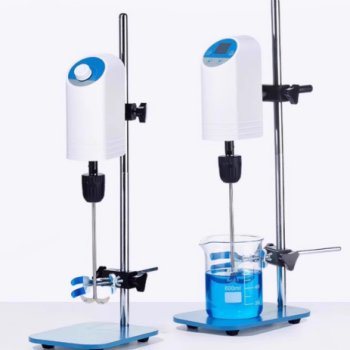
Laboratory stirring equipment acts as the fundamental regulator of reaction kinetics during the Sol-Gel process. It provides the critical mass transfer required to disperse precursors, such as tetraethyl orthosilicate (TEOS) and silane coupling agents, uniformly within the ethanol solvent. Without this mechanical intervention, the chemical environment remains static, leading to inconsistent reaction rates.
The primary role of stirring is to prevent localized rapid reactions during acid-catalyzed hydrolysis. By maintaining homogeneity, the equipment ensures the formation of a transparent, stable, and reactive sol, avoiding non-uniform gelation that compromises downstream applications.
The Mechanism of Homogeneity
Facilitating Critical Mass Transfer
In the Sol-Gel process, chemical precursors must come into contact with the catalyst and water to initiate hydrolysis.
Stirring equipment forces mass transfer, ensuring that TEOS and silane coupling agents are continuously circulated. This movement breaks down concentration gradients that naturally form when reagents are added to the ethanol solvent.
Ensuring Uniform Hydrolysis
The acid-catalyzed hydrolysis of TEOS is a time-sensitive reaction.
If the acid catalyst is not dispersed instantly, hydrolysis occurs unevenly. Continuous stirring guarantees that the acidity is uniform throughout the vessel, allowing all precursor molecules to react at a controlled and consistent rate.
Preventing Process Failures
Avoiding Localized Rapid Reactions
A major risk in static or poorly mixed systems is the phenomenon of localized rapid reactions.
When reagents pool in one area, the reaction accelerates uncontrollably in that specific zone. This leads to premature gelling or precipitation in some parts of the container while other parts remain unreacted.
Eliminating Non-Uniform Gelation
The physical result of poor mixing is often a cloudy, inhomogeneous mixture rather than a clear solution.
Stirring prevents this non-uniform gelation. It ensures the development of a coherent network structure, resulting in a sol that is optically transparent and chemically stable.
Preparing for Hybridization
Creating a Reactive Sol Solution
The goal of this specific Sol-Gel process is to create a "sol"—a colloidal suspension—that remains highly reactive.
Stirring maintains the stability of this sol, keeping the particles suspended and active. This state is a prerequisite for the material's final application.
Enabling Polyester Compatibility
The reference process is designed to prepare the sol for hybridization with polyester resins.
If the sol has gelled unevenly due to a lack of stirring, it cannot integrate properly with the resin. A uniform, transparent sol is essential to achieve a successful organic-inorganic hybrid material.
Common Pitfalls to Avoid
The Consequence of Intermittent Mixing
Consistency is just as important as the intensity of the mixing.
Stopping the agitation before the hydrolysis is complete allows concentration hot-spots to re-form. This can ruin an otherwise successful batch by introducing turbidity or localized clumps just before the hybridization step.
Misinterpreting Solution Clarity
While a transparent solution is the goal, clarity alone does not guarantee success if achieved too slowly.
If stirring is too weak, the reaction may be too slow or incomplete, leading to a sol that looks clear but lacks the high reactivity required for the polyester resin bond. The equipment must provide sufficient energy to ensure full dispersion.
Making the Right Choice for Your Goal
To ensure your Sol-Gel process yields a usable material, apply the following principles:
- If your primary focus is Optical Quality: Ensure continuous, vigorous stirring to prevent cloudiness caused by localized gelation, resulting in a transparent sol.
- If your primary focus is Chemical Hybridization: Maintain constant agitation to keep the sol highly reactive and stable, ensuring it is chemically ready to bond with polyester resins.
Uniform agitation is the defining factor between a high-performance hybrid material and a failed, non-uniform gel.
Summary Table:
| Feature | Role in Sol-Gel Process | Impact on Quality |
|---|---|---|
| Mass Transfer | Disperses TEOS & silane in ethanol | Eliminates concentration gradients |
| Hydrolysis Control | Uniformly distributes acid catalyst | Ensures consistent reaction rates |
| Homogeneity | Prevents localized rapid reactions | Avoids premature gelling & cloudiness |
| Sol Stability | Maintains colloidal suspension | Creates high-reactivity sol for hybridization |
Elevate Your Material Research with KINTEK Precision
Achieving the perfect organic-inorganic hybrid requires more than just chemistry—it requires precision engineering. KINTEK specializes in advanced laboratory equipment designed to master the Sol-Gel process.
Whether you need reliable magnetic and mechanical stirrers for uniform hydrolysis, high-temperature furnaces (muffle, vacuum, or CVD) for sintering, or crushing and milling systems for precursor preparation, our comprehensive portfolio has you covered. We also offer specialized high-pressure reactors, autoclaves, and ultrasonic homogenizers to ensure your materials reach peak performance.
Ready to optimize your lab’s efficiency and output? Contact us today to discover how KINTEK’s high-performance tools and consumables can transform your research outcomes.
References
- Adrián Bórquez-Mendivil, Jorge Luis Almaral Sánchez. Hybrid Coatings of SiO2–Recycled PET Unsaturated Polyester Resin by Sol-Gel Process. DOI: 10.3390/polym14163280
This article is also based on technical information from Kintek Solution Knowledge Base .
Related Products
- Laboratory Small Constant Temperature Heated Magnetic Stirrer Heater and Stirrer
- Custom PTFE Teflon Parts Manufacturer for Magnetic Stirring Bar
- High Performance Laboratory Stirrers for Diverse Applications
- Three-dimensional electromagnetic sieving instrument
- Custom PTFE Teflon Parts Manufacturer for PTFE Stirring Bar Recovery Rod
People Also Ask
- What role does a magnetic stirrer with heating play in ZnO nanoparticle synthesis? Precision Control for Quality Results
- What role does a constant temperature heating magnetic stirrer play in MFC-HAp synthesis? Achieve Material Homogeneity
- What is the function of a laboratory magnetic stirrer in Ni–Cr–P electrodeposition? Optimize Ion Transport & Coating
- Why is a laboratory magnetic stirrer required for benzoic acid esters? Boost Reaction Speed & Yield with High RPM
- What role does a laboratory magnetic stirrer play in TiO2 and TiO2-Ag sol preparation? Master Chemical Kinetics